Skip to content

Visiting Lucerne : what to do between Old Town, lake and peaks

A 14th-century wooden bridge over the Reuss, squares with painted facades, ramparts you can walk for free and, an hour away by boat, cogwheel trains climbing to summits above 2,000 metres. Two days for the town and lake, one or two more for the mountains.

Why visit Lucerne?

Lucerne combines a well-preserved medieval old town, a large Alpine lake served by paddle steamers and two iconic mountains, Pilatus and Rigi, both reachable in a day. The town is about 45 minutes by train from Zurich, making it the easiest base for exploring central Switzerland.

Lucerne's must-sees

Bridges, ramparts, museums and summits, between the old town and the lake.

Chapel Bridge

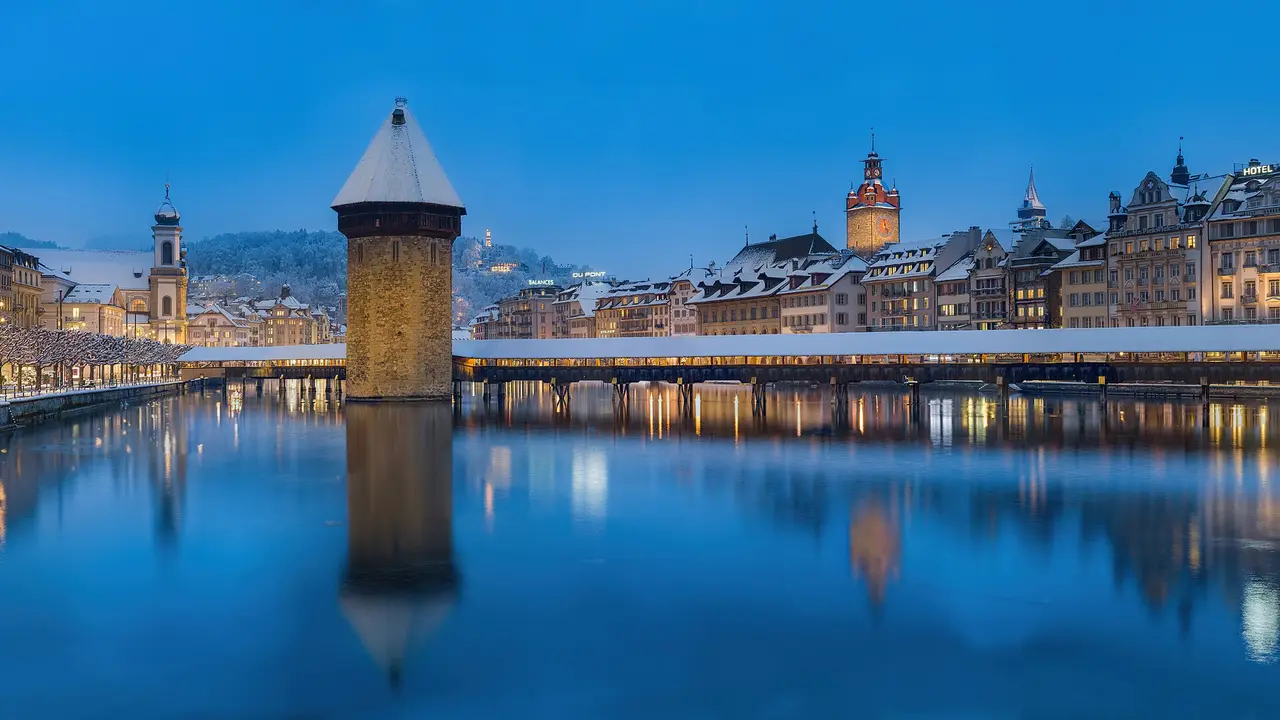
A 14th-century covered wooden bridge flanked by the octagonal Water Tower. Badly damaged by fire in 1993, it was rebuilt and keeps some of its triangular paintings.

Lion Monument

A dying lion carved into the cliff in 1821 in memory of the Swiss Guards killed at the Tuileries in 1792. A quiet, moving spot ten minutes from the centre.

Musegg Wall

A medieval wall nearly 900 metres long, four of whose towers can be visited for free from April to November. The Zytturm clock strikes one minute before all the others.

Swiss Museum of Transport

Trains, planes, boats and space: one of the most visited museums in the country, with a planetarium and simulators. Allow at least half a day, more with children.

KKL Luzern

A culture and convention centre by Jean Nouvel, opened in 2000 on the lakeshore. Its huge cantilevered roof and acoustics host the Lucerne Festival.

Mount Pilatus

A 2,128-metre summit. The classic loop combines a boat to Alpnachstad, the world's steepest cogwheel railway, then aerial cableway and gondola down to Kriens.

Mount Rigi

Nicknamed the queen of the mountains, it rises to 1,798 metres between two lakes. Reachable all year from Vitznau or Arth-Goldau, with easy trails and Alpine views.

Rosengart Collection

An intimate museum near the station, gathering many works by Picasso and Paul Klee as well as Impressionists, in a former bank building.

What to see in Lucerne and around the lake?

The Altstadt and its painted squares

On the right bank of the Reuss, the pedestrian old town strings together the Kornmarkt, the Weinmarkt and the Hirschenplatz, lined with houses whose facades are painted with historical scenes. The Renaissance town hall overlooks the river, and a market is held there on Tuesday and Saturday mornings. Allow two hours to wander at leisure, then climb to the ramparts to the north, ten minutes on foot. The lanes are very busy with tour groups between 11 am and 4 pm: aim for early morning or the evening.

The Reuss bridges and the left bank

The Reuss flows out of the lake through the town, crossed by two covered wooden bridges. Downstream of the Chapel Bridge, the quieter Spreuer Bridge shelters a dance of death painted in the 17th century under its roof. On the left bank, the Kleinstadt groups the Jesuit Church, the first large Baroque building in Switzerland north of the Alps, and calmer streets. A loop between the two bridges along the quays takes about an hour and offers the best views of the Water Tower.

The lakeside quays and Tribschen

From the station and the KKL cultural centre, the quays run east to the Swiss Museum of Transport, about thirty minutes on foot, and south to the Tribschen peninsula. Richard Wagner lived there from 1866 to 1872: his villa is now a small museum set in a lakeside park. The Lido, a public beach with lawns, lets you swim in the lake in summer. Renting a bike at the station is the most pleasant way to link these shores in half a day.

Cruising Lake Lucerne

Lake Lucerne forms a branching cross between cliffs and meadows. A fleet of boats, including five historic paddle steamers, links Lucerne to Weggis, Vitznau, Brunnen and Flüelen at the far end. The full crossing to Flüelen takes nearly three hours; a return trip to Vitznau, starting point of the Rigi railway, fits into half a day. The steamers mainly sail from late spring to early autumn, while motor vessels run all year.

The peaks of central Switzerland

Lucerne is framed by two mountains reachable by public transport: Pilatus to the south-west, whose cogwheel railway climbs gradients of up to 48%, and Rigi to the north-east, served since 1871 by Europe's first mountain railway. The Stanserhorn and its open-top cable car, or the Titlis above Engelberg, about 45 minutes away by train, round out the options. One day per summit is the minimum: set off early, as clouds often build in summer afternoons.

Fasnacht, festival and the yearly rhythm

Lucerne's carnival, the Fasnacht, starts at 5 am on the Thursday before Ash Wednesday with a loud bang, followed by six days of parades, Guggenmusik brass bands and giant masks. In summer, the Lucerne Festival fills the KKL with symphony concerts from August to September. May, June and September remain the most pleasant months to combine town and mountains. To continue across Switzerland, the panoramic train reaches Interlaken over the Brünig Pass in under two hours.

Getting there

Airports serving Lucerne, from main hubs to secondary ones.
  • GVAGeneva International AirportGenevaMain
  • ZRHZürich AirportZurichMain
  • ACHSankt Gallen Altenrhein AirportSt. GallenSecondary
  • BRNBern AirportBernSecondary
  • EMLEmmen Air BaseEmmenSecondary
  • LUGLugano AirportAgnoSecondary

Practical information for Lucerne

From Zurich

Direct trains to Lucerne in about 45 minutes from the main station, just over an hour from Zurich airport, no reservation needed.

Swiss Travel Pass

Covers lake boats and the Rigi railway; Pilatus and Titlis are only discounted. Compare with single tickets for a short stay.

Visitor Card

Issued by local accommodation, it gives benefits on some transport, museums and excursions: check the conditions on arrival.

Pilatus railway

The cogwheel train usually runs from May to November; the rest of the year, the summit is only reachable by cable cars from Kriens.

Language

Standard German in writing, Swiss German spoken. English is widely used in tourism, French much less so.

Mountain weather

It is often 10 to 15 °C colder at the summit than by the lake. Check summit webcams before paying for an excursion on a cloudy day.

Power sockets

Swiss type J, 230 V. Flat European plugs fit, round earthed plugs need an adapter.

Lucerne in pictures

Photo credits : Roy Egloff NOTE: This image is a panorama consisting of multiple frames that were merged or stitched in softwa, CC BY-SA 4.0, Wikimedia Commons ; Godot13, CC BY-SA 4.0, Wikimedia Commons ; Daniel Kraft, CC BY-SA 3.0, Wikimedia Commons ; Simon Koopmann, CC BY-SA 2.5, Wikimedia Commons

Frequently asked questions about Lucerne

Pilatus or Rigi: which one for a single day?
Pilatus offers the most dramatic terrain and a loop by boat, cogwheel railway and cable car, but its cogwheel only runs in the warmer season. Gentler Rigi suits families and hikers, stays open in winter and is included in the Swiss Travel Pass.
Why was the Chapel Bridge rebuilt?
A fire destroyed a large part of the bridge in August 1993, along with many of the 17th-century paintings that decorated its roof timbers. It was rebuilt as it was in less than a year; the blackened panels visible today bear witness to the disaster.
Can you visit Lucerne as a day trip from Zurich?
Yes for the old town, the bridges, the Lion and a short cruise: the train takes only 45 minutes. Adding Pilatus or Rigi makes the day very packed; stay one night if you want to go up a mountain without rushing.
What to see during Lucerne's Fasnacht?
The 5 am kick-off on Fat Thursday at the Kapellplatz, the big parades on Thursday and Monday afternoons, and the Guggenmusik concerts that take over the old town on Tuesday evening. Book accommodation very early, and warm clothing is essential.
Can you do Titlis as a day trip from Lucerne?
Yes. The train reaches Engelberg in about 45 minutes, then several lifts, including the revolving Rotair cable car, take you up to the glacier at around 3,000 metres. Allow a full day, sunglasses and a warm jacket even in midsummer.
Do the lake's paddle steamers sail in winter?
The paddle steamers mainly operate from late spring to early autumn, with a few special trips the rest of the year. Motor vessels, however, run connections all year round, on a reduced winter timetable.
How long should you spend at the Swiss Museum of Transport?
At least half a day for the railway, aviation and navigation halls, a full day if you add the planetarium or the chocolate experience. The museum is about ten minutes from the centre by bus or boat.
Can you visit the Musegg Wall in winter?
No, the accessible towers usually open from April to November, free of charge. The rest of the year, you can walk along the wall from the meadows that border it on the town side, where the view over the rooftops and the lake is still lovely.

Plan your trip to Lucerne

Build your day-by-day itinerary and manage budget, bookings and packing in PlanTripNow.
Aperçu de l'application PlanTripNow