Skip to content

Visiting Marseille : what to see, the calanques and how many days to plan

Founded 2,600 years ago around its harbour, Marseille runs on foot from the Vieux-Port to Le Panier, then by boat or trail toward the calanques. Allow 2 to 3 days for the city and its nature, one more to push on to Cassis.

At a glance

7-day budget
€770
Per person, comfort profile, excluding international flights.

Why visit Marseille?

Marseille combines a Mediterranean old centre, a major national museum opened in 2013, the MuCEM, and a national park of calanques reachable from the city. It is a year-round visit; spring and autumn avoid the summer crowds and the fire-risk access limits on the hills.

When to visit Marseille

Temperatures, rainfall and crowds month by month, to pick your window.
When to visit Marseille
MonthTemperaturesRainCrowdsVerdict
January4 to 12 °C5 dQuietSkies scoured by the mistral, empty calanques and sharp light: cold mornings, but little rain and low prices.
February4 to 13 °C5 dQuietThe sea at its coldest; a good month to hike the calanques, which are closed in summer for fire risk.
March7 to 16 °C4 dModerateSpring arrives early on the Vieux-Port; mistral gusts are still frequent, bring a windbreaker.
April9 to 19 °C6 dModerateIdeal mildness to walk from Le Panier to Notre-Dame-de-la-Garde; Easter brings the first busy weekends.
May13 to 24 °C4 dBusyThe best trade-off: warm without excess, calanques still reachable on foot, the sea warming up.
June17 to 28 °C3 dBusyLong evenings on the Prado beaches, water at 19C; access limits to the hills begin depending on drought.
July20 to 31 °C1 dPackedHigh summer: packed coves, full ferries to the Frioul islands, peak prices and almost no rain.
August19 to 31 °C3 dPackedThe sea at its warmest but the hills often closed for fire risk; avoid if you dislike crowds.
September16 to 26 °C5 dBusyThe ideal late season: swimming still warm, calanques reopened, the August crowd gone; watch for heavy autumn rainstorms.
October13 to 21 °C6 dModerateThe wettest month, with rain sometimes torrential in 24 hours, between fine mild days.
November8 to 16 °C7 dQuietAutumn settles in and the city empties of tourists; a good time for the MuCEM museums and the food.
December4 to 12 °C5 dQuietThe santon fair on the Vieux-Port and a Provencal Christmas mood; short days and a biting mistral.
Source: Normales 1991-2020 de Meteo-France, station Marseille-Marignane (Wikipedia, releve septembre 2026). Temperature de la mer : moyennes mensuelles des agregateurs seatemperature pour la rade de Marseille.

Marseille's must-sees

Eight places that set the tone of the city and its coast, from the historic harbour to the calanque cliffs.

Vieux-Port

The historic harbour and its fish market, Norman Foster's mirror canopy, a ferry-boat across the water.

Le Panier

The city's oldest district, sloping lanes, colourful facades and street art around the Vieille Charite.

MuCEM

Museum of Mediterranean civilisations on the J4 mole, free terraces and footbridge to Fort Saint-Jean.

Notre-Dame de la Garde

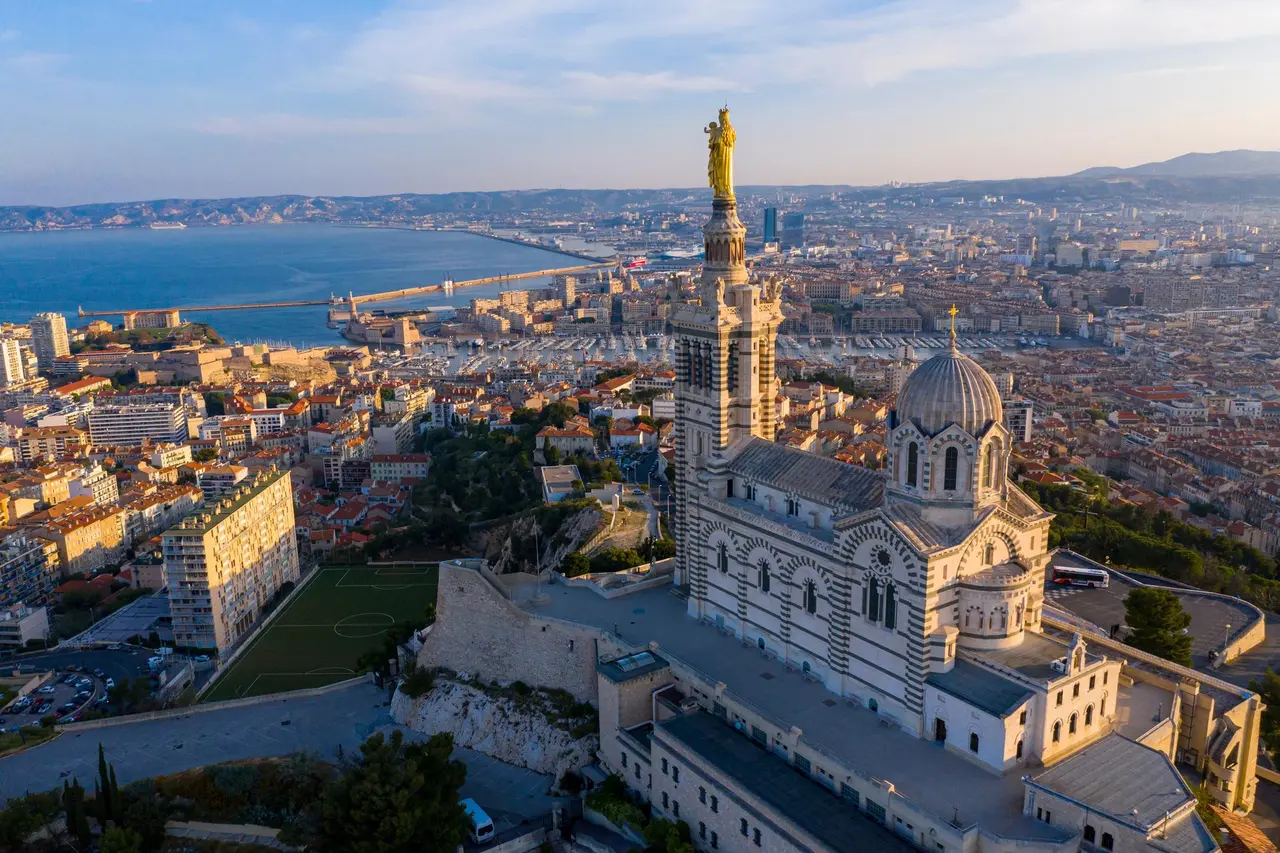
Basilica atop the city, gilded Virgin visible from afar, a 360-degree panorama of the harbour and islands.

Calanque de Sormiou

The largest of the Marseille calanques, cabins and a beach, reached on foot or by shuttle depending on the season.

Chateau d'If

16th-century island fortress, literary prison of the Count of Monte Cristo, a 20-minute ferry from the Vieux-Port.

Vallon des Auffes

Miniature fishing harbour wedged under a Corniche bridge, cabins and bouillabaisse restaurants.

Cours Julien

District of designers and street art, terraces and record shops, a flower market on Wednesday and Saturday.

What to discover in Marseille?

The Vieux-Port and Le Panier

It all starts at the Vieux-Port, with its fish market in the morning and the ferry-boat that crosses the harbour in three minutes for a few cents. To the north, Le Panier, the city's oldest district, lines up sloping lanes, colourful facades and street art around the Vieille Charite, a former almshouse turned cultural centre. Allow half a day on foot, climbing to the Place des Moulins, the high point of the quarter, for the rooftop view.
The MuCEM and the seafront

On the J4 mole, just outside the Vieux-Port, the MuCEM and its black concrete lattice are linked to Fort Saint-Jean by a footbridge: access to the terraces and the fort is free, only the exhibitions are paid, and the museum closes on Tuesdays. Next to it, the Major cathedral and the regional contemporary art centre round off the walk. Allow two to three hours, more if you go in to see an exhibition or two.

Notre-Dame de la Garde and the Corniche

The basilica, nicknamed la Bonne Mere, crowns the city's highest hill at 149 metres: you climb it on foot in 30 minutes from the Vieux-Port, or take the tourist train and bus 60. The view sweeps the whole harbour, from the Frioul islands to the calanques. Coming down on the sea side, the Corniche Kennedy follows the coast for 5 kilometres to the Vallon des Auffes, a tiny fishing harbour wedged under a bridge.

The Calanques national park

South of the city, 20 kilometres of limestone cliffs plunge into turquoise water. The most walkable ones start from Luminy, the end of bus 21: Sugiton is 45 minutes' walk away, Morgiou and Sormiou a little more. A boat from the Vieux-Port lets you see En-Vau and Port-Pin without walking at all. From June to September, access is regulated each morning by fire risk, to be checked the day before on the park website.

The Chateau d'If and the Frioul islands

A 20-minute ferry from the Vieux-Port serves the Chateau d'If, a 16th-century fortress made famous by the Count of Monte Cristo, then the Frioul archipelago: coves, fortification trails and old military installations. There is no shade and a single water point: bring a hat and a bottle. Allow half a day for both, more to swim at the Saint-Esteve cove. To carry on north, Lyon is under two hours by train.

How much it costs

Per person per day, excluding international travel.
Budget
56 €/ day
1 004 € for 2 people, 7 days, return flights included
Accommodation
25 €
Food
18 €
Local transport
6 €
Sights and activities
7 €
Comfort
110 €/ day
1 760 € for 2 people, 7 days, return flights included
Accommodation
48 €
Food
35 €
Local transport
9 €
Sights and activities
18 €
Premium
256 €/ day
3 804 € for 2 people, 7 days, return flights included
Accommodation
130 €
Food
68 €
Local transport
20 €
Sights and activities
38 €
Prices checked: Relevé septembre 2026, d'après agrégateurs (Hostelz, HostelGeeks, NomadicMatt, gotripzi, BudgetYourTrip, hikersbay). Depuis Paris, le trajet réaliste est le TGV (3 h 15) : aller-retour hors période de pointe estimé à 110 EUR par personne, valeur utilisée à la place d'un vol. Hébergement par nuit et par personne : dortoir pour backpacker, chambre double partagée a deux pour comfort et premium. Prix hors haute saison estivale, ou l'hébergement du Vieux-Port grimpe fortement.

Getting there

Airports serving Marseille, from main hubs to secondary ones.
  • AGFAgen La Garenne airportAgenSecondary
  • AJAAjaccio Napoléon Bonaparte airportAjaccioSecondary
  • ANEAngers Marcé airportAngersSecondary
  • ANGAngoulême Brie-Champniers airportAngoulêmeSecondary
  • AUFAuxerre Branches airportAuxerreSecondary
  • AURAurillac airportAurillacSecondary

Practical information for Marseille

Best time

May-June and September. In July-August, the hills are often closed in the afternoon for fire risk and prices rise.

Calanques access

From June to September, the risk level is published each day around 6pm for the next day on the national park website.

Transport

Two metro lines, a tram and RTM buses; bus 21 then 21 Jet serves Luminy, the walking gateway to the calanques.

Mistral

A cold, violent north wind, common in spring; it clears the sky but can suspend the boat shuttles.

Bouillabaisse

The real one is expensive and often ordered the day before; a charter lists the restaurants that respect the recipe.

Ferry-boat

The historic shuttle crosses the Vieux-Port between the town hall and the Place aux Huiles for a token fare.

Swimming

Prado beaches to the south, calanques to the east; the water reaches 22 to 24 °C in August, 13 °C in winter.

Vigilance

As in any big city, keep your belongings close on the metro and around Saint-Charles station.

Tipping

Service is included; leave a few euros if the meal pleased, with no obligation.

Marseille in pictures

Photo credits : Clément Bardot, CC BY-SA 4.0, Wikimedia Commons ; Fred Romero from Paris, France, CC BY 2.0, Wikimedia Commons ; Benh LIEU SONG, CC BY-SA 3.0, Wikimedia Commons ; Rémih, CC BY-SA 4.0, Wikimedia Commons

Similar destinations

Other cities you might like as much as Marseille.

Frequently asked questions about Marseille

How do you get to the calanques from central Marseille?
By bus 21 then 21 Jet to Luminy, where the trails to Sugiton and Morgiou start. Alternatively, a boat shuttle and excursion boats leave the Vieux-Port for En-Vau and Sormiou, useful if you would rather not walk.
Can you visit the calanques in summer?
Yes, but access is regulated from June to September: each day, a fire-risk level is published the evening before and can close all or part of the hills, often from midday. Check the park website before setting out on foot.
How many days do you need for Marseille?
Two days cover the Vieux-Port, Le Panier, the MuCEM and a day of calanques or islands. A third day allows Notre-Dame de la Garde, the Corniche and a train trip to Cassis.
Is the area around Saint-Charles station safe?
The Belsunce and Noailles area, very lively by day with its markets, is quieter and less welcoming at night. There is nothing wrong with walking through it, but avoid lingering there late with an open bag, and use the metro to reach your accommodation.
Marseille or Nice for the French Mediterranean?
Marseille is rawer and larger, with its calanques and port history; Nice is more of a resort, turned toward the Riviera. The two link in 2h30 by train and combine well over a week.
Is the Chateau d'If worth the crossing?
For the view of the city from the sea and the atmosphere of Dumas's novel, yes, especially as the ticket often combines with Frioul. The visit of the fortress itself is short: allow two to three hours with the trip.
Do you need a car to visit Marseille?
No, and it is even a hindrance: heavy traffic, scarce parking and a low-emission zone. The centre, the MuCEM and the calanque trailheads are served by public transport; a car only helps for Cassis or the hinterland.
Where is the best sunset in Marseille?
From the forecourt of Notre-Dame de la Garde, from the Corniche toward the Vallon des Auffes, or from Fort Saint-Jean at the MuCEM, with terraces open free until closing. The mistral, when it blows, makes the light especially sharp.

Plan your trip to Marseille

Build your day-by-day itinerary and manage budget, bookings and packing in PlanTripNow.
Aperçu de l'application PlanTripNow