Skip to content

Visiting Montreal: neighbourhoods, seasons and budget to plan your stay

Montreal changes with the thermometer: terraces and free concerts from June to August, underground galleries and snow festivals when it is -10 °C. Between the grey stone of Old Montreal, the Plateau's staircases and the Mount Royal lookout, three days are enough to grasp the essentials.

At a glance

Visa
None
Tourist stay of up to 180 days
7-day budget
€1,288
Per person, comfort profile, excluding international flights.
Recommended length
3 days
For a first trip, without rushing.

Why visit Montreal?

Montreal is Quebec's largest city and the French-speaking metropolis of North America, where daily life happens in French, with direct flights from Paris. It can be visited year-round: June to September for festivals and terraces, December to March for snow, as long as you accept January averages of -9 °C.

When to visit Montréal

Temperatures, rainfall and crowds month by month, to pick your window.
When to visit Montréal
MonthTemperaturesRainCrowdsVerdict
January-13 to -5 °C11 dVery quietThe coldest month, -13 C at dawn: life moves into the underground city, while Igloofest dances outdoors.
February-12 to -3 °C9 dQuietMontreal en Lumiere and the Fete des neiges liven up winter; skies are often blue and hotels still cheap.
March-6 to 2 °C10 dQuietFreeze-thaw cycles and slushy sidewalks, but also sugar shack season in the countryside around the city.
April1 to 11 °C10 dQuietSnow melts and terraces tentatively reopen; a grey, quiet month best kept for the museums.
May8 to 19 °C10 dModerateMount Royal turns green and Plateau laneways bloom: a fine compromise before festival season.
June14 to 24 °C10 dBusyLong evenings, the Francos and the start of the Jazz Festival: prices climb from late in the month.
July17 to 27 °C10 dPackedAbsolute peak: free concerts in the Quartier des spectacles, humid heat and rooms to book very early.
August16 to 26 °C9 dPackedOsheaga at Parc Jean-Drapeau and Quebec holidays: crowds everywhere, storms late in the day.
September11 to 21 °C9 dModerateOur favourite month: mild days, terraces still open and Jean-Talon Market overflowing with harvest produce.
October5 to 13 °C10 dBusyMaples turn red on Mount Royal and in the Laurentians; bring a coat, evenings are chilly.
November-2 to 6 °C11 dVery quietThe year's low point: grey, short days and first snow, but flights and hotels at their cheapest.
December-9 to -1 °C12 dModerateSettled snow and Christmas markets; the holidays push up flight prices from France.
Source: Normales 1991-2020 de la station Montreal-Trudeau (Environnement et Changement climatique Canada, via le tableau climatique Wikipedia), recoupees avec climatestotravel.com (memes normales 1991-2020, jours de precipitations pluie et neige confondues). Ville fluviale : pas de temperature de mer. Releve octobre 2026.

Montreal's must-sees

Six places that sum up the city, from its birthplace to its pantry.

Notre-Dame Basilica

A midnight-blue vault studded with gold stars and carved woodwork on Place d'Armes; the Aura sound and light show plays there in the evening.

Kondiaronk Lookout

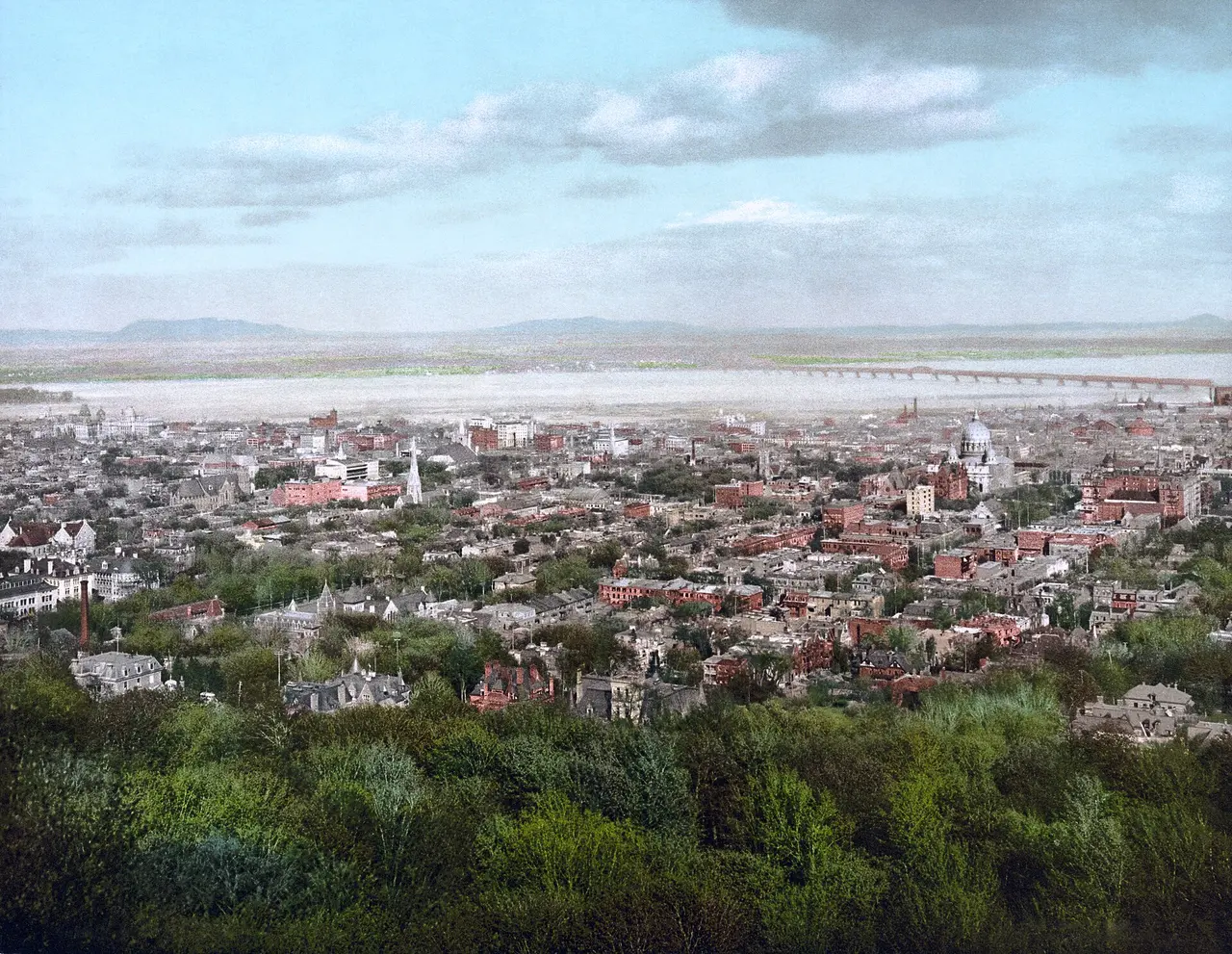
The terrace of the Mount Royal chalet, free to reach on foot, offers the most famous view of the skyscrapers and the river.

Jean-Talon Market

One of the largest public markets in North America, in Little Italy, where Quebec growers and cheesemakers trade all year round.

Pointe-à-Callière

An archaeology museum built on the site where Montreal was founded, with remains and old sewers to explore beneath the city.

Botanical Garden

Greenhouses plus Japanese and Chinese gardens facing the Olympic Stadium, best visited from May to October when the outdoor collections bloom.

Museum of Fine Arts

One of Canada's major art museums, spread across several pavilions on rue Sherbrooke, with a strong collection of Quebec and Inuit art.

What to see in Montreal?

Old Montreal and the Old Port

This is where Ville-Marie was founded in 1642, and the district keeps its cobbled streets, grey stone warehouses and European-style squares. Half a day covers Place d'Armes, rue Saint-Paul and Place Jacques-Cartier; add two hours for the archaeological remains at Pointe-à-Callière. The Old Port below is a promenade in summer and a skating rink in winter. Restaurants here cost more than elsewhere: eat in the neighbourhoods instead and come back in the evening, when the facades are lit up.

The Plateau-Mont-Royal and Mile End

The Plateau is everyday Montreal at its most photogenic: plexes with wrought-iron outdoor staircases, green laneways, cafes on rue Saint-Denis and Avenue du Mont-Royal. Further north, Mile End mixes thrift shops, artists' studios and two wood-fired bagel institutions open day and night. Boulevard Saint-Laurent, the historic line between the French-speaking east and the English-speaking west, is the street of smoked meat. Allow a full day on foot; the orange metro line serves both neighbourhoods.

Mount Royal and Outremont

The mountain that gave the city its name rises to 233 metres and forms a park designed by Frederick Law Olmsted, the landscape architect behind Central Park. Stairs from Avenue des Pins lead to the Kondiaronk lookout, taking in downtown and the St Lawrence; bus 11 crosses the park for those who would rather ride up. On summer Sundays, the tam-tams draw crowds at the foot of the George-Étienne-Cartier monument. On the north slope, Outremont lines up stately homes and quiet streets, ideal for an easy walk down.

Little Italy and the east of the city

Jean-Talon Market, open every day of the year, overflows with outdoor stalls from May to October: Île d'Orléans strawberries in July, squash and apples in autumn, Quebec cheeses all year. Around it, Little Italy keeps its espresso bars and delis. The green metro line then leads to the Olympic Park, where the Botanical Garden, the Biodome and the Insectarium make up Space for Life: allow at least four hours to see two of them. In September and October, the Chinese Garden lanterns are worth an evening visit.

Downtown and the underground city

Beneath the downtown towers runs the RÉSO, about 32 kilometres of pedestrian galleries linking metro stations, shopping centres, universities and concert halls. In January, when dawn temperatures drop below -13 °C, you can cross downtown without stepping outside. The network is better used than toured: treat it as a shortcut between the Museum of Fine Arts on rue Sherbrooke and Place des Arts. Blue RÉSO signs mark the street-level entrances.

Festival seasons

In summer the Quartier des spectacles hosts a run of festivals, part of whose concerts are free and outdoors, peaking with the International Jazz Festival from late June to early July. Osheaga takes over Parc Jean-Drapeau in early August. Winter does not stop the party: Igloofest gets the Old Port dancing in January and February, and Montreal en Lumiere livens up February. The flip side: book July accommodation three to four months ahead, when room prices reach their yearly high.

The Laurentians and nature escapes

About 135 kilometres north, the Laurentians offer lakes, maple forests and ski resorts, including Mont-Tremblant and its pedestrian village. The drive takes a little under two hours, while public transport is far less convenient. Autumn colours arrive from late September, slightly before the city; in March, the region's sugar shacks serve seasonal maple syrup meals. Montreal is also the natural gateway to the rest of French- and English-speaking Canada, by train or by plane.

Sample itineraries

Three routes built around the time you actually have.
3daysRecommended

Montreal in 3 days: food neighbourhoods, markets and the underground city

  1. Plateau-Mont-Royal and Mile End
  2. Little Italy, Jean-Talon Market and Space for Life
  3. Downtown, museums and the underground city

Best for: For travellers who already know Old Montreal or prefer lived-in neighbourhoods to monuments: lots of eating, metro rides and neighbourhood hopping. Works in any season thanks to the underground network.

How much it costs

Per person per day, excluding international travel.
Budget
71 €/ day
1 894 € for 2 people, 7 days, return flights included
Accommodation
28 €
Food
30 €
Local transport
5 €
Sights and activities
8 €
Comfort
184 €/ day
3 476 € for 2 people, 7 days, return flights included
Accommodation
90 €
Food
55 €
Local transport
14 €
Sights and activities
25 €
Premium
340 €/ day
5 660 € for 2 people, 7 days, return flights included
Accommodation
125 €
Food
110 €
Local transport
35 €
Sights and activities
70 €
Prices checked: Relevé octobre 2026, hors haute saison des festivals (fin juin a août). Hébergement : lits en dortoir affiches à partir de 19 à 25 EUR dans les auberges centrales sur Hostelworld (relevé octobre 2026), moyennes hotels 3 étoiles (181 EUR la chambre) et 4 étoiles (245 EUR) de combien-coute.net (agrégateur non officiel, prix relevés en octobre 2026 depuis hotels.com, fourchettes très larges) ; comptez a part les taxes québécoises quand elles ne sont pas incluses. Repas : combien-coute.net, octobre 2026 (déjeuner 16 EUR, dîner 3 plats 31 EUR par personne). Transport : grille officielle ARTM/STM en vigueur le 1er juillet 2026 (1 passage 3,75 CAD, 24 h 11,25 CAD, 3 jours 21,75 CAD, hebdo 33,25 CAD). Change : 1 EUR = 1,5942 CAD (taux de référence BCE du 9 octobre 2026). Vol : aller-retour Paris-Montréal environ 450 EUR par personne en octobre (moyenne ou-et-quand.net 2026, agrégateur, 396 EUR en novembre, 563 EUR en décembre), soit 900 EUR pour deux. Hébergement par personne : lit en dortoir pour backpacker, chambre double partagée a deux pour comfort et premium.

Getting there

Airports serving Montréal, from main hubs to secondary ones.
  • KESKelsey AirportKelseySecondary
  • PIWPikwitonei AirportPikwitoneiSecondary
  • QBCBella Coola AirportBella CoolaSecondary
  • WPCPincher Creek AirportPincher CreekSecondary
  • XKSKasabonika AirportKasabonikaSecondary
  • XQUQualicum Beach AirportQualicum BeachSecondary

Entry, health and safety

For FR travellers

Entry requirements

No visa for a tourist stay

Pas de visa pour un séjour touristique ou d'affaires de moins de six mois. Une autorisation de voyage électronique (AVE, 7 CAD sur le site officiel du gouvernement du Canada, valable cinq ans) est obligatoire pour arriver en avion ; le passeport doit être valide pendant tout le séjour.

Stay allowed for up to 180 days.

Health

Advised: Vaccinations du calendrier français à jour, en particulier diphtérie, tétanos, poliomyélite, coqueluche et rougeole.

Maladie de Lyme transmise par les tiques en forêt et en milieu rural, rares cas de virus du Nil occidental (protection contre les moustiques). Assurance couvrant frais médicaux et rapatriement indispensable : l'hospitalisation se règle avant la sortie. Vigilance normale sur tout le Canada ; vols d'effets personnels signalés à Montréal. Feux de forêt fréquents d'avril à septembre, fumées possibles.

Safety

Normal precautions

Emergency

911

Checked in octobre 2026 against the official source. Entry rules change: check the official source before you travel, it alone is authoritative.

Practical information for Montreal

Metro and buses

STM network: CAD 3.75 a ride, CAD 11.25 for 24 hours, CAD 21.75 for 3 days, CAD 33.25 for the week (fares in force since 1 July 2026).

Montreal-Trudeau airport

Bus 747 links the airport to downtown; it accepts the CAD 11.25 24-hour pass, then valid across the whole metro.

Displayed prices

Sales taxes (GST and QST, close to 15%) are added at the till: the price tag is never the price you pay.

Tipping

Expected in restaurants and bars, 15 to 20% of the pre-tax amount; payment terminals suggest it automatically.

Winter gear

From December to March, a long coat, waterproof boots with grippy soles and a toque are essential: icy sidewalks and biting wind.

Language

French is Quebec's official language; English is widely understood, especially in the west of the island and downtown.

Bike sharing

BIXI bikes cover downtown and the neighbourhoods, with a dense cycle path network along the Lachine Canal.

Power sockets

Types A and B, 120 V: European devices need an adapter, and check that they accept this voltage.

Currency

Canadian dollar (CAD): 1 EUR = 1.5942 CAD at the ECB reference rate of 9 October 2026. Cards accepted everywhere.

Entering Canada

An Electronic Travel Authorization (eTA) at CAD 7 is mandatory for French citizens flying in, to be requested only on the official Canadian website.

Montréal in pictures

Photo credits : Unknown author Unknown author, Public domain, Wikimedia Commons ; Louis-Philippe Hébert, CC0, Wikimedia Commons ; Diego Delso, CC BY-SA 4.0, Wikimedia Commons ; Ken Lund from Reno, Nevada, USA, CC BY-SA 2.0, Wikimedia Commons

Frequently asked questions about Montreal

Can you really visit Montreal in the depths of winter?
Yes, if you dress for it: January averages -9 °C with mornings below -13 °C. The 32 km underground network, the museums and winter festivals such as Igloofest and Montreal en Lumiere make the stay enjoyable, and hotels are at their cheapest.
Fairmount or St-Viateur: where to try Montreal bagels?
Both Mile End bakeries, a few streets apart, poach their bagels in honeyed water before baking them in a wood-fired oven. The debate comes down to taste: the simplest answer is to buy a hot sesame bagel at each and decide for yourself.
Where does Montreal's underground city begin?
There is no single entrance: the RÉSO is reached from downtown metro stations such as McGill, Peel or Place-des-Arts, and from the large shopping centres. Look for the blue RÉSO signs at street level, then follow the signage inside.
How do you get downtown from Montreal-Trudeau airport?
Bus 747 shuttles day and night between the airport and downtown. The CAD 11.25 fare is the 24-hour pass, which then remains valid on STM metro and buses: it is the cheapest way to arrive in the city.
How do you get to the top of Mount Royal?
On foot, the stairs starting from Avenue des Pins lead to the Kondiaronk lookout along wooded paths. Without effort, STM bus 11 crosses the park via Voie Camillien-Houde. In winter, people also go up on snowshoes or cross-country skis.
Do people speak English in Montreal?
French is the official language and dominates in the east and on the Plateau, but the west of the island and downtown are very bilingual. Shop staff often greet customers with a « Bonjour-Hi »: answer in English and the conversation will usually switch to English.
When can you see the autumn colours around Montreal?
Maples turn red first in the Laurentians, from late September, then on Mount Royal in early October. The first two weeks of October are the best compromise, but Mont-Tremblant weekends often sell out: book early.
When is the Montreal International Jazz Festival held?
It runs from late June to early July in the Quartier des spectacles, with many of its concerts free and outdoors. It is also when accommodation is most expensive: book several months ahead or stay on the Plateau.
How many days should you plan for Montreal?
Three days let you see Old Montreal, Mount Royal, the Plateau and Jean-Talon Market without rushing. A fourth day opens the way to the Laurentians or Parc Jean-Drapeau; two days are enough for a stopover focused on the old town and the mountain.
Can you combine Montreal with New York or Boston?
Yes, it is a common combination: Amtrak's Adirondack train links Montreal to New York through the Hudson Valley, and Boston is only a short flight away. Plan for the border crossing and the US ESTA on top of the Canadian eTA.

Plan your trip to Montréal

Build your day-by-day itinerary and manage budget, bookings and packing in PlanTripNow.
Aperçu de l'application PlanTripNow