Skip to content

Visiting New York : what to see, budget and how many days to plan

From Midtown to Brooklyn via Central Park, New York is walked district by district, with the subway to link the distances. Allow 4 days for a first visit, more to leave Manhattan and see Harlem or Queens.

At a glance

Visa
None
Tourist stay of up to 90 days
7-day budget
€1,575
Per person, comfort profile, excluding international flights.

Why visit New York?

New York packs onto a narrow island some of the richest museums in the world, an instantly recognisable skyline, major urban parks and an unmatched density of shows, restaurants and neighbourhood scenes. It is a year-round visit; spring and autumn are the most pleasant, summer is heavy and winter harsh but festive.

When to visit New York

Temperatures, rainfall and crowds month by month, to pick your window.
When to visit New York
MonthTemperaturesRainCrowdsVerdict
January-3 to 4 °C11 dQuietBiting cold and wind between the towers; outside New Year, the cheapest month to sleep in Manhattan.
February-2 to 6 °C10 dQuietStill winter, snowstorms possible; Broadway shows discount midweek seats.
March2 to 10 °C11 dModerateWeather torn between late snow and first mild spells; the St Patrick's parade on the 17th fills Fifth Avenue.
April7 to 16 °C11 dBusyCherry blossom in Central Park and Brooklyn; spring launches high season and pushes hotels back up.
May12 to 22 °C12 dBusyOne of the best months: mild air, terraces, a blooming High Line, before summer's mugginess.
June18 to 27 °C11 dBusyFree concerts in the parks and Pride in late June: a city buzzing, heat still bearable.
July21 to 30 °C10 dModerateHot and heavy, a stifling subway; New Yorkers escape to the Hamptons and hotels ease a little.
August21 to 29 °C10 dModerateHeatwaves and late-day thunderstorms; a budget sweet spot, but plan air-conditioned breaks.
September17 to 25 °C9 dBusyCooling air, clear skies, the cultural season restarting: arguably the finest time to walk the city.
October11 to 18 °C10 dPackedAutumn foliage in Central Park and peak crowds; the November marathon already tightens hotel supply.
November5 to 12 °C9 dBusyThe marathon on the first Sunday, the Thanksgiving parade at month's end: two peaks that fill the city.
December1 to 7 °C11 dPackedIce rinks, holiday windows and the Rockefeller Center tree: guaranteed magic, but dense crowds and record rates in late December.
Source: Moyennes 1991-2020 de climatestotravel.com (d'apres NOAA) recoupees avec les normales NOAA de Central Park (ecarts inferieurs a 1 degre). Releve septembre 2026. Baignade marginale a New York : pas de temperature de mer renseignee.

New York's must-sees

Twelve places that shape a first visit, from Lower Manhattan to the brownstones of Harlem.

Statue of Liberty

Ferry from Battery Park, stop at Ellis Island; pedestal or crown ticket to book weeks ahead.

9/11 Memorial

Two pools on the footprint of the towers, names engraved on the parapet; the underground museum takes 2 to 3 hours.

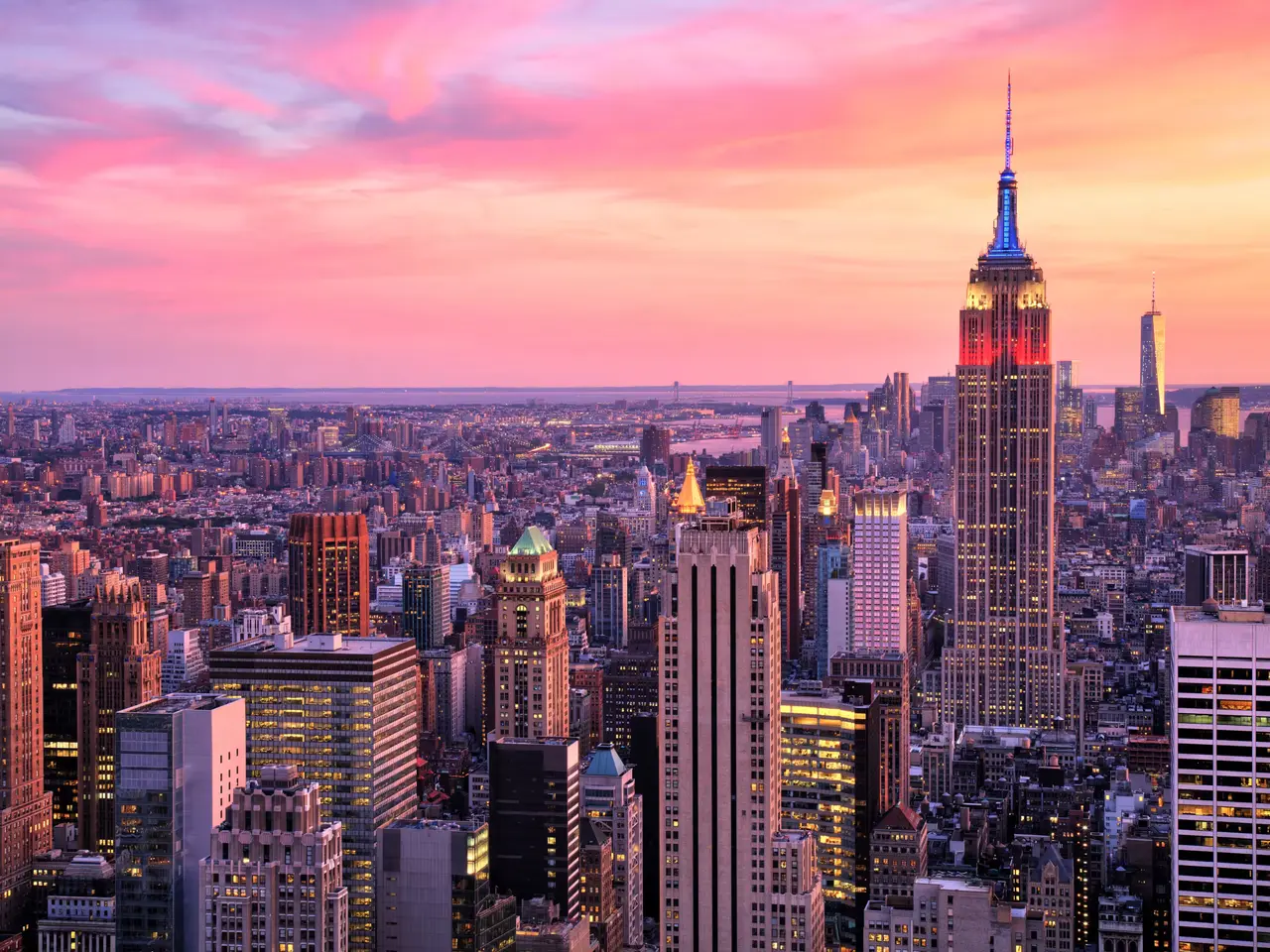
Empire State Building

Observation decks on the 86th and 102nd floors, open until 2am; a timed slot to skip the queue.

Central Park

340 hectares in the middle of Manhattan, Bethesda Terrace, the Ramble, the reservoir and the Bow Bridge.

Metropolitan Museum

One of the world's largest museums on Museum Mile; allow at least three hours, pay-what-you-wish for state residents.

Brooklyn Bridge

A 1.8 km walk on the upper deck, views of Manhattan and Dumbo; go early in the morning.

High Line

Planted walkway on an elevated railway, 2.3 km from Hudson Yards to the Meatpacking District, free access.

Times Square

Crossroads of the Broadway theatres, giant screens and the TKTS booth for same-day half-price seats.

Grand Central Terminal

1913 station, hall with a constellation-painted ceiling, a whispering gallery and a food hall below.

The Met Cloisters

Medieval branch of the Metropolitan at the north end of the island, cloisters rebuilt in a park above the Hudson.

Dumbo

Former industrial Brooklyn district, cobblestones, converted warehouses and the Manhattan Bridge view from Washington Street.

Apollo Theater

Legendary Harlem venue, Amateur Night on Wednesday evenings, daytime guided tours by reservation.

What to discover in New York?

Midtown and the skyscrapers

The tourist core is walked between Grand Central Terminal, the Public Library, Times Square and its screens, and Fifth Avenue. For the view, three observatories share the sky: the Empire State Building, the Top of the Rock at Rockefeller Center and the mirrored Summit One Vanderbilt. Book a slot online, aim for sunrise or sunset, and allow half a day with Central Park just to the north.

Lower Manhattan and the Statue of Liberty

The south of the island gathers the 9/11 Memorial and its museum, Wall Street, Trinity Church and the Oculus. The ferry to the Statue of Liberty and Ellis Island leaves from Battery Park: a named ticket to book weeks ahead to climb to the pedestal or the crown. The free Staten Island Ferry offers the same view with no booking. Allow half a day to a full day.

Central Park and the Upper East Side museums

The park, 340 hectares laid out in 1858, is crossed east to west in 20 minutes: Bethesda Terrace, the lake, the Ramble, the reservoir. On its east flank, Museum Mile lines up the Metropolitan Museum, which needs at least three hours, the Frank Lloyd Wright Guggenheim, closed on Thursdays, and several smaller museums. Pairing a morning at the Met with an afternoon in the park works well.

West Manhattan: High Line, Chelsea, the Village

The High Line, a former elevated railway turned planted walkway, runs 2.3 kilometres from Hudson Yards to the Meatpacking District, best walked north to south in about 45 minutes. Below, Chelsea holds the contemporary art galleries, free to enter, and the Chelsea Market food hall. Heading south, Greenwich Village and Washington Square keep their curved streets, jazz clubs and low townhouses, off the grid. Half a day of walking with no museum, ending with a drink in the Village.

SoHo, Nolita and the Lower East Side

Below Houston Street, SoHo lines up its 19th-century cast-iron facades, now filled with shops; Nolita and Little Italy are covered in a few streets; the Lower East Side, an immigration district turned nightlife district, holds the Tenement Museum, which tells the life of working families in a period building. Neighbouring Chinatown remains one of the largest in the West. Allow half a day.

Brooklyn: Dumbo, Williamsburg, Prospect Park

Walking the Brooklyn Bridge, early in the morning to avoid the crowd, leads to Dumbo and its framed view of Manhattan from Washington Street. Brooklyn Bridge Park follows the East River to the Brooklyn Heights Promenade. Further north, Williamsburg holds thrift stores, breweries and rooftops facing the skyline, a subway stop from Manhattan. Prospect Park, designed by the same landscapers as Central Park, is quieter and greener. A full day, more with the Brooklyn Museum.

Harlem and the Upper West Side

North of the park, Harlem is visited for its brownstone architecture, the Apollo Theater, soul food and, on Sunday mornings, the gospel services in the Baptist churches, where you arrive 30 minutes early and dress neatly. The more residential Upper West Side lines up the American Museum of Natural History, Lincoln Center and the western entrances to Central Park. Half a day to a full day, ideally a Sunday.

Beyond Manhattan: Queens and day trips

Queens, the city's most diverse borough, is visited for Flushing and its Chinatown, MoMA PS1 in Long Island City and the Rockaway beaches in summer, reachable by subway. To leave the city, the Catskills, the Hudson Valley and its estates, or Washington by high-speed train in 3 hours, are the classic options. As in Miami, some districts are best experienced by day.
How much it costs

Per person per day, excluding international travel.
Budget
89 €/ day
2 346 € for 2 people, 7 days, return flights included
Accommodation
45 €
Food
28 €
Local transport
6 €
Sights and activities
10 €
Comfort
225 €/ day
4 250 € for 2 people, 7 days, return flights included
Accommodation
130 €
Food
55 €
Local transport
10 €
Sights and activities
30 €
Premium
470 €/ day
7 680 € for 2 people, 7 days, return flights included
Accommodation
280 €
Food
100 €
Local transport
30 €
Sights and activities
60 €
Prices checked: Relevé septembre 2026, d'après agrégateurs (packzup, travelhiatus, nycitine, BudgetYourTrip, machupicchu.org) et comparateurs de vols ; montants USD convertis à 1 USD = 0,92 EUR. Vol A/R Paris-New York économique hors vacances scolaires estimé à 550 EUR par personne (plus cher au printemps et en décembre). Hébergement par nuit et par personne : lit en dortoir pour backpacker, chambre double partagée a deux pour comfort et premium. Transport local base sur le plafond hebdomadaire OMNY (environ 34 USD).

Getting there

Airports serving New York, from main hubs to secondary ones.
  • ABELehigh Valley International AirportAllentown/BethlehemSecondary
  • ABIAbilene Regional AirportAbileneSecondary
  • ABLAmbler AirportAmblerSecondary
  • ABRAberdeen Regional AirportAberdeenSecondary
  • ABYSouthwest Georgia Regional AirportAlbanySecondary
  • ACKNantucket Memorial AirportNantucketSecondary

Entry, health and safety

For FR travellers

Entry requirements

No visa for a tourist stay

Pas de visa pour un séjour touristique ou d'affaires de 90 jours maximum (programme d'exemption de visa). Autorisation électronique ESTA obligatoire avant l'embarquement, payante, valable 2 ans ou jusqu'à l'expiration du passeport. Demande recommandée au moins 72 heures avant le départ.

Stay allowed for up to 90 days.

Health

Advised: Mise a jour des vaccinations universelles (diphtérie, tétanos, poliomyélite, coqueluche, ROR).

Passeport devant couvrir la durée du séjour (Français exemptés de la regle des 6 mois ; validité de 6 mois conseillée par précaution). La source note une hausse sensible de la petite et moyenne délinquance et des agressions dans le metro dans les quartiers touristiques, et deconseille de circuler seul à pied la nuit dans les quartiers peu animés.

Safety

Normal precautions

Emergency

911

Checked in septembre 2026 against the official source. Entry rules change: check the official source before you travel, it alone is authoritative.

Practical information for New York

Best time

April-June and September-October. Summer is hot and humid, December festive but freezing, January-February the cheapest.

Subway

Open 24/7; contactless OMNY payment at the gate, a weekly cap of about 34 dollars after 12 rides.

From the airports

JFK via the AirTrain then subway or LIRR; Newark via the AirTrain then train; La Guardia by bus. Avoid taxis at rush hour.

Tipping

18 to 20 % in restaurants and bars, 1 to 2 dollars per drink at the counter, 15 to 20 % for a taxi or rideshare.

Taxes

Prices are shown pre-tax; add about 8.875 % at the register, and up to 14.75 % on a hotel night.

Broadway

The TKTS booth in Times Square sells seats at 20-50 % off on the day; online lotteries for the big productions.

Pay-what-you-wish museums

The Met, the AMNH and a few others apply a suggested but flexible price for New York State residents only.

ESTA

Electronic authorisation required before boarding for French travellers, valid two years.

Plug and voltage

Type A and B sockets, 120 V: an adapter is needed, a dual-voltage device for hairdryers and chargers.

Walking

Distances are deceptive: 20 north-south blocks are about 1.6 km, an east-west block is much longer.

Safety

The city is safe in tourist areas; stay alert on the subway late at night and avoid empty cars.

Tap water

Drinkable and well regarded across the city; restaurants serve it free on request.

New York in pictures

Photo credits : William Warby, CC BY 2.0, Wikimedia Commons ; Andrew Choy, CC BY-SA 2.0, Wikimedia Commons ; Christian David, CC BY-SA 4.0, Wikimedia Commons ; chensiyuan, CC BY-SA 4.0, Wikimedia Commons

Similar destinations

Other cities you might like as much as New York.

Frequently asked questions about New York

Should you buy a city pass for New York attractions?
It pays off if you chain three to five major paid sites in a few days, especially an observatory, a museum and a cruise. Otherwise, paying as you go is cheaper, and Central Park, the High Line and the Staten Island Ferry are free anyway.
How many days for a first trip to New York?
Four full days cover Midtown, Lower Manhattan, Central Park and the museums, plus a run into Brooklyn. A fifth day allows Harlem, Queens or a day trip without feeling like you are constantly rushing.
How do you go up the Statue of Liberty?
The ferry leaves from Battery Park in Manhattan, or Liberty State Park in New Jersey. To reach the pedestal or the crown, the named ticket must be booked weeks ahead; without one, you visit the island and Ellis Island but not the inside of the monument.
Which observatory for the New York view?
The Top of the Rock and Summit One Vanderbilt put the Empire State in the frame, which the Empire itself cannot. The Empire State stays open later at night. Choose by the angle you want and the hour, and book a sunset slot.
Can you attend a gospel service in Harlem?
Yes, several Baptist churches welcome visitors on Sunday mornings. Arrive 30 minutes early, dress neatly, do not photograph during the service and stay until the end. Separate queues often exist for tourists, with no guarantee of a seat.
Is the New York subway safe and easy to use?
It runs 24/7 and covers almost everything; contactless OMNY payment caps at the week. Most incidents happen late at night on quiet lines: stand in the conductor's car and avoid deserted platforms after midnight.
Do you need to book Broadway tickets in advance?
For the big productions yes, several weeks ahead. For the rest, the TKTS booth in Times Square offers 20 to 50 % off on the day, and online lotteries release cheap seats the evening before or in the morning.
New York or Washington if you can only do one city?
New York for the urban energy, the art museums and the neighbourhood life; Washington for the history, the monuments and its large free museums. The two link in 3 hours by train and combine easily over a week.
Is Brooklyn worth a night on site?
Yes for a second visit or if you want cheaper lodging and a slower pace. Williamsburg, Dumbo and Park Slope are well linked to Manhattan by subway. For a short first trip, a day is enough to see the essentials.
How do you get from JFK airport to central Manhattan?
The AirTrain links the terminals to Jamaica or Howard Beach stations, where you take the subway (about 1h15 total, under 12 dollars) or the faster LIRR train. Taxis have a flat fare to Manhattan but can cost double at rush hour.
What can you do in New York when it rains?
The big museums easily absorb a full day, as do Grand Central, Chelsea Market, the Morgan Library or a morning at the cinema. The subway links everything without long spells in the rain, unlike the bus.

Plan your trip to New York

Build your day-by-day itinerary and manage budget, bookings and packing in PlanTripNow.
Aperçu de l'application PlanTripNow