Skip to content

Visit Nantes : things to do between castle, island and Loire

A ducal castle of white tufa stone, a 12-metre mechanical elephant roaming former shipyards, a green line leading from one artwork to the next and a sea captains' village ten minutes away by boat: Nantes takes two or three days to explore, on foot and by tram.

Why visit Nantes?

Nantes, on the Loire about fifty kilometres from the Atlantic, was one of the capitals of the Duchy of Brittany and France's leading slave-trading port in the 18th century. It has turned its former shipyards into a cultural district, home to the Machines de l'Île. Every summer, Le Voyage à Nantes lays out an open-air contemporary art trail across the city.

Nantes' must-sees

Ten stops that tell the story of Nantes, from the Dukes of Brittany to extraordinary machines.

Castle of the Dukes

A 15th-century fortress and ducal palace in white tufa; courtyard and ramparts free to access, with the paid Nantes history museum spread over some thirty rooms.

Nantes Cathedral

A Gothic cathedral built over more than four centuries, housing the Renaissance tomb of Duke Francis II; it suffered an arson fire in July 2020.

Machines de l'Île

A giant mechanical bestiary: the 12 m Great Elephant carries passengers and the Carousel of Marine Worlds rises over three levels beside the Loire.

Passage Pommeraye

An 1843 shopping arcade over several levels, with a monumental staircase, statues and glass roof, one of the most striking covered passages in France.

Jardin des Plantes

A botanical garden opposite the station, with glasshouses, a camellia collection and quirky installations by illustrator Claude Ponti; free entry.

Slavery Abolition Memorial

A free walkway beneath Quai de la Fosse, lined with texts and dates, recalling Nantes' role in the Atlantic slave trade and the struggles for abolition.

Musée d'arts de Nantes

Painting and sculpture from the late Middle Ages to contemporary art, in a 19th-century palace extended by a modern wing; closed on Tuesdays.

Le Lieu Unique

A cultural centre in the former LU biscuit factory, recognisable by its restored tower; bar, bookshop, performances and exhibitions.

Buren's Rings

Eighteen rings by Daniel Buren and Patrick Bouchain that light up at night along Quai des Antilles, in front of the Hangar à Bananes.

Jules Verne Museum

A townhouse on the Butte Sainte-Anne devoted to the writer, born in Nantes in 1828: manuscripts, objects and models, with a view over the Loire.

What to discover in Nantes, neighbourhood by neighbourhood?

Bouffay and the medieval centre

Around Place du Bouffay, pedestrian streets keep half-timbered houses from the 15th and 16th centuries, now home to crêperies and bars. The Castle of the Dukes of Brittany and the cathedral are less than ten minutes' walk apart. Allow a morning for the area, starting with the castle ramparts, free to access, before the museum opens. Worth knowing: Nantes was a capital of the Duchy of Brittany, and the question of reattaching it to the Brittany region is still a live one.

Graslin, Feydeau and the shipowners' city

Between Place Royale and Place Graslin, the 18th and 19th-century centre lines up tufa facades, a neoclassical theatre and La Cigale brasserie, an 1895 interior listed as a historic monument. The covered arcade opened in 1843 links Rue Crébillon and Rue de la Fosse across several levels. Further east, the carved-mask facades of Île Feydeau, a former island filled in during the 20th century, recall the shipowners' wealth from the triangular trade. Allow two hours for this area, and look up at the wrought-iron balconies.

Île de Nantes

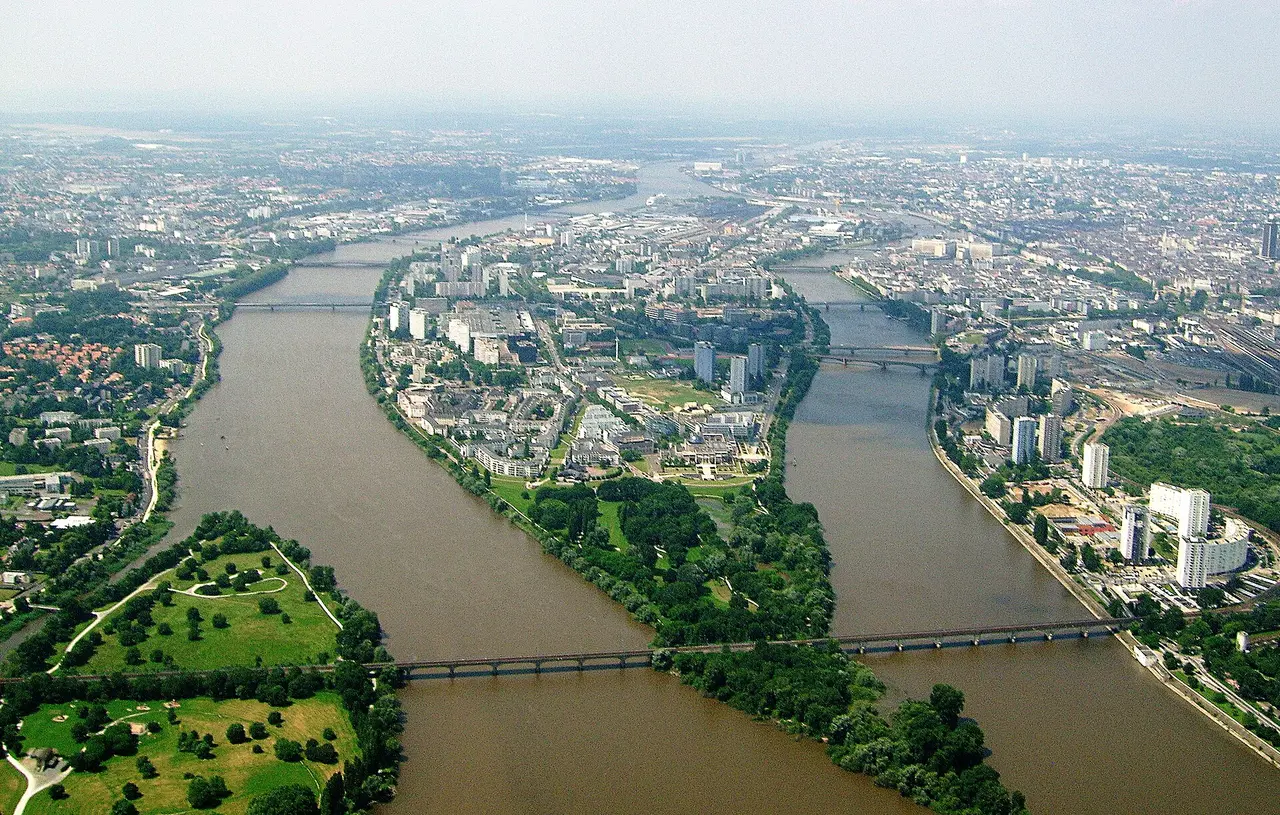
Once the site of shipyards that closed in 1987, Île de Nantes has been reinvented as a creative district, a fifteen-minute walk from the centre. The old yard halls house the machine gallery of François Delarozière and Pierre Orefice, while the Hangar à Bananes along the quay gathers bars and restaurants. The preserved yellow and grey Titan cranes act as landmarks. Allow half a day; in summer, arrive early for the elephant ride, as places are limited.

Trentemoult and the south bank

Across the Loire, the former fishing and Cape Horner village of Trentemoult, in Rezé, is about ten minutes away on the Navibus, a river shuttle on the public transport network. Its narrow lanes, colourful houses and little gardens take an hour to explore, followed by lunch on a quayside terrace. A standard tram ticket covers the trip, a chance to see the Nantes quays from the river. On sunny weekends terraces fill quickly: come on a weekday or before noon.

Quai de la Fosse and the memory of the slave trade

Nantes was France's leading slave-trading port in the 18th century. Opened in 2012 on Quai de la Fosse, a memorial leads visitors below the quay along a path of quotations and dates; entry is free, allow 30 to 45 minutes. The rooms devoted to the Atlantic slave trade in the castle's history museum complete the visit. Along the quay, shipowners' mansions continue to the Chantenay district and the Butte Sainte-Anne, a viewpoint over the Loire and its former industrial docks.

Le Voyage à Nantes in summer

Every summer, usually from early July to early September, Le Voyage à Nantes scatters temporary artworks and installations across the city, linked by a green line painted on the ground for about twenty kilometres. Permanent works stay up all year, so the line guides visitors in every season. Following the whole line takes two days; one day covers the central stretch between the station, the castle, the centre and the island. Accommodation fills up in July and August: book several weeks ahead.

Muscadet vineyards and the estuary

To the south-east, the Muscadet vineyards between the Sèvre and Maine rivers make an easy day trip, often combined with Clisson, about thirty kilometres away, and its ruined castle above the Sèvre. To the west, the Estuaire artworks dot the roughly 60 km to Saint-Nazaire, best seen by bike or on a summer cruise. For a wider loop in western France, the walled corsair town of Saint-Malo is about two hours by road and Paris two hours by TGV: two easy stops on a trip through France.

Getting there

Airports serving Nantes, from main hubs to secondary ones.
  • AGFAgen La Garenne airportAgenSecondary
  • AJAAjaccio Napoléon Bonaparte airportAjaccioSecondary
  • ANEAngers Marcé airportAngersSecondary
  • ANGAngoulême Brie-Champniers airportAngoulêmeSecondary
  • AUFAuxerre Branches airportAuxerreSecondary
  • AURAurillac airportAurillacSecondary

Practical info for Nantes

Nantes Atlantique Airport

About ten kilometres south-west; a direct shuttle reaches the station and centre in 20 to 30 minutes.

Train from Paris

Direct TGV trains from Montparnasse in just over two hours, with many daily departures.

Tramway

Three tram lines plus the Busway; in 1985 Nantes became the first French city to bring back the tram.

Navibus

River shuttles to Trentemoult are included in the public transport ticket.

Pass Nantes

A 24 to 72-hour tourist pass covering many sites and public transport; compare it with the number of visits you plan.

Closing days

Musée d'arts closed on Tuesdays; the castle museum closed on Mondays outside July and August.

Cycling

Bike-share and plenty of cycle lanes; the Loire à Vélo route runs through the city.

Local specialities

Beurre blanc, berlingot sweets, LU Petit-Beurre biscuits, rum-soaked gâteau nantais and Muscadet wine.

Talensac market

A large covered market north of the centre, open in the morning Tuesday to Sunday, the best place for local produce.

Rain

A mild oceanic climate but frequent showers from October to March: keep a raincoat handy.

Nantes in pictures

Photo credits : Jibi44, CC BY-SA 3.0, Wikimedia Commons ; Eusebius, CC BY 3.0, Wikimedia Commons ; François de Dijon, CC BY-SA 4.0, Wikimedia Commons ; Guilhem Vellut from Annecy, France, CC BY 2.0, Wikimedia Commons

Frequently asked questions about Nantes

Can you book a ride on the Great Elephant in Nantes?
The Great Elephant does not walk every day and places are limited: in summer and during school holidays, arrive at opening time or book when online ticketing allows. Check the calendar before you go, as the gallery closes for several weeks in winter.
How many days for the castle, Île de Nantes and Trentemoult?
Two days cover the essentials: the first for the castle, cathedral, Bouffay and Graslin, the second for Île de Nantes, the memorial and Trentemoult. Add a day for the Muscadet vineyards or Clisson, or in summer to follow the green line of Le Voyage à Nantes.
Is Nantes in Brittany?
Historically yes: it was one of the capitals of the Duchy of Brittany, as the Dukes' castle shows. Administratively, Loire-Atlantique has been separate from Brittany since 1941, and Nantes is the prefecture of the Pays de la Loire region. The debate on reunification is still alive.
Is Le Voyage à Nantes free?
Most artworks along the green line can be seen for free in public spaces; some venues or exhibitions charge admission or have restricted hours. The programme changes every summer, and permanent installations stay in place all year.
Can you get from Nantes to the sea without a car?
Yes: regional TER trains link Nantes with Pornic, Saint-Nazaire, La Baule or Le Croisic in about an hour, with more frequent services in summer. From Le Croisic and La Baule you can also cycle to the Guérande salt marshes.
What to bring back from Nantes?
Nantes berlingot sweets, LU biscuits, since the Petit-Beurre was born here, a bottle of Muscadet, Guérande salt, produced less than an hour and a half away, and a rum gâteau nantais, all found at Talensac market or in the city's delicatessens.
Which Nantes neighbourhood to stay in to walk everywhere?
The centre between Bouffay, Graslin and the north side of the station is the most convenient: castle, cathedral, Passage Pommeraye and tram within fifteen minutes on foot. Île de Nantes, more recent, suits those wanting to be close to the Machines and the Hangar à Bananes bars.
Can you visit the Muscadet vineyards without a car?
Partly: TER trains link Nantes with Clisson in about half an hour, and some estates can be reached by bike along the Sèvre. To visit several cellars in one day, a car or an organised tour is simpler; plan for a driver who does not drink.
When can you see Buren's Rings lit up?
They switch on at nightfall all year round: from late afternoon in winter, around 10 pm in high summer. Quai des Antilles, with the Hangar à Bananes terraces, is especially lively on summer evenings, when the Loire reflects the colours.

Plan your trip to Nantes

Build your day-by-day itinerary and manage budget, bookings and packing in PlanTripNow.
Aperçu de l'application PlanTripNow