Skip to content

Visit Naples : what to see, when to go and what budget

Naples is lived on the street, between the lanes of the Greek centre, the pizzerias of Via dei Tribunali and the seafront facing Vesuvius. Three days cover the city and Pompeii, ideally in May, June or October, when the heat stays bearable.

At a glance

Visa
None
Tourist stay of up to 90 days
7-day budget
€959
Per person, comfort profile, excluding international flights.
Recommended length
3 days
For a first trip, without rushing.

Why visit Naples?

Naples, capital of Campania and the third city of Italy, combines a UNESCO-listed historic centre, one of the world's richest archaeological museums and a food scene built around pizza. Pompeii, Herculaneum, Vesuvius and the islands of the bay are all less than an hour away.

When to visit Naples

Temperatures, rainfall and crowds month by month, to pick your window.
When to visit Naples
MonthTemperaturesRainCrowdsVerdict
January5 to 14 °C10 dVery quietMild for the season at 13 °C in the afternoon, but ten rainy days: ideal for the archaeological museum and underground Naples.
February5 to 14 °C10 dQuietHotels at their cheapest and Pompeii almost empty, as long as you pack an umbrella and accept fewer boats to Capri.
March7 to 17 °C10 dModerate16 °C and the first terraces on the Chiaia seafront; showers remain frequent and school groups start to arrive.
April10 to 20 °C9 dPackedEaster and the 25 April long weekend fill the city and Pompeii: book your hotel and tickets as soon as your dates are set.
May14 to 24 °C6 dBusyThe best month for walking: 24 °C, clear skies, a pleasant Vesuvius climb and a still cool 19 °C sea.
June18 to 28 °C4 dBusy28 °C and a 22 °C sea: ferries to Capri, Ischia and Procida run at full capacity and swimming becomes pleasant.
July20 to 31 °C2 dBusyOver 30 °C and shadeless Pompeii: see the ruins at opening time and keep the afternoon for the sea.
August21 to 31 °C4 dModerateThe hottest month: Neapolitans leave around 15 August, some pizzerias close and the islands are packed.
September17 to 27 °C6 dBusyThe sea is still 25 °C and the heat easier to bear; on 19 September the San Gennaro feast draws crowds to the Duomo.
October14 to 23 °C8 dModerateA fine late season at 23 °C with prices easing; the first autumn storms arrive late in the month.
November9 to 19 °C11 dVery quietEleven rainy days and occasionally heavy storms, offset by quiet museums and the lowest rates.
December6 to 14 °C11 dModerateVia San Gregorio Armeno and its nativity scenes draw crowds before Christmas; it rains often but is rarely cold.
Source: Normales 1991-2020 pour Naples publiées par climatestotravel.com (températures minimales, maximales et moyennes, jours de précipitations, température de la mer dans le golfe de Naples). Moyenne mensuelle = moyenne des minimales et maximales. Relevé octobre 2026. Affluence et niveau de prix estimés d'après le calendrier local : Pâques, ponts de printemps, saison des îles et de la côte amalfitaine, fête de San Gennaro le 19 septembre, crèches de décembre.

Naples' must-sees

Eight visits that sum up the city, from its ancient underground to its hills.

National Archaeological Museum

Mosaics, frescoes and everyday objects from Pompeii and Herculaneum, including the Alexander Mosaic and the Secret Cabinet, best seen before the ruins.

Veiled Christ

An 18th-century marble sculpture in the Sansevero Chapel whose veil seems transparent, visited in half an hour on a booked slot.

Via San Gregorio Armeno

The street of figurine makers, where workshops sell traditional nativity scenes and figures of current celebrities all year round.

Castel Sant'Elmo

A star-shaped fortress on top of Vomero, with ramparts taking in the city, the bay and Vesuvius.

Piazza del Plebiscito

The largest square in Naples, between the Royal Palace and the colonnade of San Francesco di Paola, a short walk from the San Carlo theatre.

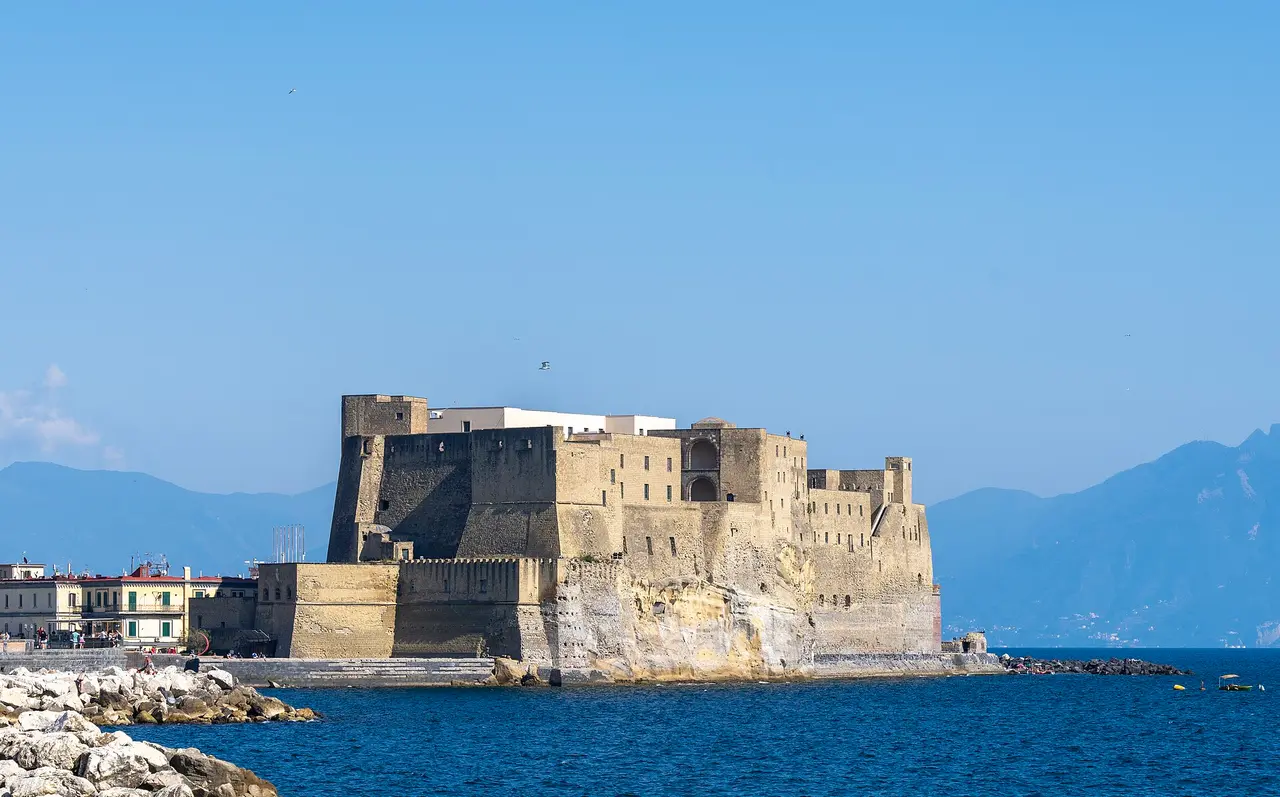
Castel dell'Ovo

The city's oldest fortress, set on an islet off the seafront, free to enter with terraces over the bay.

Catacombs of San Gennaro

Early Christian burial galleries on two levels in the heart of Sanità, visited with guides from a neighbourhood cooperative.

Pompeii

The Roman city buried in 79 AD, forty minutes away by train, which needs at least half a day and an early start in summer.

What to discover in Naples?

Spaccanapoli and the Greco-Roman city

The historic centre still follows the plan of Greek Neapolis: three parallel streets, the decumani, including Spaccanapoli, which splits the old town from west to east. Walk from Gesù Nuovo to the majolica cloister of Santa Chiara, then on to Via San Gregorio Armeno, the street of nativity craftsmen, busy all year and packed in December. Parallel to it, Via dei Tribunali gathers the historic pizzerias, where the evening wait often exceeds half an hour. Everything is done on foot, in one full day.

The Sansevero Chapel and underground Naples

The Sansevero Chapel houses the Veiled Christ, a marble sculpture whose shroud looks transparent; entry costs 12 € and the chapel closes on Tuesdays, so book a slot in season. Next door, the Duomo keeps the blood of San Gennaro, whose liquefaction draws crowds on 19 September. Beneath the streets, guided tours descend into old Greco-Roman cisterns and the remains of an ancient theatre, some forty metres down: a good option on rainy days, which are frequent from November to February.

Toledo, Plebiscito and the Spanish Quarter

Via Toledo, the main shopping street, links the centre to the Royal Palace and Piazza del Plebiscito, lined by the colonnade of San Francesco di Paola. The glass-roofed Galleria Umberto I and the San Carlo theatre complete the ensemble. West of Toledo, the Spanish Quarter is a grid of narrow lanes, laundry-hung balconies and small trattorias, with the Maradona mural now a place of pilgrimage. Also head down into Toledo metro station, one of the art stations, for its blue mosaic light well.

Vomero and Sant'Elmo hill

Three funiculars climb from the centre to Vomero, a residential district with wide streets, quieter and slightly cooler in summer. At the top, Castel Sant'Elmo gives the fullest view of the city, the bay and Vesuvius; the Certosa di San Martino next door hides a nativity museum and a viewpoint over Spaccanapoli. Come in the late afternoon for the light, then walk back down the Pedamentina steps, which reach the centre in about twenty minutes.

The seafront, Chiaia and Posillipo

The lungomare, largely closed to cars, runs along the bay from Castel dell'Ovo, free to enter, to Mergellina. Below the castle, Borgo Marinari lines up seafood restaurants and fishing boats. Behind it, Chiaia is the elegant district of boutiques and aperitivo bars. Further west, Posillipo hill, reached by bus, leads to Parco Virgiliano, overlooking the islet of Nisida and the islands of the bay. From June to September the sea is above 22 °C and Neapolitans swim off the rocks.

Sanità and Capodimonte

North of the archaeological museum, Rione Sanità is a working-class district long neglected, now revived by a cooperative of young locals who guide visitors through the San Gennaro catacombs. The Fontanelle cemetery, an ossuary dug into the tuff, and baroque palaces with double staircases complete the walk, ideally with a guide. Higher up, the Capodimonte palace shows Caravaggio, Titian and Botticelli in a 130-hectare park that is rarely crowded: half a day is enough, well away from the usual circuits.

Pompeii, Vesuvius and the islands

Naples is the base for the great sites of Campania. The Circumvesuviana train reaches Pompeii in about forty minutes, with a 20 € ticket since January 2026, and smaller, better-preserved Herculaneum in twenty. A shuttle then climbs Vesuvius, whose crater is visited on a booked slot. From the harbour, ferries and hydrofoils serve Procida, Ischia and Capri, and the Amalfi Coast is reached via Sorrento. Keep at least one day for a trip.

Sample itineraries

Three routes built around the time you actually have.
3daysRecommended

Naples in 3 days: the baroque city, Pompeii and the seafront

  1. Day 1: the historic centre and Via dei Tribunali
  2. Day 2: day trip to Pompeii
  3. Day 3: Castel dell'Ovo, Chiaia and Posillipo

Best for: The most balanced format for a first visit: a day in the historic centre, a day in Pompeii by train, then a day by the water between Castel dell'Ovo, Chiaia and Posillipo. It gives up Vomero and the major museums.

How much it costs

Per person per day, excluding international travel.
Budget
63 €/ day
1 294 € for 2 people, 7 days, return flights included
Accommodation
29 €
Food
20 €
Local transport
4 €
Sights and activities
10 €
Comfort
137 €/ day
2 330 € for 2 people, 7 days, return flights included
Accommodation
57 €
Food
45 €
Local transport
10 €
Sights and activities
25 €
Premium
310 €/ day
4 752 € for 2 people, 7 days, return flights included
Accommodation
130 €
Food
90 €
Local transport
30 €
Sights and activities
60 €
Prices checked: Relevé octobre 2026. Repas et transports : Numbeo Naples, mise à jour du 2 octobre 2026 (repas bon marché 15 €, dîner de milieu de gamme pour deux 67,50 €, cappuccino 2,05 €, ticket de bus ou métro 1,50 €, taxi 4 € de prise en charge puis 1,10 €/km). Hébergement : lit en dortoir de 12 à 18 € en basse saison et de 25 à 40 € en haute saison (hostelz.com 2026), hôtel 3 étoiles autour de 101 à 108 € la chambre double en moyenne (trip.com, moyenne sur douze mois) ; chambre double partagée à deux pour comfort et premium, lit en dortoir pour backpacker. Taxe de séjour 2026 incluse, par personne et par nuit, limitée à 14 nuits (chekin.com, 13 janvier 2026) : 4,50 € en auberge, B&B et 3 étoiles, 5 € en 4 et 5 étoiles. Activités : Pompéi 20 € depuis le 12 janvier 2026, chapelle Sansevero 12 €, musée archéologique national autour de 20 €. Vol A/R Paris-Naples : 206 € par personne, moyenne Kayak sur douze mois (fourchette habituelle 148 à 285 €, pics en août et décembre).

Getting there

Airports serving Naples, from main hubs to secondary ones.
  • BDSBrindisi AirportBrindisiMain
  • BGYIl Caravaggio International AirportOrio al SerioMain
  • BLQBologna Guglielmo Marconi AirportBolognaMain
  • BRIBari Karol Wojtyła International AirportBariMain
  • CAGCagliari Elmas AirportCagliariMain
  • CIACiampino–G. B. Pastine International AirportRomeMain

Entry, health and safety

For FR travellers

Entry requirements

No visa for a tourist stay

Aucun visa : pour un séjour de trois mois maximum, les Français entrent en Italie avec une carte nationale d'identité ou un passeport en cours de validité, à l'exclusion de tout autre document. Les mineurs doivent avoir leur propre pièce d'identité, le livret de famille ne suffit pas, et une autorisation de sortie du territoire français.

Stay allowed for up to 90 days.

Health

Advised: Mise à jour des vaccinations du calendrier français, en particulier diphtérie, tétanos, poliomyélite, coqueluche et rougeole.

Transmission possible de la dengue, du chikungunya et du virus du Nil occidental par les moustiques, surtout dans le Nord : protection anti-moustiques conseillée. Fortes chaleurs en été, prudence lors des excursions à Pompéi et au Vésuve. Carte européenne d'assurance maladie à demander au moins 15 jours avant le départ. À Naples, vols à la tire fréquents dans les gares, les transports en commun, les sites touristiques et sur les plages. Risque sismique élevé en Campanie : les Champs Phlégréens, à l'ouest de la ville, connaissent un soulèvement du sol (bradyséisme) ; suivre les informations de l'INGV et éviter les abords des volcans en période d'activité. Les cartes d'identité délivrées entre 2004 et 2013 restent reconnues cinq ans après leur expiration, mais le passeport est préférable. Consulat général de France à Naples, via Crispi 86. Numéro d'urgence unique 112.

Safety

Normal precautions

Emergency

112

Checked in octobre 2026 against the official source. Entry rules change: check the official source before you travel, it alone is authoritative.

Practical information for Naples

From the airport

Capodichino airport is about 6 km from the centre, linked by the Alibus shuttle to the central station and the port.

Tourist tax

4.50 € per person per night in hostels, B&Bs and 3-star hotels, 5 € in 4 and 5-star hotels, capped at 14 nights (2026 rates).

Public transport

A bus, metro or funicular ticket costs 1.50 €; the historic centre is best explored on foot (Numbeo, October 2026).

Pompeii ticket

20 € since 12 January 2026, best bought online to skip the queue at the entrance.

Sansevero Chapel

12 €, closed on Tuesdays; book a slot from April to October and during holidays.

Pickpockets

Stay alert in stations, on public transport, at tourist sites and on beaches, according to French official travel advice.

Seismic risk

The Phlegraean Fields west of the city are experiencing ground uplift: follow the INGV bulletins.

Pizza

A margherita in a historic pizzeria often costs under 10 €; some take a queue ticket and payment up front.

Naples in pictures

Photo credits : PaestumPaestum, CC BY-SA 4.0, Wikimedia Commons ; DimiTalen, CC0, Wikimedia Commons ; Marco Ober, CC BY-SA 4.0, Wikimedia Commons ; Lucia Montanaro, CC BY-SA 4.0, Wikimedia Commons

Frequently asked questions about Naples

Is Naples dangerous for tourists?
French official advice places all of Italy under normal vigilance. In Naples the main risk is pickpocketing, in stations, on public transport, at tourist sites and on beaches. Keep your bag in front of you, avoid flashing your phone in crowds and use official taxis at night.
How do you get from Naples to Pompeii?
The easiest way is the Circumvesuviana train from Garibaldi station, about forty minutes to the Pompei Scavi stop. The site ticket costs 20 € since January 2026. Set off early in summer: the site is huge and shade is scarce.
How many days do you need in Naples?
Two days are enough for the historic centre, Toledo and Vomero. With three days, add Pompeii; with four, Herculaneum, the Vesuvius crater and a day on the island of Procida, without giving up Sanità and its catacombs.
When is the best time to visit Naples?
May, June, September and October bring 23 to 28 °C in the afternoon and a pleasant sea. July and August top 30 °C and the islands are packed. From November to February it rains about ten days a month, but hotel rates are at their lowest.
What daily budget should you plan for Naples?
Based on our October 2026 survey, allow about 63 € a day per person in a hostel, 137 € in a 3-star hotel and 310 € for upmarket comfort, tourist tax included. A return flight from Paris averages around 206 €.
Can you climb to the crater of Vesuvius from Naples?
Yes, by train to Ercolano and then a shuttle to the volcano car park, from where a path leads to the crater. Access is on a slot booked online and may close in bad weather or during volcanic activity. Wear good shoes.

Plan your trip to Naples

Build your day-by-day itinerary and manage budget, bookings and packing in PlanTripNow.
Aperçu de l'application PlanTripNow