Skip to content

Visiting Nice : what to see, when to go and how many days to plan

Between the curve of the Baie des Anges and the hills behind, Nice is explored on foot from Old Nice to the port, then by train toward Villefranche, Eze or Monaco. Allow 2 days for the city, 3 to 4 to range along the Riviera.

At a glance

Visa
None
7-day budget
€924
Per person, comfort profile, excluding international flights.
Recommended length
3 days
For a first trip, without rushing.

Why visit Nice?

Nice combines a Genoese-influenced old town, a 7-kilometre seafront and two major museums devoted to Matisse and Chagall, all served by an airport 20 minutes from the centre by tram. Listed by UNESCO in 2021 as a winter resort town, it is a year-round visit; June and September offer a warm sea without the August crowds.

When to visit Nice

Temperatures, rainfall and crowds month by month, to pick your window.
When to visit Nice
MonthTemperaturesRainCrowdsVerdict
January6 to 13 °C6 dQuietThe mildest winter month on the coast: lunch on a sunny terrace is possible, the Promenade des Anglais almost empty, the sea cold.
February6 to 14 °C5 dBusyCarnival and flower battles: the city fills up and hotel prices rise during the two weeks of festivities, book early.
March8 to 15 °C5 dQuietMimosa in bloom on the hills and clear light: a good month to climb Castle Hill and walk toward Villefranche, without crowds.
April11 to 17 °C6 dModerateA pleasant but slightly wetter spring; the Easter holidays liven up Old Nice and the Cours Saleya.
May15 to 21 °C5 dBusyFull sun and the first swims, but the Monaco Grand Prix and the Cannes festival send accommodation prices soaring on some weekends.
June18 to 25 °C4 dBusyThe best month for the beach: the sea already at 22C, long evenings, pebbles still uncrowded before the July rush.
July21 to 28 °C2 dPackedPeak season: packed beaches, the Nice Jazz Festival, top prices and warm nights above 20C, almost no rain.
August21 to 28 °C2 dPackedThe sea at its warmest and crowds at their peak; fireworks over the bay, but humid heat and very expensive accommodation.
September18 to 25 °C5 dBusyThe ideal late season: water still at 24C, the August crowds gone; the first Mediterranean storms arrive late in the month.
October14 to 21 °C8 dModerateMild weather and swimming still possible, but one of the wettest months, with occasionally violent storm episodes.
November10 to 17 °C9 dVery quietThe wettest and quietest month: hotels at their cheapest, ideal for the Matisse and Chagall museums between showers.
December7 to 14 °C6 dQuietChristmas village on Place Massena and often sunny days; real cold is rare, and the ski resorts are 1h30 away.
Source: Normales 1991-2020 de Meteo-France, station Nice-Cote d'Azur (Wikipedia, releve octobre 2026) ; jours de pluie >= 1 mm arrondis. Temperature de la mer : moyennes mensuelles de seatemperatu.re et weather-stats.com pour la baie des Anges.

Nice's must-sees

Seven places to grasp Nice, between the sea, the old town and the painters' hills.

Promenade des Anglais

Seven kilometres of seafront, blue chairs, palm trees and the Belle Epoque facade of the Negresco.

Cours Saleya

Flower and produce market in the morning, flea market on Mondays, terraces at night at the foot of Old Nice.

Castle Hill

A park high above the sea, a waterfall and a panorama over the Baie des Anges, reached by a free lift.

Matisse Museum

A red Genoese villa in the Cimiez olive grove, works bequeathed by the painter and his family.

Marc Chagall Museum

A national museum built for the Biblical Message cycle, stained glass and a Mediterranean garden.

Place Massena

Checkerboard paving, red arcaded facades and Jaume Plensa's glowing statues, the gateway to Old Nice.

Port Lympia

Fishermen's pointus, Italian-style ochre buildings, antique dealers and ferries to Corsica.

What to discover in Nice?

Old Nice and the Cours Saleya

The historic heart fits into a triangle of narrow lanes between the sea, the hill and Place Garibaldi. In the morning, the Cours Saleya hosts the flower and produce market, replaced on Mondays by a flea market. This is where you try socca, a wood-fired chickpea pancake, before stepping into the Misericorde chapel or the Palais Lascaris, a baroque mansion with painted ceilings. Ochre facades and green shutters betray the city's Genoese and Sardinian heritage. On Sunday afternoons the lanes empty out, and Place Rossetti, around Sainte-Reparate cathedral, remains the best spot for an ice cream.

Castle Hill, above the bay

Rising 92 metres above the sea, the site of the citadel destroyed in the 18th century has become a shady park, with an artificial waterfall and the ruins of the medieval cathedral. You climb it by stairs from Old Nice or with a free lift at the end of the Quai des Etats-Unis. On one side the view takes in the whole Baie des Anges to Cap d'Antibes, on the other Port Lympia and Mont Boron. Early morning and sunset bring the best light.

The Promenade des Anglais and the beaches

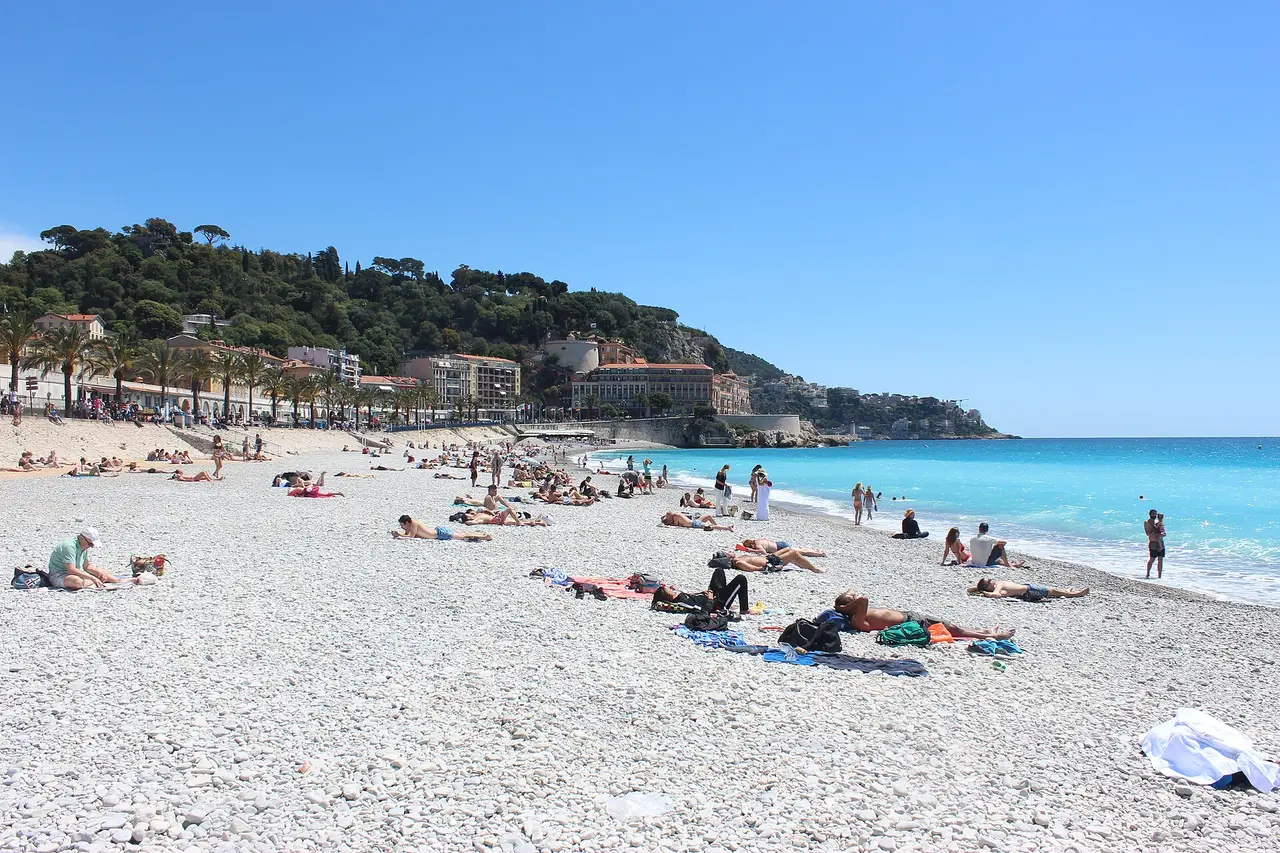
Laid out in the 19th century by the British winter colony, the Promenade runs along the sea for 7 kilometres to the airport, with its famous blue chairs and the pink-domed Negresco hotel. The beaches are pebbles: bring water shoes. Public beaches are free, private beaches rent loungers and parasols. The water tops 22 degrees from June to September and reaches 26 degrees in August, but hardly rises above 15 degrees before May. For a calmer swim, the Reserve beach at the foot of Mont Boron, or Coco Beach, offer flat rocks away from the central crowds.

Cimiez, Matisse and Chagall

On the residential Cimiez hill, where wealthy winter visitors once settled, the Matisse museum occupies a red Genoese villa in an olive grove, next to the remains of the Roman town of Cemenelum. The painter is buried in the nearby monastery cemetery. Heading back down toward the centre, the Marc Chagall national museum displays the Biblical Message cycle in a building designed for it. Both museums close on Tuesdays: take the bus up, or spend half a day walking downhill. The monastery garden, planted with roses, overlooks the Paillon valley and is free to visit.

Port Lympia and Mont Boron

Behind Castle Hill, Port Lympia lines up ochre and red Italian-style facades around traditional fishing boats, the pointus, and ferries to Corsica. It is the district of antique dealers and evening terraces. Further east, the Mont Boron trail climbs through a pine forest to Fort du Mont Alban, which overlooks both the Baie des Anges and the Villefranche harbour. Allow two hours' walk there and back from the port. On Sundays, the port flea market livens up Place Ile-de-Beaute.

Exploring the Riviera from Nice

The regional train makes Nice an ideal base: Villefranche-sur-Mer in a few minutes, Monaco in about twenty, Menton and the Italian border in just over half an hour. To the west, Cannes and its Lerins islands are about 35 minutes away. Buses serve the hilltop villages of Eze, Saint-Paul-de-Vence and Vence. For a wider tour of the French Riviera, a car becomes useful mostly inland, where transport thins out. Monaco needs no formalities, just your ID card.

Sample itineraries

Three routes built around the time you actually have.
3daysRecommended

Nice in 3 days: the city, Villefranche, Eze and Monaco

  1. Day 1: Old Nice, the port and Mont Boron
  2. Day 2: Villefranche-sur-Mer and Cap Ferrat
  3. Day 3: Eze and Monaco

Best for: Three days following the Riviera east by regional train and bus: a day in Nice, a coastal-path day between Villefranche and Cap Ferrat, and a day between the hilltop village of Eze and Monaco. For those who prefer the sea and the views to museum galleries.

How much it costs

Per person per day, excluding international travel.
Budget
69 €/ day
1 166 € for 2 people, 7 days, return flights included
Accommodation
32 €
Food
25 €
Local transport
4 €
Sights and activities
8 €
Comfort
132 €/ day
2 048 € for 2 people, 7 days, return flights included
Accommodation
60 €
Food
45 €
Local transport
7 €
Sights and activities
20 €
Premium
320 €/ day
4 680 € for 2 people, 7 days, return flights included
Accommodation
160 €
Food
90 €
Local transport
25 €
Sights and activities
45 €
Prices checked: Relevé octobre 2026, d'après agrégateurs (BudgetYourTrip : moyenne 169 EUR/jour, dortoir ~35 USD ; The Savvy Backpacker : dortoir 23-33 EUR, hotel milieu de gamme 100-130 EUR, repas 15-22 EUR ; Hostelz) et grille Lignes d'Azur 2026 (trajet 1,70 EUR, pass 24h 7 EUR, 7 jours 20 EUR). Vol Paris-Nice aller-retour : 72 EUR en moyenne chez easyJet et 122 EUR chez Air France (liligo, octobre 2026), valeur retenue 100 EUR par personne hors vacances scolaires. Hébergement par nuit et par personne : dortoir pour backpacker, chambre double partagée a deux pour comfort et premium. Prix hors juillet-août et hors Carnaval/Grand Prix, ou l'hébergement grimpe fortement.

Getting there

Airports serving Nice, from main hubs to secondary ones.
  • AGFAgen La Garenne airportAgenSecondary
  • AJAAjaccio Napoléon Bonaparte airportAjaccioSecondary
  • ANEAngers Marcé airportAngersSecondary
  • ANGAngoulême Brie-Champniers airportAngoulêmeSecondary
  • AUFAuxerre Branches airportAuxerreSecondary
  • AURAurillac airportAurillacSecondary

Entry, health and safety

For FR travellers

Entry requirements

No visa for a tourist stay

Aucune formalité d'entrée pour un ressortissant français. Pour un vol intérieur vers l'aéroport Nice-Côte d'Azur, une carte nationale d'identité, un passeport, un titre de séjour ou un permis de conduire avec photo reconnaissable est accepté ; un livret de famille ou un justificatif de demande de papiers, sans photo, est refusé. Pour une excursion à Monaco ou en Italie voisine, emporter la carte d'identité ou le passeport.

Health

Safety

Normal precautions

Emergency

112

Checked in octobre 2026 against the official source. Entry rules change: check the official source before you travel, it alone is authoritative.

Practical information for Nice

Best time

June and September: the sea above 22 degrees, fewer people than in July-August. October and November are the wettest months.

Airport

Nice-Cote d'Azur, linked to the centre and the port by tram line 2; a flight of about 1h30 from Paris.

Transport

Lignes d'Azur buses and trams: 1.70 euros a journey, 7 euros the 24-hour pass, 20 euros the 7-day pass in 2026.

Budget

About 69 euros a day per person backpacking, 132 euros mid-range, 320 euros upmarket, excluding travel from France.

Events

Carnival and flower battles in February, the Nice Jazz Festival in July; accommodation also climbs during the Monaco Grand Prix in May.

Vigilance

Pickpockets work the Promenade, the tram and the area around Nice-Ville station: keep bags closed and phones pocketed.

Nice in pictures

Photo credits : Uhooep, CC BY-SA 4.0, Wikimedia Commons ; GFreihalter, CC BY-SA 4.0, Wikimedia Commons ; Cayambe, CC BY-SA 3.0, Wikimedia Commons ; Ermell, CC BY-SA 4.0, Wikimedia Commons

Frequently asked questions about Nice

How many days do you need to visit Nice?
Two days are enough for Old Nice, Castle Hill, the Promenade and the Cimiez museums. Three to four days let you add Villefranche, Eze and Monaco to the east, or Cannes and Saint-Paul-de-Vence to the west, all without a car.
What is the best time to go to Nice?
June and September combine a warm sea, little rain and reasonable crowds. July and August are the hottest and most expensive months. In winter, afternoons often reach 13 degrees in the sun, and February draws the Carnival crowds.
Can you swim in Nice?
Yes, straight from the Promenade des Anglais. The water reaches about 22 degrees in June and 26 in August, but stays around 13 degrees in winter. The beaches are pebbles, so water shoes make getting into the sea far more comfortable.
How do you get from Nice airport to the city centre?
Tram line 2 links Nice-Cote d'Azur airport to the centre and the port in about twenty minutes, with a standard Lignes d'Azur ticket. A taxi is faster outside rush hour but considerably more expensive.
Do you need a car to visit Nice and its surroundings?
Not for the city and the coast: the regional train links Villefranche, Monaco, Menton and Cannes, and buses climb to Eze or Saint-Paul-de-Vence. A car only becomes useful for the hinterland and the Alpine valleys, which are poorly served.
What should you eat in Nice?
Socca, the chickpea pancake sold hot in Old Nice, pissaladiere with onions and anchovies, pan bagnat, stuffed vegetables and the local version of salade nicoise. The Cuisine Nissarde label marks restaurants that respect the traditional recipes.

Plan your trip to Nice

Build your day-by-day itinerary and manage budget, bookings and packing in PlanTripNow.
Aperçu de l'application PlanTripNow