Skip to content

Visit Rome : what to see, when to go and what budget

Rome is explored on foot, from an ancient forum to a baroque square, then from a church to a neighbourhood trattoria. Three days are enough for the Colosseum, the Vatican and Trastevere, provided you book tickets ahead and avoid the heat of July and August.

At a glance

Visa
None
Tourist stay of up to 90 days
7-day budget
€994
Per person, comfort profile, excluding international flights.
Recommended length
3 days
For a first trip, without rushing.

Why visit Rome?

Rome, the capital of Italy, packs the Colosseum, the Roman Forum, the Pantheon and dozens of baroque churches into a few kilometres. The Vatican, an independent state, is a walk from the centre. April to May and September to October offer the best balance between weather and crowds.

When to visit Rome

Temperatures, rainfall and crowds month by month, to pick your window.
When to visit Rome
MonthTemperaturesRainCrowdsVerdict
January4 to 12 °C7 dVery quietThe quietest month: 12 °C in the afternoon, cut-price hotels and the Sistine Chapel without the crush.
February4 to 13 °C7 dQuietChilly 4 °C nights, but rates stay low until the European winter school holidays.
March6 to 16 °C7 dModerateSchool groups and Holy Week arrive: book the Colosseum as soon as your dates are set.
April9 to 19 °C7 dPackedEaster, long weekends and Rome's birthday on 21 April: glorious light, and queues to match.
May13 to 23 °C6 dPackedIdeal 23 °C weather, which also makes it the dearest month of the year.
June17 to 28 °C4 dBusy28 °C and long terrace evenings; 29 June, the feast of Saints Peter and Paul, is a public holiday in Rome.
July19 to 31 °C2 dBusySee the ruins before 10 am: at 31 °C the shadeless Forum becomes punishing.
August20 to 31 °C3 dModerateRomans leave around Ferragosto on 15 August: trattorias close while tourists keep coming.
September16 to 27 °C6 dBusyThe heat eases to 26 °C and the city comes back to life, but hotel rates climb fast.
October13 to 22 °C8 dBusyA fine late season at 22 °C, provided you accept a few storms late in the month.
November9 to 17 °C9 dQuietThe wettest month, nine days of showers, offset by empty museums and gentle prices.
December5 to 13 °C8 dModerateNativity scenes, the Piazza Navona Christmas market and Mass at St Peter's lift crowds in late December.
Source: Normales 1991-2020 de la station de Rome-Ciampino (climatestotravel.com), recoupées avec weatherspark.com (écart inférieur à 1 °C chaque mois). Jours de pluie : moyenne des deux sources, arrondie. Température de mer non renseignée : le centre de Rome est à environ 25 km du littoral d'Ostie. Relevé octobre 2026.

Rome highlights

Ten sights that justify the trip on their own, most of them to book ahead.

Colosseum

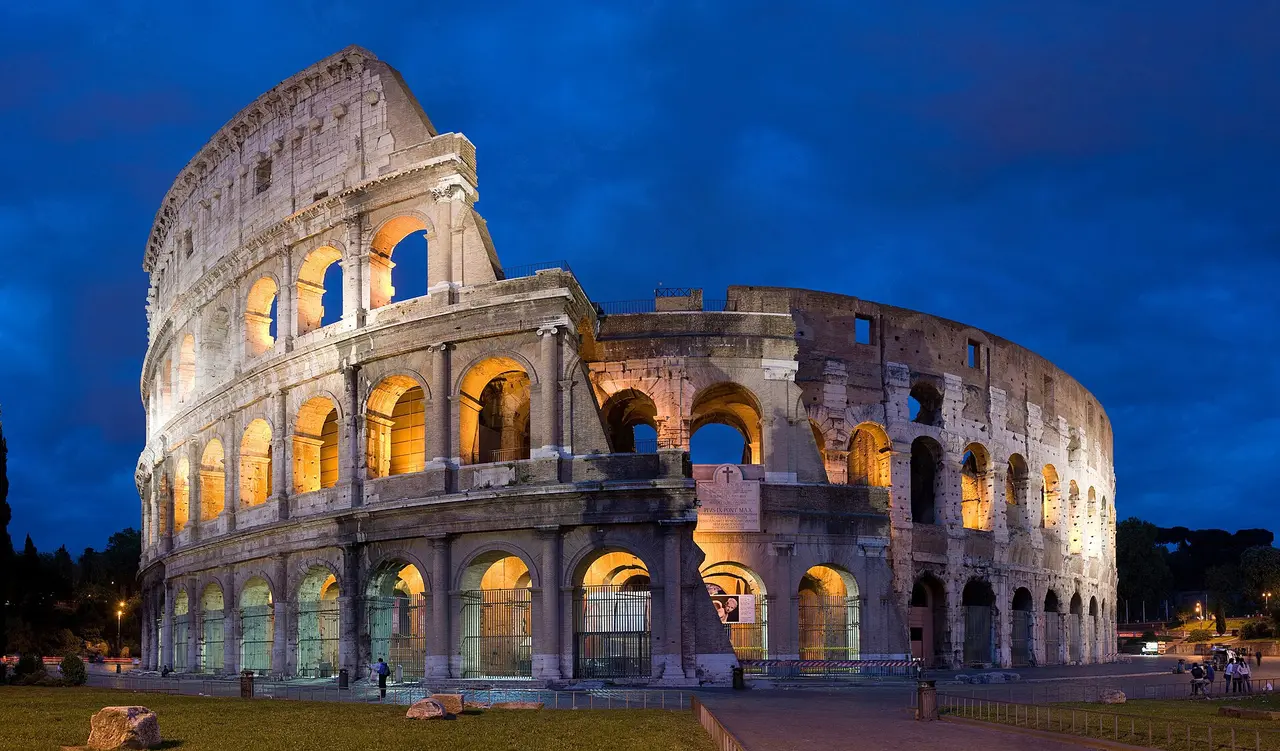
The largest amphitheatre of Roman antiquity, inaugurated in AD 80, visited on a booked time slot, ideally right at opening.

Forum and Palatine

Ruined temples, basilicas and imperial palaces, included in the Colosseum ticket and worth several hours, with very little shade.

Pantheon

An ancient temple crowned by a dome with an oculus nearly nine metres wide, now a church entered with a 5 € ticket.

Sistine Chapel

Michelangelo's ceiling frescoes and Last Judgement, seen at the end of the Vatican Museums route.

St Peter's Basilica

The largest church in Christendom, with Michelangelo's Pietà and a dome you can climb for the view.

Trevi Fountain

A monumental baroque fountain whose basin has charged visitors since February 2026, while the square remains free to enter.

Borghese Gallery

Bernini sculptures and Caravaggio paintings in a 17th-century villa, visited by reservation only in two-hour slots.

Castel Sant'Angelo

Hadrian's mausoleum turned papal fortress, linked to the Vatican by a passage and topped by a terrace over the Tiber.

Baths of Caracalla

Vast ruins of 3rd-century public baths, far less crowded than the Forum, hosting open-air opera in summer.

Piazza Navona

A baroque square built on the outline of an ancient stadium, with Bernini's Fountain of the Four Rivers and a Christmas market in December.

What to discover in Rome?

The ancient heart, from the Capitoline to the Caelian

Between the Capitoline and the Caelian Hill lies the Rome of the emperors: amphitheatre, forums, Palatine and triumphal arches. An 18 € ticket, valid for 24 hours, covers the Colosseum, the Forum and the Palatine; book a time slot on the official site, as same-day entries sell out fast from April to October. Allow a full day and start early: in July and August highs exceed 31 °C and shade is scarce among the ruins. Finish on the Capitoline, whose terrace overlooks the Forum at sunset.

The historic centre and Campo de' Fiori

Inside the bend of the Tiber, the historic centre lines up the Pantheon, Piazza Navona and the Campo de' Fiori market, all within a twenty-minute walk. The Pantheon has charged admission since 2023 (5 €), and access to the Trevi Fountain basin has cost 2 € since February 2026, while the square stays free. Come in the morning for the market, then in the evening when the squares come alive. It is also the priciest area to sleep in: hotels just outside it often cost half as much.

The Tridente and Villa Borghese

To the north, three straight streets fan out from Piazza del Popolo towards the Spanish Steps: this is the Tridente, the shopping district of Via del Corso and Via Condotti. Above it, Villa Borghese is the city's great park, with the Pincio terrace and the Borghese Gallery, which can only be visited by reservation, in two-hour slots. Book several weeks ahead in spring. Half a day covers the park and the gallery, another half day the shopping streets.

The Vatican and the Prati district

On the right bank, the Vatican, the world's smallest state, holds St Peter's Basilica and the Vatican Museums, including the Sistine Chapel. Allow three hours for the museums, closed on Sundays except the last of the month, and an hour for the basilica, where shoulders and knees must be covered. Climb the dome for the view over the square. Next door, Prati is a residential district of wide avenues, handy for lunch away from the crowds, and Castel Sant'Angelo closes the walk along the Tiber.

Trastevere and the Janiculum

Across the Tiber, Trastevere keeps its cobbled lanes, ivy-covered facades and trattorias, around the basilica of Santa Maria in Trastevere and its mosaics. The district is above all an evening place: come from 7 pm, when the terraces fill up. In the morning, climb the Janiculum, fifteen minutes' walk away, for the fullest view over Rome's rooftops and domes. At weekends the area is very busy; on weekdays its streets regain a village feel.

Monti and the Esquiline

Just behind the Forum, Monti is the former working-class quarter of the Subura, now home to designer shops, wine bars and small trattorias around Piazza della Madonna dei Monti. Further east, the Esquiline, near Termini station, is the city's most cosmopolitan district, with Santa Maria Maggiore and the covered market of Piazza Vittorio. It makes a good base for cheaper nights, ten minutes' walk from the Colosseum, with two metro lines at the station.

Testaccio and the Aventine

To the south, Testaccio is the old slaughterhouse district, cradle of Roman offal cooking and cacio e pepe, with a covered market where lunch costs around ten euros. Above it, the Aventine Hill is quiet and residential: its Orange Garden looks over the Tiber, and the keyhole on Piazza dei Cavalieri di Malta frames the dome of St Peter's. Allow half a day, ideally in the late afternoon, then dinner in Testaccio, away from the tourist circuits.

The Appian Way and day trips

To the south-east, the Via Appia Antica runs through a park of umbrella pines, tombs and catacombs, closed to cars on Sundays; a rented bike lets you cover it in a day. The Catacombs of St Callixtus close on Wednesdays. Further out, Tivoli, about an hour away by train, combines Villa d'Este and Hadrian's Villa, both UNESCO-listed. On a high-speed train, Naples and Campania are just over an hour away, which makes it easy to extend the trip south.

Sample itineraries

Three routes built around the time you actually have.
3daysRecommended

Rome in 3 days: Monti, the Vatican and the Appian Way

  1. Day 1: Monti, the Colosseum and the Roman Forum
  2. Day 2: the Vatican, Prati and Castel Sant'Angelo
  3. Day 3: the Appian Way, the catacombs and Testaccio

Best for: Three days to see the essentials while keeping one day outside the centre, on the Appian Way and in its catacombs. It suits travellers who like walking or cycling and prefer lively neighbourhoods to back-to-back monuments; Trastevere is left out.

How much it costs

Per person per day, excluding international travel.
Budget
72 €/ day
1 358 € for 2 people, 7 days, return flights included
Accommodation
35 €
Food
22 €
Local transport
5 €
Sights and activities
10 €
Comfort
142 €/ day
2 338 € for 2 people, 7 days, return flights included
Accommodation
60 €
Food
45 €
Local transport
12 €
Sights and activities
25 €
Premium
335 €/ day
5 040 € for 2 people, 7 days, return flights included
Accommodation
150 €
Food
90 €
Local transport
35 €
Sights and activities
60 €
Prices checked: Relevé octobre 2026. Repas et transports : Numbeo Rome, mise à jour du 3 octobre 2026 (repas bon marché 15 €, dîner de milieu de gamme pour deux 60 €, ticket de bus ou métro 1,50 €, taxi 6 € de prise en charge puis 1,50 €/km). Hébergement : lit en dortoir de 30 à 45 € hors pic (hostelz.com, the-travel-bunny.com 2026), hôtel 3 étoiles central de 80 à 120 € la chambre double (the-travel-bunny.com 2026) ; chambre double partagée à deux pour comfort et premium, lit en dortoir pour backpacker. Taxe de séjour 2026 incluse, par personne et par nuit (Holidu, février 2026) : 3,50 € en auberge, 6 € en 3 étoiles, 7,50 € en 4 étoiles, 10 € en 5 étoiles. Activités : Colisée, Forum et Palatin 18 €, musées du Vatican 20 €, Panthéon 5 €, accès au bassin de la fontaine de Trevi 2 € depuis le 2 février 2026. Vol A/R Paris-Rome : 175 € par personne, moyenne Kayak sur douze mois (fourchette habituelle 129 à 249 €, pics en avril et août). Prix hors haute saison : en avril-mai et en octobre, l'hébergement est nettement plus cher.

Getting there

Airports serving Rome, from main hubs to secondary ones.
  • BDSBrindisi AirportBrindisiMain
  • BGYIl Caravaggio International AirportOrio al SerioMain
  • BLQBologna Guglielmo Marconi AirportBolognaMain
  • BRIBari Karol Wojtyła International AirportBariMain
  • CAGCagliari Elmas AirportCagliariMain
  • CIACiampino–G. B. Pastine International AirportRomeMain

Entry, health and safety

For FR travellers

Entry requirements

No visa for a tourist stay

Aucun visa : pour un séjour de trois mois maximum, les Français entrent en Italie avec une carte nationale d'identité ou un passeport en cours de validité, à l'exclusion de tout autre document. Les mineurs doivent avoir leur propre pièce d'identité, le livret de famille ne suffit pas.

Stay allowed for up to 90 days.

Health

Advised: Mise à jour des vaccinations du calendrier français, en particulier diphtérie, tétanos, poliomyélite, coqueluche et rougeole.

Hausse des cas de rougeole signalée en mars 2026. Transmission possible de la dengue, du chikungunya et du virus du Nil occidental par les moustiques, surtout dans le Nord : protection anti-moustiques conseillée. Fortes chaleurs durables en été. À Rome, vols à la tire fréquents dans le métro, surtout la ligne B, et dans les bus 40 et 64 qui desservent les sites touristiques. Carte européenne d'assurance maladie à demander au moins 15 jours avant le départ. Les cartes d'identité délivrées entre 2004 et 2013 restent reconnues cinq ans après leur expiration, mais le passeport est préférable. Numéro d'urgence unique 112 (italia.it).

Safety

Normal precautions

Emergency

112

Checked in octobre 2026 against the official source. Entry rules change: check the official source before you travel, it alone is authoritative.

Practical information for Rome

From Fiumicino

The direct Leonardo Express train links the airport with Termini station in about thirty minutes.

City tax

From 3.50 € in hostels to 10 € in 5-star hotels, per person per night, capped at the first ten nights (2026 rates).

Colosseum ticket

18 €, valid 24 hours for the Colosseum, the Forum and the Palatine, on a booked time slot.

First Sunday of the month

Free entry to state museums and sites, the Colosseum included, with very heavy crowds.

Public transport

Metro or bus ticket at 1.50 €; the historic centre is mostly explored on foot (Numbeo, October 2026).

Pickpockets

Stay alert on metro line B and on buses 40 and 64, which serve the tourist sights.

Church dress code

Shoulders and knees must be covered at St Peter's and in most basilicas.

Drinking water

The nasoni, cast-iron public fountains, provide free drinking water all over the city.

Power sockets

Types C, F and L, 230 V: a standard French plug fits types C and F.

Region

Lazio, of which Rome is the capital.

Rome in pictures

Photo credits : Diliff, CC BY-SA 2.5, Wikimedia Commons ; Wilfredor, CC0, Wikimedia Commons ; This Photo was taken by Wolfgang Moroder . Feel free to use my photos, but please mention me as the author and, CC BY-SA 3.0, Wikimedia Commons ; Diliff, CC BY-SA 3.0, Wikimedia Commons

Frequently asked questions about Rome

Do you need to book the Colosseum several days ahead?
From April to October, yes: slots for the 18 € ticket often sell out several days in advance, especially in the morning. The ticket covers the Forum and the Palatine for 24 hours. In January and February, booking the day before is usually enough.
Can you visit the Vatican Museums on a Sunday?
The Vatican Museums are closed on Sundays, except the last Sunday of the month, when entry is free in the morning with a very long queue. St Peter's Basilica stays open, but services can restrict access at certain times.
Is the Trevi Fountain now paid?
Since 2 February 2026, going down to the basin costs non-resident visitors 2 € during the hours the system operates. The square itself remains free, and the view from the top of the steps requires no ticket.
How do you get from Fiumicino to central Rome?
The simplest option is the Leonardo Express train, non-stop to Termini station in about thirty minutes. From Termini, two metro lines and many buses reach the neighbourhoods. A taxi is more practical with luggage or in a group.
Are three days in Rome enough?
Three days cover the Colosseum and Forum, the Vatican and the baroque centre, with a free day for the Appian Way or Trastevere. With four days, add the Borghese Gallery and a trip to Tivoli, about an hour away by train.
Is Rome in August a good idea?
Afternoons average 31 °C and many Romans leave around Ferragosto on 15 August, so some trattorias close. The sights stay open: see the ruins before 10 am and keep the museums for the middle of the day.
Which neighbourhood should you stay in on a first trip to Rome?
The historic centre lets you do everything on foot but is the most expensive. Monti offers a good balance ten minutes from the Colosseum, Prati is quiet and close to the Vatican, and Trastevere suits those who go out at night.
What daily budget should you plan for Rome?
Based on our October 2026 survey, allow about 72 € per person per day in a hostel, 142 € in a 3-star hotel and 335 € for upmarket comfort, city tax included. Accommodation prices rise sharply in April, May and October.

Plan your trip to Rome

Build your day-by-day itinerary and manage budget, bookings and packing in PlanTripNow.
Aperçu de l'application PlanTripNow