Skip to content

Visiting San Sebastian: bay, pintxos and beaches

Wrapped around La Concha bay, San Sebastian, or Donostia, packs one of the world's highest concentrations of great food, three city-centre beaches and two hills for the view. Two to three days cover the city, one more for the txakoli coast and Bilbao.

At a glance

Visa
None
7-day budget
€938
Per person, comfort profile, excluding international flights.

Why visit San Sebastian?

San Sebastian is the capital of Gipuzkoa, in the Spanish Basque Country, 20 kilometres from the French border. A former royal beach resort, it is now a culinary reference, with several starred restaurants and hundreds of pintxos bars. Its bay, closed off by Santa Clara island, is one of the most sheltered on the Bay of Biscay.

When to visit San Sebastián

Temperatures, rainfall and crowds month by month, to pick your window.
When to visit San Sebastián
MonthTemperaturesRainCrowdsVerdict
January5 to 12 °C13 dQuietThe coldest, wet month, 12C at best; the Tamborrada on 20 January has the whole city drumming for 24 hours.
February5 to 13 °C11 dQuietQuiet low season: the Parte Vieja pintxos bars for regulars, hotel rates at their lowest of the year.
March7 to 15 °C12 dQuietGreen returns on Mount Igueldo, 15C days between showers, the Concha promenade almost deserted.
April8 to 16 °C13 dModerateThe wettest month alongside October: bring a raincoat, though Easter week already fills the old town.
May11 to 19 °C12 dModerateA mild 19C and gardens in bloom; the water sits at 16C, too cold for most swimmers.
June14 to 22 °C9 dModerateDrier at last, 22C, long evenings: the best window before the summer crowds, though prices are already rising.
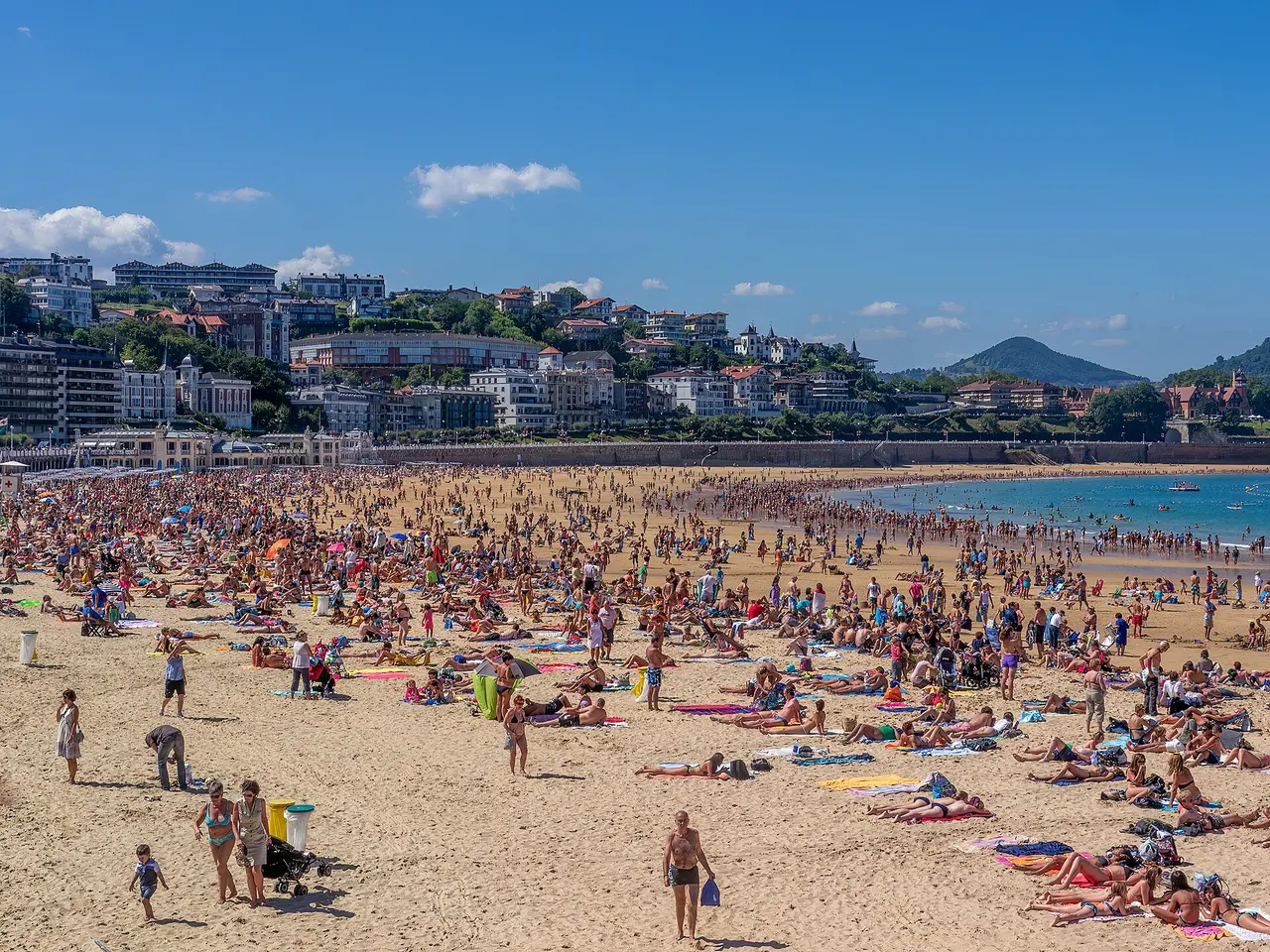
July16 to 24 °C8 dBusyLa Concha beach packed, the Heineken Jazzaldia in late July, hotels at peak rates; it can still rain one day in three.
August16 to 25 °C9 dPackedThe year's peak: Semana Grande around 15 August runs a fireworks contest and dense crowds, book from spring.
September15 to 23 °C10 dPackedThe sea still at 20C and the Film Festival in late September fills the city with stars and press: as pricey as August.
October12 to 19 °C13 dModerateRain and Atlantic storms return to sweep the bay; fine light in between, and the cider txotx season nearing.
November8 to 15 °C13 dQuietGrey and damp at 15C, the city handed back to the Donostiarras; stew season and heated bars.
December6 to 13 °C13 dQuietThe Santo Tomas fair on 21 December, talo and txistorra on every corner, then the Christmas market: atmosphere without the summer crowds.
Source: Climat oceanique du golfe de Gascogne, doux et tres arrose (environ 1 500 mm et 140 jours de pluie par an). Normales recoupees entre Climates to Travel et les moyennes AEMET (stations Igueldo et Hondarribia), releve septembre 2026. Temperature de la mer sur la baie de la Concha.

San Sebastian's must-sees

Eight landmarks that sum up the city and its bay, all reachable on foot or by funicular.

La Concha beach

A crescent of sand in the very centre, one of Europe's most famous urban beaches, patrolled and sheltered by Santa Clara island.

Peine del Viento

Three wrought-iron sculptures by Eduardo Chillida set into the rocks at the western tip of the bay, with sea-blowholes built into the ground.

Monte Igueldo

The western hill with its century-old funicular and retro amusement park, the best viewpoint over La Concha bay.

Monte Urgull

A wooded hill at the end of the old town, the Mota castle, old gun batteries and a hilltop Christ overlooking the harbour.

Parte Vieja

The heart of the pintxos bars and the evening txikiteo, with the Bretxa market and the baroque Santa Maria del Coro church.

Kursaal centre

Two volumes of translucent glass by Rafael Moneo beside the Zurriola, home of the international Film Festival.

San Telmo Museum

The oldest museum in the Basque Country, in a 16th-century convent against Monte Urgull, free on Tuesdays.

Zurriola beach

The surf beach of the Gros district, direct Atlantic swell, schools and board hire all year round.

What to see in San Sebastian, district by district?

The Parte Vieja and the centre

The old town, wedged between the harbour and the Urumea at the foot of Monte Urgull, fits into a few pedestrian streets that hold the best-known pintxos bars, the Bretxa market and the Constitucion and Trinidad squares. People come mostly in the evening for the txikiteo: one pintxo and a glass of txakoli per bar, standing, moving from counter to counter from around 8pm. To the south, the 19th-century Ensanche lines up its bourgeois blocks, the Buen Pastor cathedral and the shops of calle San Martin. Allow half a day for the Parte Vieja, plus a full evening for pintxos.

La Concha bay and the hills

The Concha promenade, with its white art nouveau balustrade that has become the city's emblem, links the main beach to Ondarreta over two kilometres. At the western tip, Eduardo Chillida's Peine del Viento, three iron sculptures anchored in the rock, is at its most dramatic in rough weather. Monte Igueldo, reached by a 1912 funicular, offers the postcard view over the bay and a small retro amusement park. Opposite, Monte Urgull is a 30-minute climb to the Mota castle and its Sacred Heart statue.

Gros, the Zurriola and the Basque coast

Across the Urumea, the Gros district has a younger feel, a creative pintxos scene and Zurriola beach, open to the ocean and popular with surfers. The Kursaal conference centre, two glass cubes by Rafael Moneo, hosts the Film Festival in September. From Donostia, the Basque coast runs west to Getaria, a hillside harbour ringed by txakoli vines, and Zarautz with its long beach. Eastward, Pasaia and its listed bay, and Hondarribia, are reachable by bus or boat.

How much it costs

Per person per day, excluding international travel.
Budget
62 €/ day
1 048 € for 2 people, 7 days, return flights included
Accommodation
32 €
Food
22 €
Local transport
3 €
Sights and activities
5 €
Comfort
134 €/ day
2 116 € for 2 people, 7 days, return flights included
Accommodation
65 €
Food
45 €
Local transport
6 €
Sights and activities
18 €
Premium
315 €/ day
4 770 € for 2 people, 7 days, return flights included
Accommodation
160 €
Food
90 €
Local transport
20 €
Sights and activities
45 €
Prices checked: Relevé septembre 2026. Coûts sur place recoupés entre BudgetYourTrip, Viajes del Norte et Machu Picchu (guides budget San Sebastian 2026). Accès depuis Paris : vol Paris-Biarritz sur compagnie a bas coût puis 45 min de transfert, ou vol Paris-Bilbao (100 km), ou TGV Paris-Hendaye puis Euskotren. Coût aller-retour hors vacances scolaires estimé à 90 EUR/pers (backpacker), 120 (confort), 180 (premium). Chambre double partagée a deux pour confort et premium, lit en dortoir pour backpacker. Prix HORS juillet-août, Semana Grande et Festival du film de septembre, ou l'hébergement double ou triple.

Getting there

Airports serving San Sebastián, from main hubs to secondary ones.
  • ACECésar Manrique-Lanzarote AirportSan BartoloméMain
  • AGPMálaga-Costa del Sol AirportMálagaMain
  • ALCAlicante-Elche Miguel Hernández AirportAlicanteMain
  • BCNJosep Tarradellas Barcelona-El Prat AirportBarcelonaMain
  • BIOBilbao AirportBilbaoMain
  • FUEFuerteventura AirportEl MatorralMain

Entry, health and safety

For FR travellers

Entry requirements

No visa for a tourist stay

L'Espagne est membre de l'Union européenne et de l'espace Schengen : les ressortissants français entrent librement avec une carte nationale d'identité ou un passeport en cours de validité, sans limite de durée pour un séjour touristique. Un passeport valide est recommande plutôt qu'une CNI à la date de fin de validité dépassée.

Health

Advised: Aucun vaccin spécifique. Mise a jour du calendrier vaccinal français recommandée.

Aucun risque sanitaire particulier. Carte européenne d'assurance maladie à emporter pour la prise en charge des soins. Baignade sur les plages surveillées de la Concha, de la Zurriola et d'Ondarreta ; la Zurriola est exposée à la houle atlantique et aux courants.

Safety

Normal precautions

Emergency

112

Checked in septembre 2026 against the official source. Entry rules change: check the official source before you travel, it alone is authoritative.

Practical information for San Sebastian

Languages

Spanish and Basque (euskara), both on signage; French is often understood in hotels and restaurants.

Pintxos

You pay at the end, keeping your toothpicks or plate for the count; the best pintxos are ordered from the menu and cooked to order, not the ones sitting on the bar.

Meal times

Lunch around 2pm, dinner rarely before 9pm; the txikiteo starts around 8pm and many kitchens close by 11pm.

Booking

Essential for starred tables, sometimes months ahead; for pintxos bars, arriving early or late avoids the crush.

Weather

It rains roughly one day in two year-round; pack a waterproof jacket even in summer, when morning sea mist is common.

Swimming

La Concha and Ondarreta are calm, Zurriola is exposed to currents and often closed to swimming under a red flag.

Getting around

The city is fully walkable; Dbus buses at 1.95 euro, the Igueldo funicular separate. The Euskotren train serves Hendaye, Bilbao and the coast.

From France

Biarritz airport is 45 minutes away, San Sebastian airport at Hondarribia handles a few flights, or the TGV to Hendaye then the Topo train.

Weeks to avoid

Semana Grande in mid-August and the Film Festival in late September: a full city, doubled hotel rates, book from spring.

Payment

Cards accepted everywhere, contactless standard; a few old pintxos bars are cash only, keep some coins.

San Sebastián in pictures

Photo credits : Ermell, CC BY-SA 4.0, Wikimedia Commons ; Rodelar, CC BY-SA 4.0, Wikimedia Commons ; Alberto-g-rovi, CC BY 3.0, Wikimedia Commons

Frequently asked questions about San Sebastian

How many days do you need for San Sebastian?
Two full days cover the Parte Vieja, La Concha bay, the two hills and two pintxos evenings. A third day allows a cider house in Astigarraga or the txakoli coast; a fourth, a trip to Bilbao or the Rioja Alavesa.
Where do you do a real pintxos crawl in Donostia?
In the Parte Vieja around calle 31 de Agosto for the classics, and in the Gros district for a more creative, less touristy version. Order the hot pintxos cooked to order from the menu rather than the ones displayed on the counter.
Can you swim in San Sebastian?
Yes from June to September, but the water rarely tops 20 degrees, even in August. La Concha and Ondarreta are sheltered and family-friendly; Zurriola, open to the ocean, suits surfing and is often closed to swimming due to currents.
When is the San Sebastian Film Festival?
Every year around the third week of September, at the Kursaal and in several cinemas across the city. The weather is superb then, but lodging books up very early and prices match peak summer.
Do you need a car for a stay in San Sebastian?
No for the city, fully pedestrian, where parking is hard and expensive. A car is only useful for the coast and hinterland, and even then Getaria, Zarautz, Hondarribia and Bilbao are all reachable by bus or Euskotren train.
What is a sidreria and when should you go?
A Basque cider house serves a set menu, salt-cod omelette, rib steak and Idiazabal cheese, with cider drawn straight from the barrel at the call of txotx. Peak season runs January to April; those in Astigarraga, 15 minutes away, open all year.
San Sebastian or Bilbao for a first Basque trip?
San Sebastian for the bay, the beaches and the food, in a compact seaside format. Bilbao for the Guggenheim, contemporary architecture and a real city. The two are 1h15 apart by bus and combine easily over a long weekend.
Can you visit the txakoli coast from Donostia?
Yes, Getaria is 30 minutes by PESA bus: you visit the Balenciaga museum, have a whole grilled fish at an asador, and taste txakoli straight from the winery. Zarautz and its two-kilometre beach are the next stop on the same line.

Plan your trip to San Sebastián

Build your day-by-day itinerary and manage budget, bookings and packing in PlanTripNow.
Aperçu de l'application PlanTripNow