Skip to content

Visit Santiago de Chile: what to see, when to go and which day trips

Santiago surprises with its setting: the snowy Andes tower over a busy city of colonial squares, bohemian districts and glass towers. You ride funiculars up its hills, eat seafood at the central market and head off in an hour to the vineyards or the ocean.

At a glance

Visa
None
Tourist stay of up to 89 days
7-day budget
€707
Per person, comfort profile, excluding international flights.

Why visit Santiago de Chile?

Santiago, the capital of Chile, is the country's gateway, at the foot of the Andes. It brings together a colonial centre founded in 1541, major museums such as the Pre-Columbian Art Museum, panoramic hills and quick access to vineyards and Valparaíso. Allow two to four days, ideally from October to April, before heading to Patagonia or the Atacama.

When to visit Santiago

Temperatures, rainfall and crowds month by month, to pick your window.
When to visit Santiago
MonthTemperaturesRainCrowdsVerdict
January13 to 31 °C0 dModerateDry midsummer at 31 °C: the city empties to the coast, ideal for vineyards in the morning.
February12 to 30 °C0 dModerateChilean holidays: Santiago is quiet, the coastal resorts and Valparaíso packed.
March11 to 29 °C1 dModerateGrape harvest in the Maipo and Casablanca valleys, wine festivals and mild evenings.
April8 to 25 °C1 dQuietGolden autumn and still-dry skies: the best light on the Andes from Cerro San Cristóbal.
May5 to 20 °C4 dQuietThe first rains and winter smog settling in, but calm museums and prices.
June3 to 17 °C5 dModerateSki resorts open an hour and a half from the city, with nights close to 3 °C.
July3 to 16 °C5 dBusyPeak ski season at Valle Nevado; snowy Andes on clear days after rain.
August4 to 18 °C4 dModerateStill cool and sometimes polluted, but snowy slopes and quiet vineyards.
September6 to 21 °C3 dBusyFiestas Patrias on the 18th and 19th: popular celebrations, empanadas and slowed services.
October8 to 24 °C1 dModerateDry spring and still-white Andes: ideal for the Cajón del Maipo and the city.
November10 to 27 °C0 dModerateThe best month: 27 °C, clearer air and lively Lastarria terraces.
December12 to 30 °C0 dBusyEarly summer and year-end holidays: flights from Europe are pricey, book early.
Source: Normales 1991-2020 via climatestotravel.com, recoupées avec les relevés de la station Quinta Normal (Weatheronthisday : maximale de janvier vers 30 °C ; Meteored : juillet autour de 9 °C de moyenne et 15 °C de maximale), relevé novembre 2026. Hémisphère sud : l'été va de décembre à février. Ville de vallée andine, sans température de mer.

Santiago de Chile's must-sees

Heritage, panoramas and culture, the visits that count.

Plaza de Armas

The city's founding square, lined by the cathedral, the central post office and the National History Museum.

Pre-Columbian Art Museum

An exceptional collection of ceramics, textiles and sculpture from the peoples of the Americas before the conquest.

La Moneda Palace

The neoclassical presidential palace, scene of the 1973 coup, with a regular changing of the guard.

Cerro San Cristóbal

A hill reached by funicular and cable car, with the statue of the Virgin and views of the Andes.

Cerro Santa Lucía

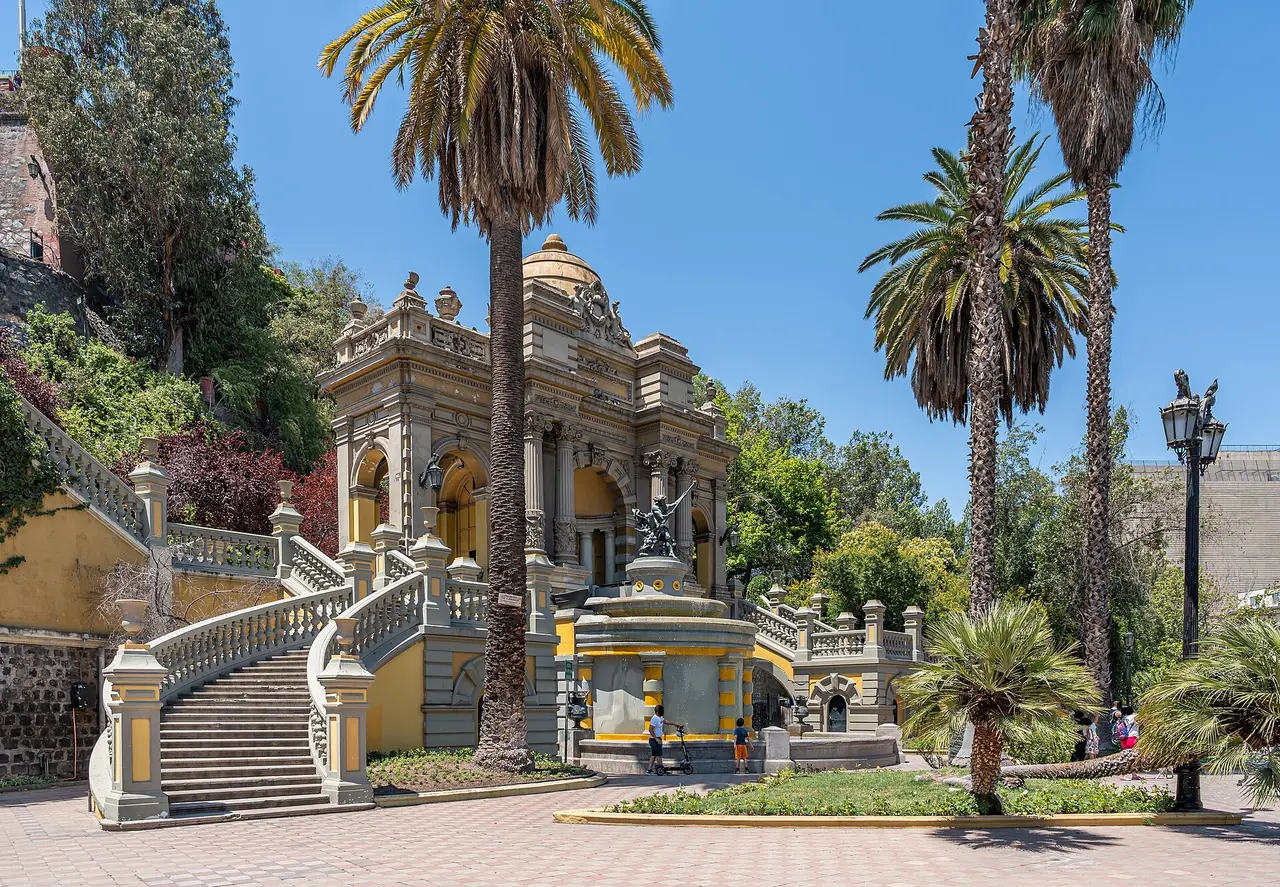
A hill laid out with terraces and stairs, cradle of Santiago's founding, with a lookout over the centre.

La Chascona

Poet Pablo Neruda's house in Bellavista, turned into a museum full of collectibles.

Museum of Memory

A free museum devoted to the victims of the military dictatorship from 1973 to 1990.

Mercado Central

A 19th-century iron-framed market hall for seafood lunches and conger eel soup.

Sky Costanera

An observatory atop South America's tallest tower, with 360-degree views over the city.

What to discover in Santiago de Chile?

The historic centre and La Moneda

Founded in 1541, the city is organised around the Plaza de Armas, lined by the cathedral and the central post office. A few streets away, the Chilean Museum of Pre-Columbian Art holds one of Latin America's finest collections. La Moneda presidential palace, bombed in 1973, hosts a changing of the guard every other day in late morning. The Mercado Central, under its iron frame, serves seafood and conger eel soup at lunch.

Santa Lucía and Lastarria

Cerro Santa Lucía, the small hill where Pedro de Valdivia founded the city, is climbed in twenty minutes by stairs and terraces to a lookout over the centre. At its foot, the Lastarria district lines up cafés, bookshops, galleries and the Gabriela Mistral cultural centre, devoted to the performing arts. It is one of the most pleasant areas to dine or stay, close to the metro and the historic centre. In the evening, its terraces stay lively until late.

Bellavista and Cerro San Cristóbal

Across the Mapocho, the bohemian Bellavista district lives on painted facades, bars and La Chascona, Pablo Neruda's house turned museum. Above it, Cerro San Cristóbal is climbed by funicular to the statue of the Virgin, where the view over the city and the Andes is spectacular on clear days, especially after winter rain. A cable car then links the summit to the Providencia district. Go up in the morning if possible, before the heat haze or smog.

Memory and modern architecture

The free Museum of Memory and Human Rights traces the military dictatorship of 1973 to 1990 through archives, testimonies and objects; allow two hours, the visit is moving. To the east, the Providencia and Las Condes districts gather office towers and malls, including the Gran Torre Costanera, South America's tallest tower, with the Sky Costanera observatory about 300 m up, ideal at sunset.

The Maipo and Casablanca wine valleys

Santiago is surrounded by renowned vineyards. To the south, the Maipo valley, known for its Cabernet Sauvignon, has large estates open to visitors under an hour's drive away, some reachable by metro and taxi. To the west, on the road to Valparaíso, the Casablanca valley produces crisp white wines thanks to the ocean's influence. Tours with tastings are booked ahead, especially during the March and April harvest. Several estates also offer lunch among the vines.

Valparaíso, the Andes and the mountains

The UNESCO-listed port of Valparaíso is about an hour and three quarters away by bus: its hills covered in colourful houses and murals are explored by funicular lifts. To the east, the Cajón del Maipo offers canyons, hikes and the turquoise El Yeso lake. From June to September, the Valle Nevado and Farellones ski resorts are about an hour and a half's drive from the city. For Valparaíso, leave early and come back before dark.

How much it costs

Per person per day, excluding international travel.
Budget
48 €/ day
2 772 € for 2 people, 7 days, return flights included
Accommodation
21 €
Food
18 €
Local transport
3 €
Sights and activities
6 €
Comfort
101 €/ day
3 514 € for 2 people, 7 days, return flights included
Accommodation
33 €
Food
40 €
Local transport
8 €
Sights and activities
20 €
Premium
258 €/ day
5 712 € for 2 people, 7 days, return flights included
Accommodation
98 €
Food
80 €
Local transport
25 €
Sights and activities
55 €
Prices checked: Relevé novembre 2026 : Numbeo (mis à jour le 13/11/2026) pour repas, cafés, bière, métro et taxis ; Momondo, HotelsCombined et Wandertooth d'après Booking.com pour l'hébergement (auberge ou hôtel 2 étoiles env. 46 dollars la nuit, 3 étoiles env. 68 dollars, 5 étoiles env. 210 dollars). Faute de prix fiable de lit en dortoir, le profil backpacker est calé sur une chambre d'auberge ou de 2 étoiles partagée à deux ; chambre double partagée à deux pour comfort et premium. Vol A/R Paris-Santiago avec escale env. 1 050 € par personne (moyenne Liligo 1 025 € sur 3 mois, Kayak 976 à 1 380 €), hors juillet-août et fêtes de fin d'année. Peso chilien converti en euros.

Getting there

Airports serving Santiago, from main hubs to secondary ones.
  • ANFAndrés Sabella Gálvez International AirportAntofagastaMain
  • CCPCarriel Sur International AirportConcepcionMain
  • IPCMataveri International AirportIsla De PascuaMain
  • IQQDiego Aracena International AirportIquiqueMain
  • PMCEl Tepual International AirportPuerto MonttMain
  • PUQPresident Carlos Ibáñez International AirportPunta ArenasMain

Entry, health and safety

For FR travellers

Entry requirements

No visa for a tourist stay

Pas de visa pour un séjour de moins de trois mois. À l'arrivée, la police chilienne (PDI) remet une Tarjeta Única Migratoria, à conserver pendant tout le séjour : elle est exigée à la sortie du pays. Par voie terrestre, passer par un poste frontière pour obtenir le tampon d'entrée.

Stay allowed for up to 89 days.

Health

Passeport valable pendant toute la durée du séjour. Hausse de la petite délinquance : vigilance renforcée et discrétion recommandées à Santiago, notamment dans les quartiers de Suecia, Bellavista et Providencia ; ne pas résister en cas d'agression. Vols de voitures de location en hausse. Séismes fréquents et risque de tsunami sur la côte (informations SENAPRED). Araucanie, Bío-Bío et Los Lagos en vigilance renforcée.

Safety

Normal precautions

Checked in novembre 2026 against the official source. Entry rules change: check the official source before you travel, it alone is authoritative.

Practical information for Santiago de Chile

Entry

French citizens need no visa for up to three months; keep the Tarjeta Única Migratoria issued on arrival, required on departure. Check the rules for your nationality.

Safety

Petty crime is rising: be discreet in Bellavista, Providencia and Suecia, keep your phone away in the street and do not resist if mugged.

Bip! card

A rechargeable card required for the metro and buses, sold in stations; the metro is one of Latin America's largest.

Winter smog

From May to August, pollution can be heavy in the basin: choose days after rain for the views.

Earthquakes

Chile has regular earthquakes: note your hotel's safety instructions and follow SENAPRED updates.

From the airport

Regular buses and official taxis to the centre in 30 to 45 minutes depending on traffic; avoid unofficial drivers.

Tipping

A 10% tip is usually suggested on the restaurant bill.

Mealtimes

Lunch is late, around 1.30 or 2pm, and dinner rarely before 8.30pm.

Power plugs

220 V, type C and L sockets: European two-pin plugs usually fit.

Fiestas Patrias

On 18 and 19 September, the national holidays slow services and shops, with a festive atmosphere in the fondas.

Santiago in pictures

Photo credits : Rjcastillo, CC BY-SA 4.0, Wikimedia Commons ; Rjcastillo, CC BY 4.0, Wikimedia Commons

Frequently asked questions about Santiago de Chile

How many days do you need in Santiago?
Two days are enough for the historic centre, the two hills and Bellavista. Three to four days let you add Valparaíso, the Maipo valley vineyards or the Cajón del Maipo. Most travellers then continue to Patagonia or the Atacama desert.
Can you visit Valparaíso from Santiago in a day?
Yes, buses leave the bus station very often and take about an hour and three quarters. A day is enough for Cerro Alegre and Cerro Concepción, the lifts and La Sebastiana, Neruda's house. Stay careful with your belongings in the port streets.
Is Santiago dangerous?
The city is not in an advised-against area, but France reports rising petty crime and recommends discretion in Bellavista, Providencia and Suecia. Keep your phone away in the street, avoid deserted streets at night and use official taxis or ride-hailing. Check your own government's advice.
Which vineyards should you visit near Santiago?
The Maipo valley, to the south, for its Cabernet Sauvignon and large estates under an hour's drive away; the Casablanca valley, on the road to Valparaíso, for its white wines. Book tours and tastings ahead, especially in March and April.
Can you ski near Santiago?
Yes, from June to September, the Valle Nevado, La Parva and Farellones resorts are about an hour and a half's drive away. Shuttles leave the city in the morning. The mountain road is winding and may require chains after snowfall.
Can Santiago be combined with Mendoza or Buenos Aires?
Yes. Mendoza and its Argentine vineyards are about six to eight hours by bus over the Andes pass, depending on border checks and snow. Buenos Aires is about two hours by plane, making it easy to combine both capitals.
What is the best season for Santiago?
From October to April, with dry skies and afternoon temperatures of 24 to 31 °C. Spring and autumn offer the best balance. Winter, from June to August, is cool and sometimes polluted, but ideal for skiing.

Plan your trip to Santiago

Build your day-by-day itinerary and manage budget, bookings and packing in PlanTripNow.
Aperçu de l'application PlanTripNow