Skip to content

Ubud , the Bali of rice terraces, temples and dance

In Ubud, the day starts early: a walk along the Campuhan ridge, offerings at the market, macaques beneath the banyans of the sacred forest. To the north, the Tegallalang terraces and the holy water of Tirta Empul; in the evening, legong dance in the palace courtyard. Here, you slow down.

At a glance

Visa
Required
Tourist stay of up to 30 days
7-day budget
€462
Per person, comfort profile, excluding international flights.
Recommended length
3 days
For a first trip, without rushing.

Ubud or southern Bali: where should you stay?

Ubud is a small town in inland Bali, in Indonesia: the district had 74,800 inhabitants at the 2020 census. People stay here for culture, rice fields and calm, not for the beach. Three days cover the essentials; add one more for sunrise on Mount Batur.

When to visit Ubud

Temperatures, rainfall and crowds month by month, to pick your window.
When to visit Ubud
MonthTemperaturesRainCrowdsVerdict
January24 to 29 °C19 dModerateThe heart of the rainy season, with a shower almost every other day: the rice fields are a deep green but the ridge paths are slippery, and the flight from Paris is at its cheapest, 781 euros median.
February24 to 30 °C16 dQuietStill humid, but Ubud empties out: a good month for a yoga retreat or a cooking class, keeping mornings for temples before the afternoon storms.
March23 to 30 °C13 dQuietThe rain eases and the waterfalls are in full flow; it is often the month of Nyepi, the day of silence when the whole island stays indoors, preceded the evening before by ogoh-ogoh parades in the villages.
April23 to 30 °C9 dModerateStart of the dry season, rice fields still green and paths walkable: a very good balance for the Campuhan ridge walk and Tirta Empul without the summer crowds.
May23 to 30 °C6 dModerateOne of the best months: skies often clear at sunrise on Mount Batur, cooler nights in Ubud and prices still reasonable.
June23 to 29 °C4 dBusyThe dry season is well established, under 30 °C in the afternoon and around 23 °C at night; visitor numbers rise from the end of the month, so book yoga retreats ahead.
July22 to 29 °C4 dPackedThe coolest month, ideal for hiking, but flights at their peak, 1,243 euros median, and traffic jams on the Tegallalang road: leave before 8 am.
August22 to 29 °C2 dPackedThe driest month, barely 15 mm: the best chance of a clear sunrise on Batur, but peak crowds at the Monkey Forest and on the rice terraces.
September22 to 30 °C3 dModerateStill dry and the summer crowds have gone: the best month to combine Jatiluwih, waterfalls and sunrise on Batur without booking weeks ahead.
October23 to 31 °C6 dModerateEnd of the dry season, the heat climbs to 31 °C; the Ubud Writers & Readers Festival is usually held in the autumn, and the French autumn school holidays push prices up slightly.
November23 to 31 °C12 dQuietThe rain returns, mostly as afternoon showers; the replanted rice fields turn green again and Ubud's guesthouses are quiet.
December24 to 30 °C17 dBusyFrequent rain but heavy year-end holiday crowds: villas and flights climb again from mid-December, and the Batur climb is often in the clouds.
Source: Températures (moyennes des maxima et des minima, moyenne mensuelle calculée comme leur demi-somme) et jours de pluie (au moins 1 mm environ) : WeatherSpark, page « Climat et météo moyenne tout au long de l'année à Ubud » (consultée le 11 octobre 2026), série 1980-2016 issue de la réanalyse NASA MERRA-2 et des stations des aéroports de Bali et de Lombok corrigées de l'altitude d'Ubud (environ 210 m) ; valeurs converties depuis les degrés Fahrenheit et arrondies. Ubud est à l'intérieur des terres : pas de température de la mer. Prix : vols A/R Paris-Denpasar sur Kayak, relevé du 11 octobre 2026 (janvier le mois le moins cher à 781 € en médiane, juillet 1 243 € et août 1 178 €, moyenne annuelle 901 €) ; les autres mois sont estimés à partir de cette moyenne et des vacances scolaires françaises. Affluence : estimation éditoriale (pic de juillet-août et des fêtes de fin d'année, Ubud étant l'étape la plus fréquentée de l'intérieur de Bali).

Six experiences unique to Ubud

What people come here for, and what Bali's beach resorts in the south cannot offer.

Legong at the palace

Dancers in gold costumes, to the sound of the gamelan, in the courtyard of the royal palace where Ubud's princes once received their guests.

Ritual bath at Tirta Empul

Stepping under the fountains of a holy spring in a sarong, among Balinese families who have come to purify themselves.

Daybreak on Batur

The sun rising behind Mount Agung, seen from the summit of an active volcano after a night climb.

Balinese cooking class

The market in the morning, then base genep spice paste pounded in a mortar and dishes served on banana leaves.

Craft workshop

Silver jewellery in Celuk, wooden masks and statues in Mas, painting in Batuan: every village has its speciality.

Campuhan ridge at dawn

A free walk between two valleys, before the heat, ending in the rice fields of Bangkiang Sidem.

Ubud, between rice fields, temples and workshops: where to start?

The centre, around the royal palace

Everything starts at the crossroads where Puri Saren palace and the market face each other. In the morning, the market sells fruit, flowers and offering baskets; from 9 am, stalls of sarongs, basketry and carvings take over, and you bargain without pushing too hard. The palace courtyard can be visited freely during the day. Just behind a café on the main street, Taman Saraswati temple, dedicated to the goddess of the arts, opens onto a large lotus pond.

The Sacred Monkey Forest

South of the centre, the Padangtegal Sacred Monkey Forest shelters several temples beneath great banyan trees and hundreds of long-tailed macaques. Entry is 130,000 IDR per adult, 9 am to 6 pm, last entry at 5 pm. The monkeys snatch glasses, hats and bags holding food: put everything away, do not feed them, do not stare at them. Rabies is present in Bali, so any bite means seeing a doctor the same day.

Dance and painting, the legacy of the 1930s

Ubud owes its artistic reputation to the palace princes, who welcomed Western painters such as the German Walter Spies, who settled here in 1927. With the Dutchman Rudolf Bonnet, he founded the Pita Maha association in 1936, which transformed Balinese painting. The Puri Lukisan and ARMA museums trace that story. In the evening, several troupes perform legong, barong or kecak in the palace courtyard and in temples around the centre, with tickets sold in the street.

Rice terraces: Tegallalang up close, Jatiluwih on a grand scale

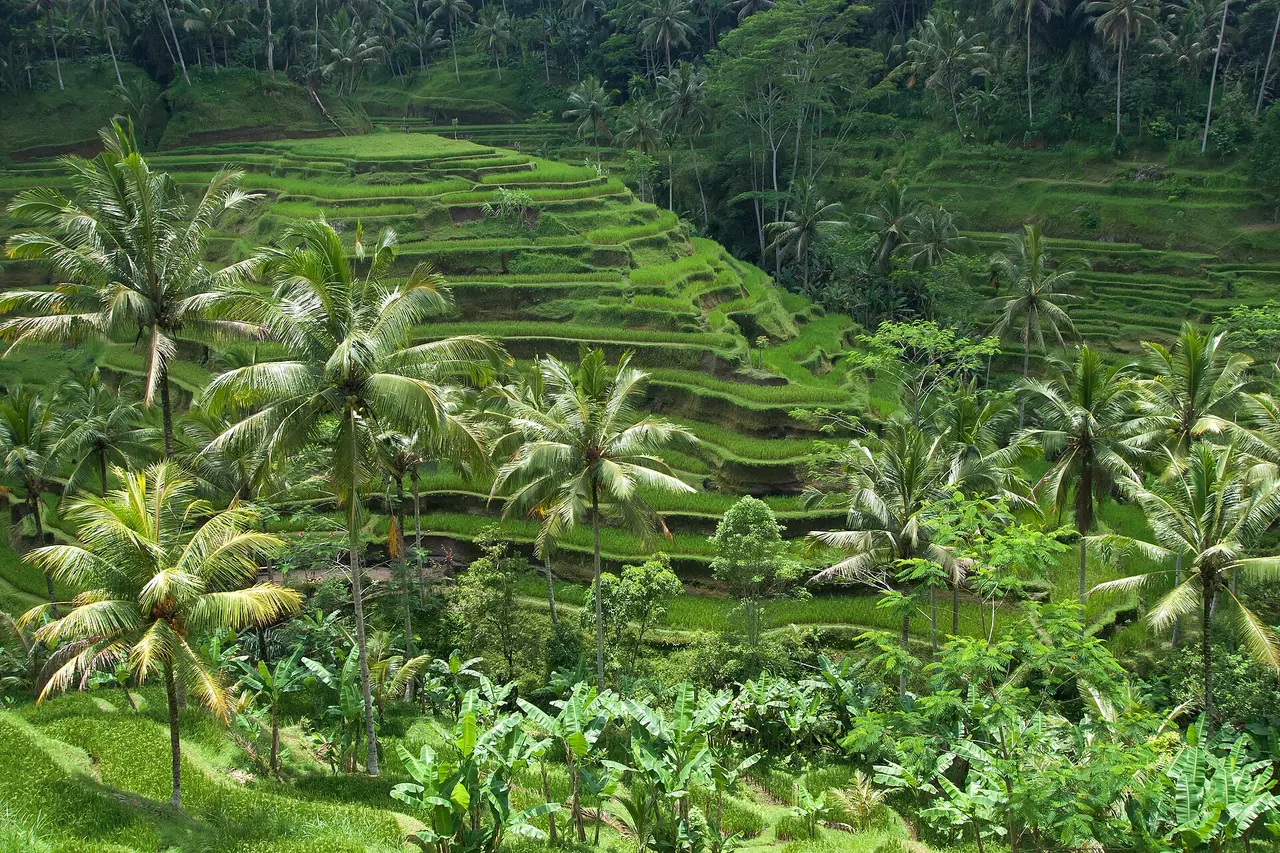
North of Ubud, the Tegallalang terraces tumble down a valley of coconut palms; come before 8 am, ahead of the coaches and selfie swings, and carry a few notes for the donations requested by plot owners. Further west, Jatiluwih offers a far wider and quieter landscape, listed as a UNESCO World Heritage site in 2012 together with the subak irrigation system. Allow a full day with a driver to get there.

The water temples of the north

At Tampaksiring, Tirta Empul temple is built around a holy spring: worshippers pass under each spout of the pool for melukat, a purification rite that visitors may join wearing a sarong, following the order of the fountains. Nearby, Gunung Kawi lines up 11th-century shrines carved into the cliff, at the bottom of a rice-growing valley. Further south, Goa Gajah cave and its ancient bathing pools round off the day.

Mount Batur before dawn

This is the trip that gets Ubud up at 2 am: a drive north, then about two hours of climbing by headlamp to the summit of Batur, 1,717 m, to watch the day break over the lake and Mount Agung. The volcano is active; the French foreign ministry requires treks to be done with an accredited guide and advises checking volcanic activity before setting off. Bring a windproof jacket and closed shoes, the summit is cold.

Slowing down: yoga, Campuhan ridge and waterfalls

Ubud is also Bali's yoga capital, with drop-in classes at many studios and retreats lasting several days. The Campuhan ridge walk is free and best done at sunrise. As for waterfalls, Tibumana is the easiest to reach, Tukad Cepung drops into a cave and Tegenungan is the most powerful. The steps down are slippery, and never swim after heavy rain, when the water can rise suddenly.

Sample itineraries

Three routes built around the time you actually have.
3daysRecommended

Ubud in 3 days: Monkey Forest, Tegallalang and water temples

  1. Monkey Forest and central Ubud
  2. Tegallalang, Tirta Empul and Gunung Kawi
  3. Campuhan and craft villages

Best for: The classic format for a first stay: one day in the centre, one day heading north with a driver for the rice terraces and sacred temples, a final day of walking and crafts. It leaves out Mount Batur, which means a very short night.

How much it costs

Per person per day, excluding international travel.
Budget
23 €/ day
2 022 € for 2 people, 7 days, return flights included
Accommodation
6 €
Food
8 €
Local transport
3 €
Sights and activities
6 €
Comfort
66 €/ day
2 624 € for 2 people, 7 days, return flights included
Accommodation
25 €
Food
18 €
Local transport
9 €
Sights and activities
14 €
Premium
197 €/ day
4 458 € for 2 people, 7 days, return flights included
Accommodation
94 €
Food
45 €
Local transport
20 €
Sights and activities
38 €
Prices checked: Relevé du 11 octobre 2026. Roupie convertie au taux de référence BCE du 9 octobre 2026 (1 € = 20 036,94 IDR). Repas : Numbeo Ubud, mise à jour du 2 octobre 2026, 21 contributeurs sur 18 mois, échantillon modeste mais valeurs propres à Ubud, distinctes de Denpasar (repas bon marché 50 000 IDR soit 2,50 €, dîner pour deux en restaurant de gamme moyenne 350 000 IDR soit 17,47 €, bière pression 40 000 IDR, cappuccino 35 833 IDR). Hébergement : lit en dortoir autour de 6 € (médiane des prix plancher de 24 auberges d'Ubud sur Hostelworld, consulté le 11 octobre 2026, prix non datés) ; hôtel 3 étoiles 42 €, hôtel avec piscine 60 €, 4 étoiles 91 € et 5 étoiles 284 € la nuit en moyenne selon combien-coute.net (Ubud, d'après hotels.com, relevé d'octobre 2026, site non officiel). Activités : forêt des singes 130 000 IDR par adulte (site officiel monkeyforestubud.com, consulté le 11 octobre 2026) ; les autres entrées (Tirta Empul, Tegallalang, Jatiluwih) et l'ascension guidée du Batur ne sont pas chiffrées faute de tarif officiel 2026, le poste activités des profils confort et premium est donc une estimation éditoriale. Voiture avec chauffeur 10 heures : 550 000 à 800 000 IDR selon le véhicule (grille 2026 de Bali Touristic, opérateur privé) ; profil routard à pied et en courtes courses (prise en charge taxi 8 153 IDR puis 6 000 IDR le km selon Numbeo), profil confort avec un chauffeur trois jours par semaine, profil premium avec un chauffeur chaque jour. Vol A/R Paris-Denpasar avec une escale hors vacances scolaires estimé à 850 € par personne (Kayak, relevé du 11 octobre 2026 : fourchette habituelle 786 à 1 131 €, moyenne 901 €, janvier 781 € en médiane, juillet 1 243 €). Taxe touristique de Bali de 150 000 IDR (7,5 €) par personne non comprise. Hébergement par nuit et par personne : dortoir pour le profil routard, chambre double partagée à deux pour les autres ; chauffeur partagé à deux. Le poste repas du profil premium est une estimation éditoriale. weekTwoPax = 7 jours x 2 personnes + 2 vols.

Getting there

Airports serving Ubud, from main hubs to secondary ones.
  • AAPAji Pangeran Tumenggung Pranoto International AirportSamarindaSecondary
  • AEGAek Godang AirportPadang SidempuanSecondary
  • BDOHusein Sastranegara International AirportBandungSecondary
  • BEJKalimarau AirportTanjung Redeb - Borneo IslandSecondary
  • BIKFrans Kaisiepo AirportBiakSecondary
  • BKSFatmawati Soekarno AirportBengkuluSecondary

Entry, health and safety

For FR travellers

Entry requirements

Visa required

Visa obligatoire pour un séjour touristique : visa à l'arrivée (VOA) délivré à l'aéroport Ngurah Rai de Denpasar, le plus proche d'Ubud, ou e-VOA demandé avant le départ sur le portail de l'immigration indonésienne (evisa.imigrasi.go.id). Valable 30 jours, entrée unique, prolongeable une fois de 30 jours sur place. Tarif de 500 000 IDR (environ 25 €) en octobre 2026 ; une hausse à 750 000 IDR pour l'e-VOA et 1 000 000 IDR au guichet a été annoncée en août 2026, sans date d'application. Billet retour ou de continuation exigé. Passeport en très bon état, valable plus de six mois à l'entrée. Taxe touristique de Bali de 150 000 IDR par entrée, payable en ligne (Love Bali) ou à l'arrivée. Formulaire électronique All Indonesia (douane et santé) à remplir dans les 72 heures avant l'arrivée.

Stay allowed for up to 30 days.

Passport valid for 6 months beyond your return date.

Health

Required: Fièvre jaune uniquement pour les voyageurs en provenance d'une zone d'endémie.

Advised: Vaccinations du calendrier français à jour (diphtérie, tétanos, poliomyélite, coqueluche, rougeole) ; selon la durée et les conditions du séjour, hépatite A, fièvre typhoïde, hépatite B (séjours fréquents ou longs), rage (jeunes enfants, séjours ruraux), encéphalite japonaise, dengue et chikungunya dans certains cas.

Pas de paludisme à Bali. Très forte recrudescence de la dengue dans tout le pays : se protéger des moustiques, nombreux autour des rizières et des cascades, éviter les anti-inflammatoires en cas de fièvre. Plusieurs dizaines de cas de rage signalés, surtout à Bali : ne pas nourrir ni toucher les macaques de la forêt des singes, ne pas approcher les chiens, consulter immédiatement après une morsure ou une griffure. Eau capsulée uniquement. Côté sécurité, Bali n'est dans aucune zone déconseillée. Volcans actifs sous surveillance, dont le Batur : se renseigner avant toute randonnée, treks obligatoirement avec un guide accrédité. Inondations et glissements de terrain fréquents en saison des pluies, prudence aux abords des cascades. Accidents de scooter fréquents (casque vital, conduite de nuit déconseillée), arak frelaté au méthanol pouvant rendre aveugle ou tuer, vols en hausse dans les zones touristiques. Fiches France Diplomatie mises à jour le 15 septembre 2026 ; montant du visa d'après la presse spécialisée (visasnews.com, 12 août 2026).

Emergency

112 (urgences), ambassade de France à Jakarta +62 21 23 55 80 00

Checked in octobre 2026 against the official source. Entry rules change: check the official source before you travel, it alone is authoritative.

What to know before heading to Ubud

Visa

30-day visa on arrival or e-VOA, 500,000 IDR in October 2026, extendable once.

Bali tourist levy

150,000 IDR per person per entry, online (Love Bali) or at the airport.

All Indonesia form

Online customs and health declaration, within 72 hours before arrival.

Getting around

On foot in the centre; a car with driver, 550,000 to 800,000 IDR for ten hours, for day trips.

Scooters

A helmet is vital and night riding is discouraged by the French foreign ministry; accidents are common.

Temple dress

Sarong and sash required, often lent or rented at the entrance; shoulders covered.

Monkeys

Carry nothing edible, do not feed them; see a doctor the same day after a bite.

Tap water

Not drinkable: use bottled or jug water, including for brushing teeth.

Ubud in pictures

Photo credits : Vyacheslav Argenberg, CC BY 4.0, Wikimedia Commons ; Jakub Hałun, CC BY-SA 4.0, Wikimedia Commons ; Tigerente, CC BY-SA 4.0, Wikimedia Commons ; Chainwit., CC BY 4.0, Wikimedia Commons

Your questions about Ubud

How many days should I spend in Ubud?
Three days cover the centre and the Monkey Forest, the Tegallalang rice terraces and the Tirta Empul and Gunung Kawi temples. Add a fourth day for sunrise on Mount Batur, and a fifth for Jatiluwih or the waterfalls.
What is the best season for Ubud?
April to September, the dry season: August is the driest month, July the coolest. May, June and September combine clear skies with moderate crowds. From December to February it rains often, but the rice fields are very green and prices lower.
How much is the Monkey Forest entrance fee?
130,000 IDR per adult and 100,000 IDR per child according to the official website, checked in October 2026. The site is open from 9 am to 6 pm, last entry at 5 pm. Come at opening time, while it is still cool and before the groups arrive.
Do I need a guide to climb Mount Batur?
Yes. The French foreign ministry states that treks on Indonesian volcanoes must be done with accredited guides, and advises checking conditions before setting off. Agencies in Ubud offer the climb with a night transfer, a guide and breakfast at the summit.
Ubud or Tegallalang: where should I stay?
Central Ubud lets you do everything on foot, restaurants and shows included. Places to stay among the rice fields, towards Tegallalang or Penestanan, are quieter but mean taking a scooter or taxi in the evening. For a first stay, the centre is the simplest choice.
What daily budget should I plan for Ubud?
Around 23 euros per person for a backpacker in a dorm, 66 euros for comfort with a shared double room and a driver three days a week, and close to 200 euros for premium. Add the flight, about 850 euros return from Paris outside school holidays.
Where can I see a Balinese dance show in Ubud?
Every evening, troupes perform in the courtyard of Puri Saren palace and in several temples around the centre: legong, barong, kecak or ramayana depending on the day. Programmes are posted along the main street, where vendors sell tickets. Arrive early for a front-row seat.
Can Ubud be combined with other regions?
Yes, Ubud fits well into a trip around Southeast Asia: a few days in inland Bali after Java or before Singapore, or a final stretch on the beaches in the south of the island. Keep at least three nights in Ubud so you are not rushing everything.

Plan your trip to Ubud

Build your day-by-day itinerary and manage budget, bookings and packing in PlanTripNow.
Aperçu de l'application PlanTripNow