Skip to content

Visit Venice: what to see, when to go and what budget

Without a single car, Venice reveals itself at the pace of its alleys, its bridges and the vaporetto gliding up the Grand Canal. Between the mosaics of St Mark's, the bacari of Cannaregio and the painted houses of Burano, the city rewards those who stray from the beaten path and get up early.

At a glance

Visa
None
Tourist stay of up to 90 days
7-day budget
€1,330
Per person, comfort profile, excluding international flights.
Recommended length
3 days
For a first trip, without rushing.

Why visit Venice?

Venice is a city in north-eastern Italy built on a lagoon of the Adriatic, divided into six districts called sestieri and linked to the mainland by a road and rail bridge. Getting around is only on foot or by boat, and its historic centre, like its lagoon, is a UNESCO World Heritage Site.

When to visit Venise

Temperatures, rainfall and crowds month by month, to pick your window.
When to visit Venise
MonthTemperaturesRainCrowdsVerdict
January0 to 8 °C6 dQuietFog over the lagoon and hotels at rock bottom: Venice belongs to Venetians again after New Year.
February1 to 9 °C5 dBusyCarnival sends prices and crowds soaring, yet masks on St Mark's Square are worth the cold.
March5 to 13 °C6 dModerateBetween Carnival and Easter, 13 °C in the afternoon and still gentle rates: the clever window.
April9 to 18 °C8 dBusyEaster and 25 April, St Mark's feast day, fill the alleys: book early and pack an umbrella.
May14 to 22 °C8 dPackedAn ideal 22 °C for walking, but day-trippers swamp the Rialto from 10 am.
June18 to 26 °C9 dBusyLate-afternoon thunderstorms are common; long evenings on the Zattere make up for them.
July19 to 29 °C7 dPackedMuggy heat and mosquitoes, but the Redentore fireworks over St Mark's Basin are unforgettable.
August19 to 29 °C7 dBusyMany Venetians close shop in mid-August: 25 °C sea at the Lido, a slightly frozen city.
September15 to 24 °C7 dPackedFilm festival on the Lido and Regata Storica on the Grand Canal: the priciest month, and the liveliest.
October11 to 19 °C7 dBusyGolden light on the facades and 18 °C, with the first acqua alta tides late in the month.
November6 to 13 °C7 dQuietAcqua alta season: boots advised, but empty museums and rooms at slashed prices.
December1 to 8 °C6 dQuietIcy calm until Christmas, then New Year's Eve pushes rates up for the countdown at St Mark's.
Source: Températures moyennes 1991-2020 d'après climatestotravel.com, recoupées avec weatherspark.com (analyse 1980-2016, écart sur les maximales inférieur à 1,5 °C), relevé octobre 2026. Jours de pluie : moyenne des deux sources, arrondie. Température de la mer (Adriatique, côté Lido) : moyenne des deux sources. Affluence et prix : estimations éditoriales d'après le calendrier local (Carnaval, Pâques, Redentore, Mostra de Venise, Regata Storica, fêtes de fin d'année).

Venice must-sees

Nine places that sum up the city and its lagoon.

St Mark's Basilica

A Byzantine church with domes covered in gold-ground mosaics, once the doges' chapel. Book a time slot online to skip the long queue on the square.

Doge's Palace

Seat of the Republic's power for centuries, with the Great Council Hall, the prisons and the Bridge of Sighs. The ticket includes the Museo Correr.

Rialto Bridge

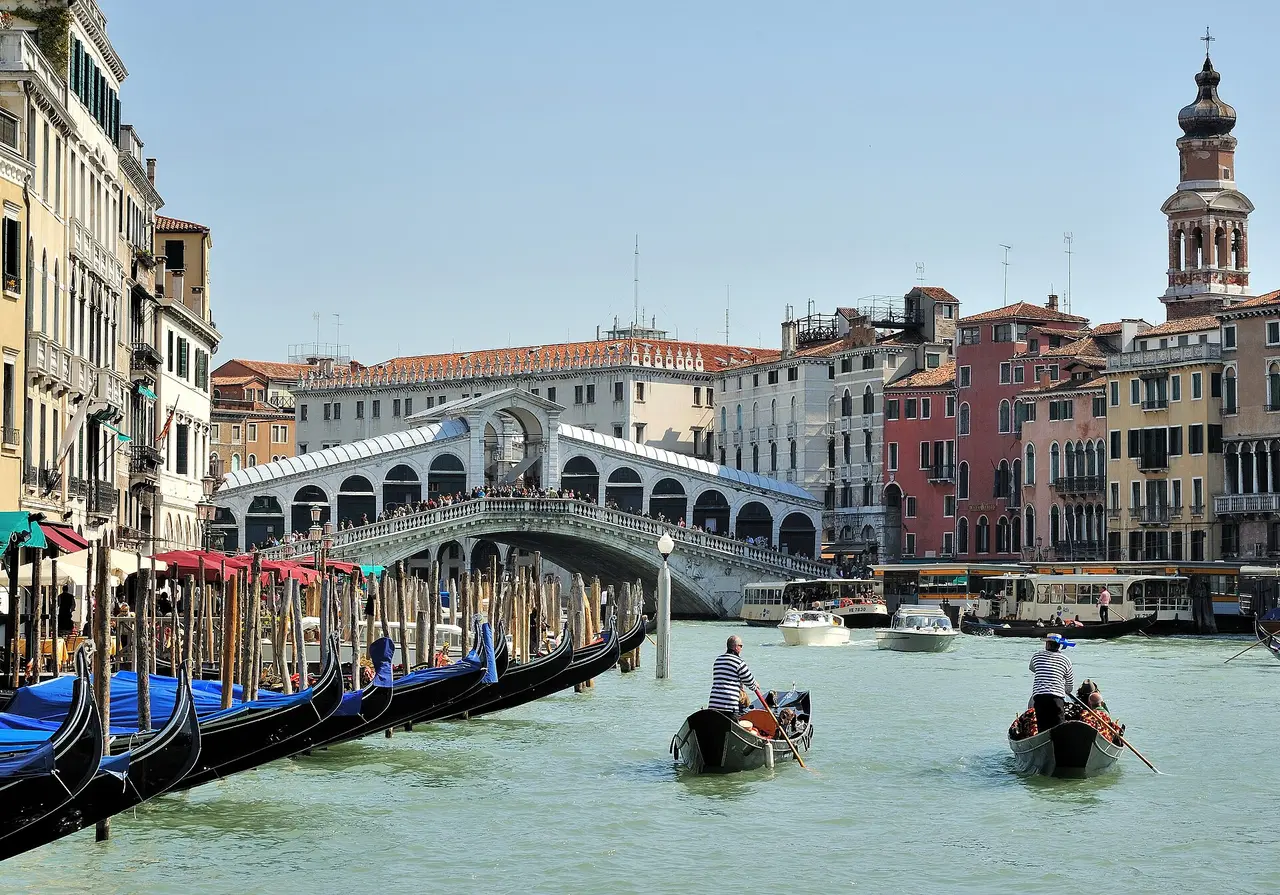
The oldest of the four bridges spanning the Grand Canal, lined with shops. Climb it early in the morning for the view of the palaces without the crowds.

Gallerie dell'Accademia

The great collection of Venetian painting, from Bellini to Titian and Veronese, housed in a former school in Dorsoduro. Early closing at 2 pm on Mondays.

Peggy Guggenheim Collection

Modern and surrealist art in the American patron's unfinished palazzo, with a sculpture garden and a terrace on the Grand Canal. Closed on Tuesdays.

Frari Basilica

A vast brick Franciscan church in San Polo, keeping Titian's Assumption behind its high altar and Canova's monumental tomb.

Scuola Grande di San Rocco

A confraternity whose halls are painted entirely by Tintoretto. Mirrors provided on site help you study the ceilings without straining your neck.

Burano

A fishing island of brightly coloured facades, known for its needle lace. Combine it with Murano and Torcello on the same day.

Torcello Cathedral

On an almost abandoned island, Santa Maria Assunta keeps one of the oldest mosaic Last Judgements in the lagoon, and a bell tower open to visitors.

What to discover in Venice?

San Marco, the political heart

The San Marco sestiere gathers the basilica, the Doge's Palace, the campanile and the Procuratie around the only square Venetians call a piazza. It is also the most crowded district: between 10 am and 4 pm from May to September, queues stretch in front of every monument. Aim for the basilica's opening time with an online booking, then the Doge's Palace, whose 30 € ticket includes the Museo Correr. In the evening, once day-trippers leave, the square regains its calm and its café orchestras.

Dorsoduro, museums and sunny quays

Across the Accademia Bridge, Dorsoduro holds the major collections: the Gallerie dell'Accademia for Venetian painting and the Peggy Guggenheim Collection for modern art, closed on Tuesdays. The Punta della Dogana and the Salute basilica close off the Grand Canal. The Zattere, long south-facing quays opposite the Giudecca, make the ideal late-afternoon walk, while Campo Santa Margherita remains one of the liveliest squares at night, popular with university students.

San Polo and Santa Croce, around the Rialto

The Rialto Bridge, built in stone since the late 16th century, opens onto the merchant district of San Polo. The Pescheria fish market livens up the mornings, except Sundays and Mondays, and nearby bacari serve cicchetti and glasses of wine from noon. Further on, the Frari basilica holds Titian's Assumption and the Scuola Grande di San Rocco houses Tintoretto's canvases. Allow half a day for the lot. Santa Croce, more residential, leads to Piazzale Roma, the terminus for buses and taxis.

Cannaregio, lived-in Venice

The most populated sestiere stretches from Santa Lucia station, where trains arrive from all over Italy, to the Fondamente Nove, where boats leave for the islands. The Ghetto, founded in 1516, keeps its synagogues, visited with the Jewish Museum. Fondamenta della Misericordia and degli Ormesini line up bars and waterside tables at gentler prices than around St Mark's. One day is enough to explore it unhurried, ending at the Ca' d'Oro on the Grand Canal.

Castello, the Arsenale and the Biennale

The largest district starts behind St Mark's and stretches east to the island of Sant'Elena. The Arsenale, the Republic's former shipyard, hides behind its monumental gate guarded by stone lions. The Giardini and part of the Arsenale host the Biennale, which alternates between art and architecture from one year to the next, from late spring to November. Via Garibaldi, the city's only wide street, keeps a neighbourhood market in the morning and fishermen's trattorias.

The Giudecca and San Giorgio Maggiore

Separated from the centre by a canal roughly 300 metres wide, the Giudecca is a long residential island two vaporetto stops from the Zattere. People come for Palladio's Redentore church, centre of the festival on the third weekend of July and its fireworks, and to dine facing the city. Right next door, the island of San Giorgio Maggiore offers from its lift-served campanile one of the finest views over St Mark's Basin, often without a wait.

The lagoon islands

The islands need a full day. Murano, ten minutes by boat from the Fondamente Nove, keeps the craft of blown glass alive. Burano, about 40 minutes away on line 12, lines up painted houses and lace shops, and Torcello, almost deserted, keeps the Byzantine mosaics of its cathedral. To the south, the Lido, a long sandbar on the Adriatic, hosts the Venice Film Festival in late August and can be cycled to Malamocco. To continue on the mainland, the northern Italian lakes are under two hours away by train.

Sample itineraries

Three routes built around the time you actually have.
3daysRecommended

Venice in 3 days: Cannaregio, Castello and the colourful lagoon islands

  1. Day 1: Cannaregio and the Ghetto
  2. Day 2: Murano, Burano and Torcello
  3. Day 3: Castello, the Arsenale and the Giardini

Best for: For travellers who have already seen St Mark's or prefer lived-in Venice to queues: working-class districts, shipyards and a full day on the islands. It trades the big museums for walking and boat rides.

How much it costs

Per person per day, excluding international travel.
Budget
79 €/ day
1 336 € for 2 people, 7 days, return flights included
Accommodation
35 €
Food
25 €
Local transport
9 €
Sights and activities
10 €
Comfort
190 €/ day
2 890 € for 2 people, 7 days, return flights included
Accommodation
85 €
Food
60 €
Local transport
15 €
Sights and activities
30 €
Premium
405 €/ day
5 900 € for 2 people, 7 days, return flights included
Accommodation
160 €
Food
120 €
Local transport
45 €
Sights and activities
80 €
Prices checked: Relevé octobre 2026. Repas : Numbeo Venise, mis à jour le 2 octobre 2026 (repas bon marché 20 €, dîner de milieu de gamme pour deux 87,50 €, cappuccino 2 €). Hébergement : lits en dortoir des auberges du centre historique et de Mestre de 30 à 50 € (Hostelworld, Hostelz, The Savvy Backpacker) ; hôtels 3 et 4 étoiles autour de 229 € la nuit en moyenne annuelle, janvier le moins cher (178 €), septembre le plus cher (Kayak). Transports : pass ACTV vaporetto 72 h 45 €, 7 jours 65 €, billet 75 minutes 9,50 € ; bateau-taxi privé aéroport-Venise 160 €, navette partagée 34 € par personne. Activités : Palais des Doges 30 € (accès Correr, musée archéologique et bibliothèque Marciana inclus), gondole 90 € les 30 minutes de jour et 110 € le soir par embarcation (tarif municipal). Vol A/R Paris-Venise estimé à 115 € par personne hors vacances scolaires (ou-et-quand.net, moyennes 2026 : septembre 87 €, novembre 97 €, octobre 114 €, août 132 €). Hébergement par nuit et par personne : lit en dortoir pour backpacker, chambre double partagée à deux pour comfort et premium, hors Carnaval, Pâques et septembre. Taxe de séjour municipale (variable selon catégorie et saison) non incluse ; les visiteurs qui dorment sur place sont exemptés du contributo d'accesso de 5 à 10 € exigé des excursionnistes certains jours d'avril à juillet (Comune di Venezia, cda.ve.it).

Getting there

Airports serving Venise, from main hubs to secondary ones.
  • BDSBrindisi AirportBrindisiMain
  • BGYIl Caravaggio International AirportOrio al SerioMain
  • BLQBologna Guglielmo Marconi AirportBolognaMain
  • BRIBari Karol Wojtyła International AirportBariMain
  • CAGCagliari Elmas AirportCagliariMain
  • CIACiampino–G. B. Pastine International AirportRomeMain

Entry, health and safety

For FR travellers

Entry requirements

No visa for a tourist stay

Aucun visa : pour un séjour de trois mois maximum, les Français entrent en Italie avec une carte nationale d'identité ou un passeport en cours de validité. Le livret de famille n'est pas un document de voyage, y compris pour les mineurs.

Stay allowed for up to 90 days.

Health

Advised: Vaccinations du calendrier français à jour, en particulier diphtérie, tétanos, poliomyélite, coqueluche et rougeole.

La transmission du virus du Nil occidental est possible localement, notamment dans le nord de l'Italie : répulsif et vêtements longs conseillés en été, comme contre la dengue et le chikungunya. À certaines périodes, l'acqua alta inonde la ville et complique les déplacements : consulter le calendrier des marées avant la visite. Les vols à la tire sont fréquents dans les gares et les transports publics.

Safety

Normal precautions

Emergency

112

Checked in octobre 2026 against the official source. Entry rules change: check the official source before you travel, it alone is authoritative.

Practical information for Venice

From Marco Polo airport

Bus to Piazzale Roma in about twenty minutes, Alilaguna boat to central stops, or private water taxi around 160 € (shared shuttle from 34 € per person).

Vaporetto

Single ACTV ticket at 9.50 € valid 75 minutes; 24-hour pass at 25 €, 72 hours at 45 € and 7 days at 65 €, quickly worth it.

Access fee

In 2026, day visitors pay 5 to 10 € on certain days from April to July, 8.30 am to 4 pm. Travellers staying overnight are exempt.

Acqua alta

High tides mostly hit from October to December. The MOSE mobile barriers hold back the strongest, but boots still come in handy some mornings.

Gondola

Municipal rate of 90 € for 30 minutes by day and 110 € in the evening, per boat for up to five passengers. Traghetti cross the Grand Canal for a few euros.

Typical prices

Simple meal around 20 €, mid-range dinner for two around 88 €, cappuccino at 2 € at the bar (Numbeo, October 2026).

Coperto

Most restaurants charge a cover per person, shown on the menu. Standing at a bacaro counter costs far less than sitting on a terrace.

Local rules

Picnicking on monument steps or swimming in the canals is banned and can be fined. Guided groups are limited to 25 people.

Power sockets

Types F and L, 230 V: standard European plugs fit most sockets, an Italian adapter can help in older hotels.

Venise in pictures

Photo credits : Saffron Blaze, CC BY-SA 3.0, Wikimedia Commons ; Vyacheslav Argenberg, CC BY 4.0, Wikimedia Commons ; Marco Ober, CC BY-SA 4.0, Wikimedia Commons ; This Photo was taken by Wolfgang Moroder . Feel free to use my photos, but please mention me as the author and, CC BY-SA 3.0, Wikimedia Commons

Frequently asked questions about Venice

Do you have to pay to enter Venice?
Only if you visit for the day: in 2026, an access fee of 5 € (booked at least four days ahead) or 10 € applies on 60 days from April to July, from 8.30 am to 4 pm. If you sleep in Venice you are exempt, but you pay the tourist tax.
Should you stay in Venice itself or in Mestre?
Mestre, on the mainland, is cheaper and about ten minutes by train from Santa Lucia. Staying in the historic centre, however, lets you enjoy the city early in the morning and in the evening, once day-trippers have gone, which changes everything.
How many days do you need in Venice?
Two days cover St Mark's, the Rialto and Dorsoduro. Allow three days to add Cannaregio and a day on Murano, Burano and Torcello, and four for the Lido, the Giudecca and the great churches of San Polo, without rushing.
Is a gondola ride worth its 90 €?
The municipal rate is 90 € by day for 30 minutes, 110 € in the evening, but it is set per boat, for up to five passengers. Shared, it becomes reasonable. For a single crossing, the traghetto takes you over the Grand Canal standing up, like Venetians, for a few euros.
What to do in Venice during acqua alta?
Check the city's tide forecasts, which announce peaks to the hour. Flooding usually lasts a few hours around high tide. Pack boots, favour the higher districts and visit museums during the peak.
Where to eat cicchetti in Venice?
The bacari around the Rialto and along the Cannaregio fondamenta serve cicchetti, small bites such as baccalà mantecato or sarde in saor, with an ombra, a small glass of wine. They are eaten standing at the counter, late morning or at aperitivo time.
Can you swim in Venice?
Not in the canals, where swimming is banned. However, the Lido beaches on the Adriatic are about fifteen minutes by vaporetto from St Mark's. The sea there exceeds 25 °C in July and August, with public beaches and paid concessions.
Venice at Carnival: should you book early?
Yes. During the ten days of Carnival in February, crowds and hotel prices climb sharply, especially at weekends. Book several months ahead, or stay in Mestre and come in by train, avoiding Saturday if you dislike crowds.

Plan your trip to Venise

Build your day-by-day itinerary and manage budget, bookings and packing in PlanTripNow.
Aperçu de l'application PlanTripNow