Skip to content

Visit Zurich : things to do, when to go and what budget to plan

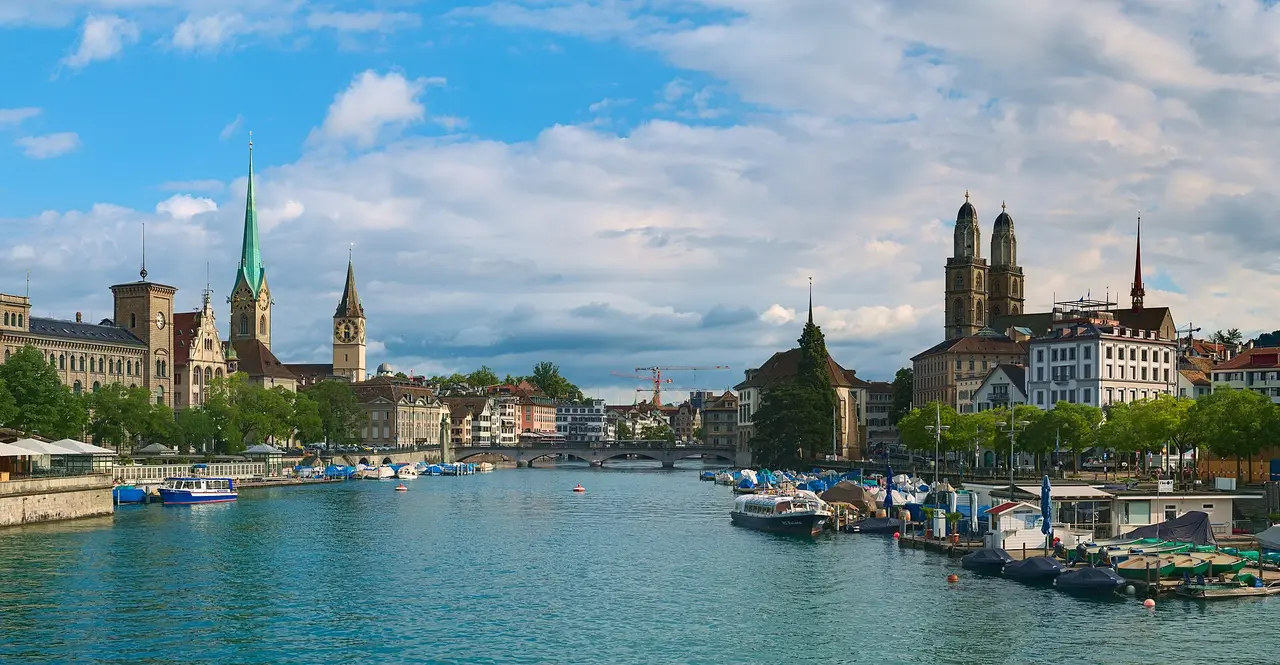
Zurich, Switzerland's largest city, spreads out at the end of a glacial lake with the Alps in sight. Between Reformation church towers, art museums, summer swims in the Limmat and old factories turned trendy district, it is best explored on foot over two or three days, four hours from Paris by TGV.

At a glance

Visa
None
Tourist stay of up to 90 days
7-day budget
€1,715
Per person, comfort profile, excluding international flights.
Recommended length
3 days
For a first trip, without rushing.

Why visit Zurich?

Zurich is the largest city in Switzerland and its main financial centre, but not its capital, which is Bern. Its Old Town lines the Limmat where the river leaves Lake Zurich. People come for the museums, urban swimming in summer and as a base for day trips by train.

When to visit Zurich

Temperatures, rainfall and crowds month by month, to pick your window.
When to visit Zurich
MonthTemperaturesRainCrowdsVerdict
January-1 to 4 °C10 dVery quietThe coldest month, yet hotels stay pricey because of the nearby Davos Forum.
February-1 to 5 °C9 dVery quietEmpty museums and the lowest rates: ideal for a cheaper cultural break.
March2 to 10 °C10 dQuietStill chilly, but the Limmatquai terraces reopen as soon as the sun breaks through.
April5 to 15 °C11 dModerateSechseläuten and its burning snowman herald spring, so book early.
May9 to 19 °C12 dModeratePack an umbrella: May is among the wettest months despite the mild air.
June13 to 22 °C12 dBusyThe lake baths open and long evenings make June an excellent pick.
July14 to 24 °C12 dBusyPeak summer around 24°C, swimming in the Limmat and frequent afternoon storms.
August14 to 24 °C12 dPackedThe Street Parade packs the city in August, with hotels sold out that weekend.
September11 to 19 °C10 dBusyThe best compromise: still mild air, a calm lake and less rain than summer.
October7 to 14 °C10 dModerateThe Zurich Film Festival opens autumn, followed by frequent morning fog over the lake.
November3 to 8 °C10 dQuietGrey and damp until the Christmas markets open late in the month.
December0 to 4 °C11 dModerateThe Christmas market in the main station hall makes up for very short days.
Source: Normales 1991-2020 de la station MeteoSwiss Zürich-Fluntern (via Wikipédia, NOAA/MeteoSwiss) recoupées avec Climates to Travel (1991-2020), relevé octobre 2026. Affluence et prix : estimations éditoriales (Street Parade, Sechseläuten, Zurich Film Festival, marchés de Noël, salons d'affaires).

Zurich's must-sees

Seven places to understand the city, from its church towers to its viewpoints.

Grossmünster

Romanesque church with twin towers, cradle of the Zurich Reformation, where you can climb one tower for the view over the lake.

Fraumünster windows

Five stained-glass windows by Marc Chagall made late in his life, bathing the choir in blue and green light.

Kunsthaus Zurich

Switzerland's major fine arts museum, with the largest Alberto Giacometti collection and an extension designed by David Chipperfield.

Swiss National Museum

A neo-Gothic castle behind the main station telling the country's story from its first inhabitants to modern Switzerland.

Lindenhof hill

A lime-shaded terrace above the Limmat, on the old Roman fort, with the best free view in the city.

Pavillon Le Corbusier

The architect's last building, in steel and coloured glass, in the Zürichhorn park on the lakeshore.

Uetliberg summit

An 871-metre viewpoint linked by train to the main station, with its observation tower and ridge trails.

What to discover in Zurich?

The right-bank Old Town and the Niederdorf

On the right bank of the Limmat, the Niederdorf strings together cobbled lanes, guild houses and small restaurants up to the Grossmünster, where Zwingli launched the Zurich Reformation in 1519. You can climb the church towers for a view over the lake. The district takes half a day, but it comes alive in the evening around the pedestrian Niederdorfstrasse. Places on the main street target tourists: for a fondue or Zurich-style veal at fairer prices, look in the parallel streets that climb towards the university.

The left bank, from the Lindenhof to Bahnhofstrasse

Opposite, the Lindenhof hill, once the site of a Roman fort, gives the best free view of the Old Town. Below, the Fraumünster holds five stained-glass windows by Marc Chagall installed in 1970, and St Peter's Church displays one of the largest clock faces in Europe. Allow two to three hours for these three stops. Bahnhofstrasse, about 1.4 kilometres of luxury shops between the station and the lake, can be walked or ridden by tram to Paradeplatz, where Sprüngli's Luxemburgerli make a sweet break.

The lake, Seefeld and the public baths

The Utoquai and Mythenquai promenades run along the lake for several kilometres. In Seefeld, the Zürichhorn park is home to the Pavillon Le Corbusier, the architect's last building. From mid-May to mid-September, locals swim at the Badis, wooden baths set on the water and open to the public for a few francs, or for free at the Oberer Letten river bath on the Limmat. ZSG boats leave from Bürkliplatz: a short cruise of an hour and a half is enough to see the villas of the Gold Coast.

Zurich West, the former industrial district

Around Hardbrücke station, the old factories of Zurich West have become the city's most creative district, dominated by the 126-metre Prime Tower. Under the railway viaduct arches, Im Viadukt gathers shops and a hall of local produce. Nearby, the Freitag container tower and the pop-up Frau Gerolds Garten draw a young crowd. Allow half a day, ideally in the late afternoon, since the area mostly comes alive at night with the Schiffbau theatre and its bars.

Museums and collections

The Kunsthaus, extended in 2021 by David Chipperfield, holds the largest collection of Alberto Giacometti, along with Munch, Monet and Swiss painting: plan three hours, and note that it closes on Mondays, like the Swiss National Museum behind the station. The Rietberg Museum, in a park by the lake, is devoted to the arts of Asia, Africa and Oceania. Families prefer the zoo and its Masoala rainforest hall, or the Lindt chocolate museum in Kilchberg, about twenty minutes from the centre.

The Uetliberg and train day trips

The city's own mountain, the Uetliberg, rises to 871 metres and is reached in twenty-five minutes on the S10 train from the main station. On clear days the view stretches over the lake and the Alps. Zurich also makes an excellent base: Lucerne is under an hour by direct train, the Rhine Falls about an hour, close to the border with Germany, and Rapperswil can be reached by boat across the lake. For several trips, compare the price of an SBB day pass with single tickets.

Sample itineraries

Three routes built around the time you actually have.
3daysRecommended

Zurich in 3 days through its districts: the Landesmuseum, Zurich West and the Uetliberg

  1. Day 1: the Landesmuseum, Bahnhofstrasse and the Lindenhof
  2. Day 2: Zurich West and the Limmat baths
  3. Day 3: the Uetliberg and the panorama trail to Felsenegg

Best for: For travellers who want the living city rather than the postcard: Swiss history, converted industrial districts, river baths and a hike on the city's own mountain. The Kunsthaus and long day trips are left out.

How much it costs

Per person per day, excluding international travel.
Budget
110 €/ day
1 832 € for 2 people, 7 days, return flights included
Accommodation
55 €
Food
35 €
Local transport
10 €
Sights and activities
10 €
Comfort
245 €/ day
3 722 € for 2 people, 7 days, return flights included
Accommodation
105 €
Food
95 €
Local transport
15 €
Sights and activities
30 €
Premium
530 €/ day
7 712 € for 2 people, 7 days, return flights included
Accommodation
220 €
Food
170 €
Local transport
50 €
Sights and activities
90 €
Prices checked: Relevé octobre 2026. Restauration et transports : Numbeo (mis à jour le 6 octobre 2026 : repas simple 31 €, menu pour deux 129 €, taxi 7,23 € + 4,07 €/km) ; billet 24 h ZVV zones 1-2 (ville de Zurich) à 9,40 CHF sur zvv.ch ; hébergement : Budget Your Trip (dortoir moyen 62 USD) et Kayak (3 étoiles 246 USD, 4 étoiles 351 USD en moyenne par chambre). Conversion 1 CHF ≈ 1,06 € et 1 USD ≈ 0,86 €. Dortoir pour le profil routard, chambre double partagée à deux pour confort et premium. Vol A/R Paris-Zurich hors vacances scolaires : 146 € par personne (moyenne liligo, Air France dès 130 €). Prix hors Street Parade et salons, qui font grimper les hôtels.

Getting there

Airports serving Zurich, from main hubs to secondary ones.
  • GVAGeneva International AirportGenevaMain
  • ZRHZürich AirportZurichMain
  • ACHSankt Gallen Altenrhein AirportSt. GallenSecondary
  • BRNBern AirportBernSecondary
  • EMLEmmen Air BaseEmmenSecondary
  • LUGLugano AirportAgnoSecondary

Entry, health and safety

For FR travellers

Entry requirements

No visa for a tourist stay

Aucun visa : la Suisse est dans l'espace Schengen. Carte nationale d'identité ou passeport en cours de validité (CNI délivrée entre 2004 et 2013 valable 5 ans de plus) ; au-delà de trois mois, titre de séjour cantonal.

Stay allowed for up to 90 days.

Health

Advised: Vaccins du calendrier français à jour (diphtérie, tétanos, polio, coqueluche, rougeole) ; encéphalite à tiques selon les activités en nature.

Tiques actives de mars à novembre jusqu'à 2 000 m (encéphalite à tiques, maladie de Lyme). Hausse des cas de rougeole signalée en 2026. Vigilance normale sur tout le territoire, vols à la tire dans les gares et transports. Frais de secours non remboursés pouvant atteindre plusieurs milliers d'euros : assurance assistance indispensable.

Safety

Normal precautions

Emergency

112

Checked in octobre 2026 against the official source. Entry rules change: check the official source before you travel, it alone is authoritative.

Practical information for Zurich

Currency

Swiss franc (CHF). Euros are sometimes accepted, but change comes back in francs at a poor rate: pay by card, contactless is everywhere.

Fountain water

The city's public fountains, more than 1,200 of them, run with drinking water: a refillable bottle covers the whole day.

Power sockets

Swiss type J sockets. Flat two-pin European plugs fit, but grounded round-pin plugs do not: bring an adapter.

Tipping

Service is included in prices. People simply round up the bill in restaurants, with no obligation.

Transport tickets

The whole city lies in ZVV zone 110, which counts as two zones: the 24-hour ticket costs CHF 9.40 and covers trams, buses, urban trains and Limmat boats.

Sunday shopping

Most shops close on Sundays, except those in the main station and at the airport, open every day.

Museums closed Mondays

The Kunsthaus and the Swiss National Museum close on Mondays: schedule them mid-stay.

From the airport

Kloten airport is linked to the main station by very frequent trains, in about fifteen minutes.

Language

Swiss German when spoken, standard German in writing. English is widely spoken, French far less than in Geneva.

Restaurant prices

Expect about €30 for a simple dish in a cheap restaurant and €15 for a fast-food meal: Coop and Migros supermarkets remain the answer for tight budgets.

Zurich Card

Valid for 24 or 72 hours, it includes public transport in the urban zone, the airport transfer and free or reduced entry to many museums.

Zurich in pictures

Photo credits : Daniel Kraft, CC BY-SA 3.0, Wikimedia Commons ; Jakub Hałun, CC BY 4.0, Wikimedia Commons

Frequently asked questions about Zurich

Can you swim in Lake Zurich and the Limmat?
Yes, it is a local tradition. From mid-May to mid-September, wooden public baths such as Utoquai or the Frauenbad open to the public, and the Oberer Letten river bath lets you swim in the Limmat for free. The water rarely goes above 22°C.
Zurich or Geneva for a first trip to Switzerland?
Zurich offers more museums, livelier nightlife and better train access to central Switzerland and the Rhine Falls. Geneva is French-speaking and better placed for Lake Geneva and Chamonix. Both remain among the most expensive cities in Europe.
How long is the train from Paris to Zurich?
The TGV Lyria links Paris Gare de Lyon to Zurich in just over four hours with no change. Tickets are much cheaper when booked several weeks ahead, and the train avoids the transfer from Kloten airport.
When is the Zurich Street Parade?
The Street Parade, one of the world's largest electronic music parades, takes place every year on a Saturday in August around the lake basin. Hotels sell out and prices soar that weekend: book very early or avoid those dates.
What is Sechseläuten?
It is the spring festival of Zurich's guilds, in April. After a costumed parade, the Böögg, a snowman stuffed with firecrackers on top of a bonfire, is set alight: how fast its head explodes is said to predict the summer.
Is the Uetliberg worth the trip in winter?
Yes, especially on overcast days: the 871-metre summit often rises above the sea of fog that covers the city in November and December. The S10 train runs all year, but the ridge trail can be icy, so wear good shoes.
What should you bring back from Zurich?
Luxemburgerli, small macarons from the Sprüngli confectioner on Paradeplatz, to eat within three days, Swiss chocolate, or a recycled tarpaulin bag from Freitag, a brand born in Zurich, sold in its container tower in Zurich West.

Plan your trip to Zurich

Build your day-by-day itinerary and manage budget, bookings and packing in PlanTripNow.
Aperçu de l'application PlanTripNow