Skip to content

Visit Bergen : what to do between Bryggen and the fjords

Norway's second city keeps its colorful Hanseatic houses on the harbor, climbs its mountains by funicular and serves as the base for the country's finest fjords. Allow two days for the city, two more for the Sognefjord or the Hardangerfjord, and always pack a rain jacket.

Why choose Bergen to see the fjords?

Bergen is the main starting point for the Sognefjord and the Hardangerfjord, both reachable by train, boat or car in a day. Its Bryggen wharf, a former Hanseatic trading post, has been a UNESCO World Heritage Site since 1979. It is also the home port of the Hurtigruten, which sails the coast to Kirkenes.

Bergen's must-sees

Historic sites, viewpoints and museums, almost all within walking distance of the harbor.

Bryggen

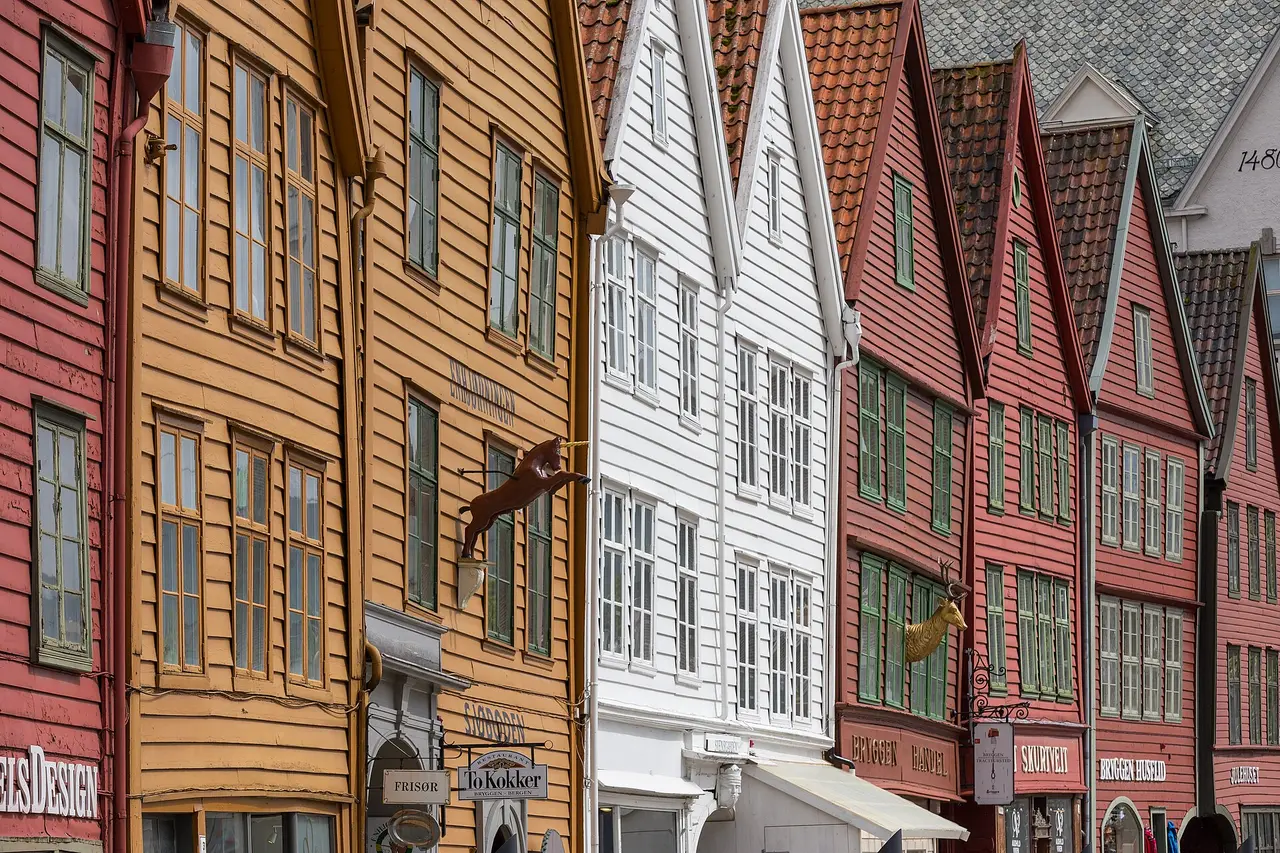
A row of wooden merchant houses on the harbor, a legacy of the Hanseatic trading post and a UNESCO World Heritage Site. The Hanseatic Museum tells its story.

Fløibanen funicular

It climbs in a few minutes to the top of Fløyen, 320 meters up, for the classic view over the harbor. The way down is an easy walk.

Ulriken cable car

Access to the highest of Bergen's seven peaks, 643 meters, with a panorama over the city, the islands and the North Sea. Trailhead for the Vidden hike.

Fisketorget

The fish market at the head of Vågen, dating back to the Middle Ages: shrimp, salmon, whale and fish soup, outdoors or in the covered hall.

Bergenhus Fortress

At the harbor entrance, it brings together Håkonshallen, a 13th-century royal hall, and the Rosenkrantz Tower, both open to visitors.

KODE museums

Four buildings on the shore of Lille Lungegårdsvann lake, with a major Edvard Munch collection and Norwegian painting, plus rooms devoted to Grieg.

Troldhaugen

Edvard Grieg's lakeside home south of the city, with his composing hut, his grave and a hall where concerts are held.

What to discover in Bergen, neighborhood by neighborhood?

Vågen harbor and the Hanseatic waterfront

Everything starts around Vågen, the bay that cuts into the center. On its east side, German Hanseatic merchants traded from the 14th to the 18th century; the wooden alleys rebuilt after the 1702 fire can be explored freely behind the facades. The fish market closes the bay to the south. Come before 9 am or after 5 pm: in summer, several cruise ships unload their passengers in mid-morning.

Nordnes and old fishermen's Bergen

The Nordnes peninsula, a 15-minute walk west of the harbor, remains a maze of white wooden houses and steep steps. At its tip, the aquarium and Nordnes park face the sea, and the heated seawater pool of Nordnes sjøbad stays open all year. Half a day is enough. To the north, the open-air Old Bergen Museum in Sandviken gathers around fifty houses from the 18th and 19th centuries.

Fjellveien and the seven mountains

Bergen is ringed by seven peaks, and locals head up them the way others go to the park. The pedestrian Fjellveien road runs along the hillside above the center, with views over the harbor. From Fløyen (320 m), a network of easy trails and lakes takes two to three hours. Seasoned hikers link Ulriken (643 m) to Fløyen along the Vidden ridge: about 15 km, a full day in good weather.

Fjords and getaways from Bergen

The Norway in a Nutshell tour links Bergen to the Nærøyfjord in one long day: train to Myrdal, the Flåm Railway, a boat and then a bus back via Voss. The Hardangerfjord, known for its orchards in bloom in May, is about 1 hour 30 minutes by road. To go further, the rest of Norway is reached on the Bergen to Oslo train, then neighboring Sweden; Copenhagen is just one direct flight away.

Getting there

Airports serving Bergen, from main hubs to secondary ones.
  • AESÅlesund AirportÅlesundMain
  • BGOBergen Airport, FleslandBergenMain
  • BOOBodø AirportBodøMain
  • EVEHarstad/Narvik AirportEvenesMain
  • KRSKristiansand AirportKristiansandMain
  • OSLOslo-Gardermoen International AirportOsloMain

Good to know before going to Bergen

Flesland Airport

About twenty kilometers south. The Bybanen light rail reaches the center in roughly 45 minutes, the Flybussen airport bus a little faster.

Rain

Over 2,000 mm of precipitation a year, in every season. A waterproof jacket and closed shoes are essential; umbrellas often struggle in the wind.

Daylight

Nearly 19 hours of daylight in late June, about 6 hours in late December. Winter days are short for fjord excursions.

Currency

Norwegian krone (NOK).

Payment

Contactless cards are accepted everywhere, even for small amounts. Some shops no longer take cash.

Buying alcohol

Wine and spirits only at Vinmonopolet, the state monopoly. Supermarkets stop selling beer at 8 pm on weekdays, 6 pm on Saturdays, and not at all on Sundays.

Tap water

Safe and excellent: no need to buy bottled water, refill your bottle anywhere.

Tipping

Not required, service is included. Rounding up the bill at restaurants for good service is common.

Power plugs

Types C and F, 230 V, as in most of continental Europe.

Bergen Card

A 24 to 72-hour card covering city transport and free entry or discounts at most museums. Worth it if you visit several sites.

Toll ring

An automatic toll surrounds the city, charged by number plate recognition. With a rental car, the rental company bills it back to you.

Bergen in pictures

Photo credits : JoachimKohler-HB, CC BY-SA 4.0, Wikimedia Commons ; Diego Delso, CC BY-SA 4.0, Wikimedia Commons ; auteur inconnu, Public domain, Wikimedia Commons ; scott1346 from Mechanicsville, MD, USA, CC BY 2.0, Wikimedia Commons

Frequently asked questions about Bergen

Can you see a fjord from Bergen without a car?
Yes. The Norway in a Nutshell route combines a train, the Flåm Railway, a boat on the Nærøyfjord and a bus, returning the same evening. Cruises of about three hours also leave straight from the harbor for the fjords close to the city.
Should you take the Fløibanen or walk up Fløyen?
Walking up the switchbacks from the center takes 45 minutes to an hour. Many people ride the funicular up and walk back down. In summer, when cruise ships are in port, the Fløibanen line can get long in the middle of the day.
How long does the Vidden hike between Ulriken and Fløyen take?
Allow a full day for about 15 km across an exposed plateau, often in fog. Only set off in stable weather, with warm clothes and food. Riding the Ulriken cable car up and finishing with the Fløyen funicular saves the two big climbs.
How do you get from Bergen to Oslo by train?
The Bergensbanen line links the two cities in about seven hours, crossing the Hardangervidda plateau at over 1,200 meters. There are several daily departures, including a night train. Tickets booked early on the Vy website are much cheaper.
Can you visit Troldhaugen and Fantoft Stave Church on the same day?
Yes, both are south of the city on the Bybanen light rail line. Fantoft is a few minutes from the Paradis stop, Troldhaugen about twenty minutes on foot from the Hop stop. Half a day covers both comfortably.
When can you see the Pepperkakebyen gingerbread town?
Pepperkakebyen is on display every year from late November to late December. Schools, businesses and residents build hundreds of gingerbread houses, boats and trains. December weekends are very busy, so aim for a weekday morning.
Which month is best for Bergen and the Hardangerfjord?
May combines orchards in bloom in Hardanger, long days and fewer cruise passengers than July. June to August bring the best weather but peak crowds and prices. In late May, the Bergen International Festival also livens up the city.

Plan your trip to Bergen

Build your day-by-day itinerary and manage budget, bookings and packing in PlanTripNow.
Aperçu de l'application PlanTripNow