Skip to content

Visit Frankfurt : what to see in 2 to 4 days and when to go

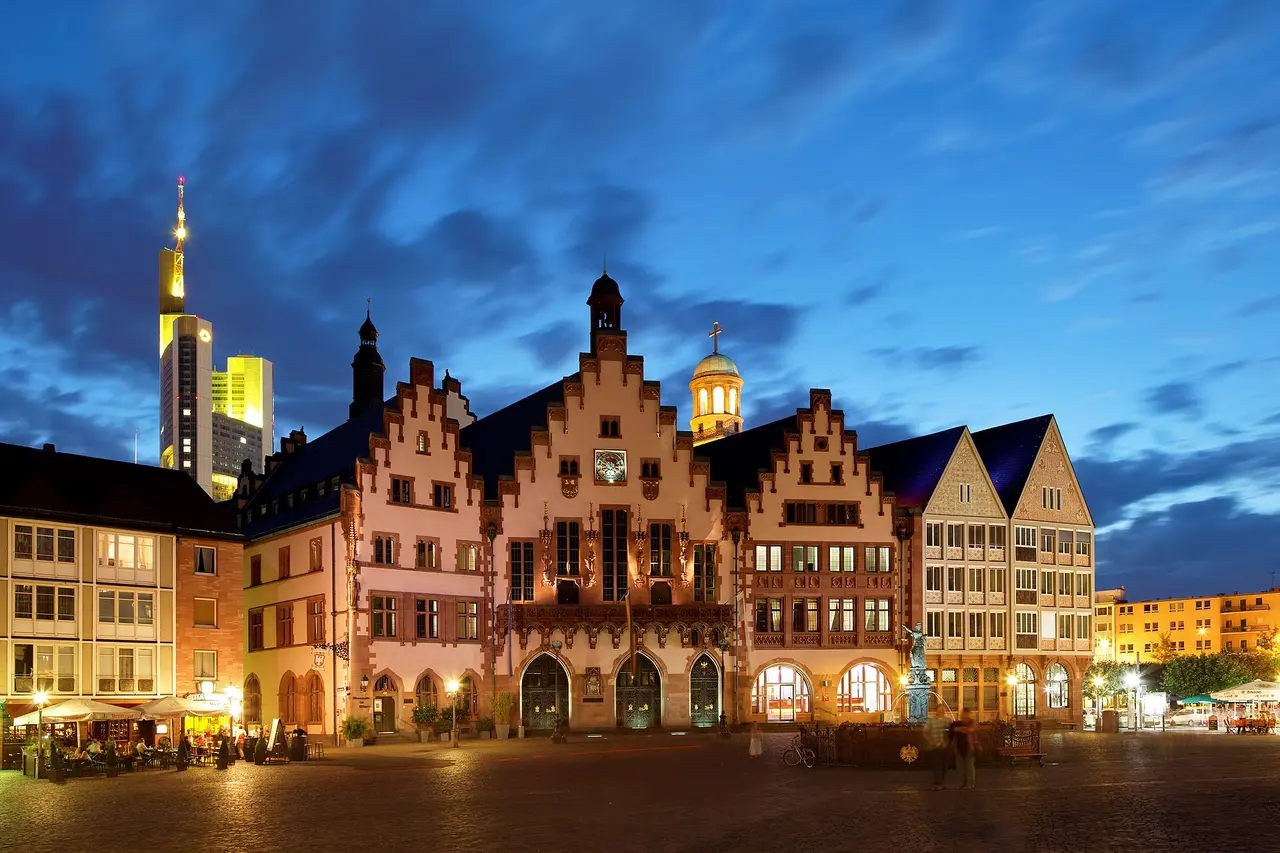
Frankfurt surprises those who see it only as an airport and a financial centre. Between the glass towers you find the half-timbered houses of the Römerberg, a whole riverbank of museums, dark-wood cider taverns, and an hour away by train the castles of the Rhine valley.

At a glance

Visa
None
7-day budget
€1,029
Per person, comfort profile, excluding international flights.

Why visit Frankfurt?

Frankfurt am Main, the largest city in Hesse and seat of the European Central Bank, combines a rebuilt old town, Goethe's birthplace and a dozen museums lined up along the Main. It is also a gateway to the Upper Middle Rhine Valley and Heidelberg. Allow two to four days, ideally from May to September, avoiding the big trade fairs.

When to visit Frankfurt

Temperatures, rainfall and crowds month by month, to pick your window.
When to visit Frankfurt
MonthTemperaturesRainCrowdsVerdict
January0 to 5 °C10 dQuietDamp cold and low skies: the Museumsufer museums and Sachsenhausen cider taverns are the plan.
February0 to 7 °C8 dQuietAffordable hotels outside trade fairs, but check the Messe calendar before booking.
March2 to 11 °C8 dQuietMagnolias in the Palmengarten and the first riverside terraces on the Main, between showers.
April6 to 16 °C8 dModerateIdeal for pairing the city with a day in the Rhine Valley before the summer cruises.
May10 to 20 °C9 dModerateThe best month: 20 °C, cider gardens open and lively Main riverbanks in the evening.
June13 to 24 °C9 dModerateLong evenings on the Mainufer and open-air concerts, with a few late-day thunderstorms.
July15 to 26 °C10 dModerateFew trade fairs, so business hotels are cheaper over the summer.
August15 to 26 °C9 dBusyThe Museumsufer festival in late August: stalls, concerts and reduced museum fees along the river.
September11 to 21 °C8 dModerateGrape harvest in the nearby Rheingau and big trade fairs that push room prices up.
October7 to 15 °C9 dBusyThe Book Fair in mid-October: full hotels and soaring rates, avoid unless you are going to it.
November3 to 9 °C9 dQuietGrey and quiet until the Christmas market opens at the end of the month.
December1 to 6 °C10 dBusyThe Römerberg Christmas market, among Germany's oldest, packed at weekends.
Source: Normales 1991-2020 via climatestotravel.com, recoupées avec l'office statistique de la ville de Francfort (moyenne annuelle 11,1 °C sur 1991-2020, station de l'aéroport du Deutscher Wetterdienst), relevé novembre 2026. Ville de l'intérieur, sans température de mer.

Frankfurt's must-sees

Heritage, museums and viewpoints, the visits worth the trip.

Römerberg Square

The central square lined with half-timbered houses and the town hall, heart of the Christmas market in December.

Neue Altstadt

Rebuilt lanes between the Römerberg and the cathedral, opened in 2018 on the layout of the pre-war old town.

Imperial Cathedral

St Bartholomew's Cathedral, where emperors were crowned, whose tower can be climbed for a view over the Main.

Main Tower

The only skyscraper open to the public, with an open-air platform about 200 m above the city.

Städel Museum

A major European art museum on the Museumsufer, from the Renaissance to contemporary art; closed on Mondays.

Goethe House

The writer's birthplace, restored with its furniture, next to the German Romanticism Museum.

Kleinmarkthalle

A covered market hall in the centre where you lunch standing up on sausages, cheeses and green sauce.

Palmengarten

A 19th-century botanical garden with tropical greenhouses and landscaped park, north of the Westend district.

Alt-Sachsenhausen

A district of cider taverns and cobbled lanes on the south bank of the Main, liveliest in the evening.

What to discover in Frankfurt?

The Römerberg and the Neue Altstadt

The historic heart, almost entirely destroyed in 1944, was rebuilt in two stages. The half-timbered houses of the Römerberg, facing the town hall, date from the 1980s, while the Neue Altstadt, opened in 2018, revived some thirty houses between the square and the imperial cathedral. Allow two hours on foot, adding the Kleinmarkthalle for lunch, where you can try green sauce and local sausages.

The skyscraper district

Frankfurt is the only German city with a real forest of skyscrapers, hence its nickname Mainhattan. The Main Tower is the only tower open to the public, with a viewing platform at about 200 m, for a few euros; expect a security check at the entrance. The euro symbol in front of the former European Central Bank headquarters remains a classic photo stop five minutes away.

The Museumsufer, the museum embankment

On the south bank of the Main, a dozen museums follow one another over less than two kilometres. The Städel, closed on Mondays, covers seven centuries of European painting, from Botticelli to Monet and Beckmann. The Film Museum, the Museum of Applied Arts and the Museum of Communication complete the line-up. A two-day museum pass pays off from the third museum; in late August, the Museumsufer festival fills the whole bank.

Sachsenhausen and its cider taverns

Across the Eiserner Steg footbridge, old Sachsenhausen is the district of Apfelwein, the dry local cider served in a stoneware jug called a Bembel. The taverns, with long shared tables, also serve Handkäse, a cheese marinated with onions, and pork ribs. Come after 7pm, when the rooms fill with locals; book at weekends for the best-known places. A jug for the table is the usual order.

Goethe, the Paulskirche and democratic history

Goethe's birthplace, rebuilt identically after the war, can be visited together with the neighbouring German Romanticism Museum, opened in 2021. A few minutes away, St Paul's Church hosted the first elected German parliament in 1848, a symbol of the country's democratic tradition. Allow half a day for both, easily combined with the nearby Römerberg. Both sites close on some Mondays, so check opening hours before you go.

Day trips: the Rhine, the Taunus and Heidelberg

The UNESCO-listed Upper Middle Rhine Valley begins an hour away by train at Rüdesheim: boats run past the castles and the Loreley rock from April to October. The Taunus hills to the north-west offer forest trails up to the Großer Feldberg, 879 m. Heidelberg and its castle above the Neckar are about an hour away by train, an easy day trip.

How much it costs

Per person per day, excluding international travel.
Budget
84 €/ day
1 536 € for 2 people, 7 days, return flights included
Accommodation
40 €
Food
30 €
Local transport
8 €
Sights and activities
6 €
Comfort
147 €/ day
2 418 € for 2 people, 7 days, return flights included
Accommodation
60 €
Food
55 €
Local transport
12 €
Sights and activities
20 €
Premium
325 €/ day
4 910 € for 2 people, 7 days, return flights included
Accommodation
125 €
Food
110 €
Local transport
35 €
Sights and activities
55 €
Prices checked: Relevé novembre 2026 : Numbeo (mis à jour le 14/11/2026) pour repas, cafés, transports (3,80 € le trajet) et taxis ; Hostelz, Momondo, Skyscanner et Trip.com pour l'hébergement (lit en auberge env. 40 €, fourchette Hostelz de 20 à 65 €, 3 étoiles env. 120 € la chambre, 5 étoiles env. 250 € la chambre). Lit en dortoir pour backpacker, chambre double partagée à deux pour comfort et premium. Trajet depuis Paris en train direct ICE ou TGV, environ 3 h 50 : env. 90 € l'aller en moyenne (Liligo, SNCF Connect), soit 180 € l'aller-retour. Hors salons professionnels, qui font fortement monter les prix des hôtels.

Getting there

Airports serving Frankfurt, from main hubs to secondary ones.
  • BERBerlin Brandenburg AirportBerlinMain
  • BREBremen AirportBremenMain
  • CGNCologne Bonn AirportKölnMain
  • DRSDresden AirportDresdenMain
  • DTMDortmund AirportDortmundMain
  • DUSDüsseldorf AirportDüsseldorfMain

Entry, health and safety

For FR travellers

Entry requirements

No visa for a tourist stay

Libre entrée pour les Français avec une carte nationale d'identité ou un passeport ; un passeport périmé depuis moins de cinq ans est accepté. Depuis mai 2025, l'Allemagne a renforcé les contrôles à toutes ses frontières : contrôles d'identité possibles à l'arrivée en avion, train, bus ou voiture.

Health

Allemagne en vigilance normale. Petite délinquance (vols à la tire, vols par ruse) en hausse dans les zones touristiques, les grands aéroports et les gares centrales ; prudence dans les lieux publics et lors des grands rassemblements.

Safety

Normal precautions

Checked in novembre 2026 against the official source. Entry rules change: check the official source before you travel, it alone is authoritative.

Practical information for Frankfurt

Documents

Identity card or passport for EU citizens; border identity checks have been stepped up since May 2025, so keep your documents to hand. Check the rules for your nationality.

Trade fairs

During the big Messe fairs, including the Book Fair in October, hotel prices can multiply: check the calendar before booking.

From the airport

S-Bahn S8 or S9 to the central station in about fifteen minutes; direct long-distance trains from the airport station.

Bottle deposit

Most bottles and cans carry a deposit: return them to supermarket machines to get the money back.

Sundays

Shops and supermarkets close on Sundays, except in stations; museums and taverns stay open.

Station district

The Bahnhofsviertel around the central station has a visible drug scene: keep an eye on your belongings, especially at night.

Frankfurt in pictures

Photo credits : Thomas Wolf ( Der Wolf im Wald ), CC BY-SA 3.0, Wikimedia Commons ; DXR, CC BY-SA 4.0, Wikimedia Commons ; Christian Wolf ( www.c-w-design.de ), CC BY-SA 3.0 de, Wikimedia Commons ; Dguendel, CC BY 3.0, Wikimedia Commons

Frequently asked questions about Frankfurt

Is Frankfurt worth visiting beyond a stopover?
Yes, for two or three days: the rebuilt old town, the museum embankment, the cider tavern atmosphere and the nearby Rhine and Heidelberg make it a good base. For a short stopover, the old town and the Main Tower fit into half a day from the airport.
What is Apfelwein and where should you drink it?
It is a dry, tart apple cider, the regional speciality, served in a stoneware jug called a Bembel and a diamond-patterned glass. The traditional taverns of Alt-Sachsenhausen and Bornheim are the best places; you can mix it with sparkling water if it is too dry.
How do you visit the Rhine valley from Frankfurt?
Regional train to Rüdesheim in about an hour, then a boat to St. Goar or Boppard among the castles and the Loreley rock, returning by train. Boats run mainly from April to October; out of season, do the route by train along the left bank.
Is the Städel worth half a day?
Yes, it is one of Germany's great art museums, with works by Botticelli, Vermeer, Rembrandt, Monet and the German Expressionists. Allow three hours; it is closed on Mondays. Major temporary exhibitions often require booking a time slot online.
Is Frankfurt easy to reach from Paris?
Yes, direct ICE and TGV trains link Paris-Est to Frankfurt central station in about three hours fifty, with an average one-way fare around 90 euros and lower fares when booked early. It is often faster than flying once transfers are counted.
Can you combine Frankfurt with Berlin or Munich?
Yes, by ICE: Berlin is about four hours away, Munich just over three. Frankfurt often serves as the gateway for a tour of Germany thanks to its airport, the busiest in the country.
When can you see the Frankfurt Christmas market?
It sets up on the Römerberg and nearby squares from late November to around 22 December. Come on a weekday early in the evening to avoid weekend crowds, and try the hot apple wine, a local twist on Glühwein, and Bethmännchen almond biscuits.

Plan your trip to Frankfurt

Build your day-by-day itinerary and manage budget, bookings and packing in PlanTripNow.
Aperçu de l'application PlanTripNow