Skip to content

Visit Ibiza : Dalt Vila, hidden coves, Formentera and electronic nights

Ibiza is far more than its clubs. Behind the ramparts of Dalt Vila, in the whitewashed inland villages or facing the rock of Es Vedrà, the island shows another side, especially in May, June and September. And Formentera, half an hour away by boat, rounds off the trip.

At a glance

Visa
None
7-day budget
€1,155
Per person, comfort profile, excluding international flights.
Recommended length
3 days
For a first trip, without rushing.

Is Ibiza only a party island?

No: Ibiza, the third largest island of the Balearic archipelago, has been a UNESCO World Heritage site since 1999 for its upper town, its Phoenician remains and its Posidonia seagrass meadows. The partying is concentrated in Platja d'en Bossa, Sant Antoni and a handful of big clubs; the north, the interior and the protected south around Ses Salines stay quiet, even in summer.

When to visit Ibiza

Temperatures, rainfall and crowds month by month, to pick your window.
When to visit Ibiza
MonthTemperaturesRainCrowdsVerdict
January8 to 16 °C5 dVery quietClubs shut, empty beaches and sparse Formentera ferries: a month for Dalt Vila and walking the island.
February8 to 16 °C5 dVery quietAlmond trees bloom in the Santa Agnès valley, a quiet show that few visitors ever see.
March10 to 18 °C3 dQuietJust three rainy days and 18C afternoons, but a 14C sea that rules out swimming.
April12 to 20 °C4 dQuietHotels and beach bars reopen one by one; Easter brings the first wave of Spanish visitors.
May15 to 23 °C3 dModerateBig-club opening parties, still-quiet coves and 23C: Ibiza in May is well worth it.
June18 to 27 °C1 dBusySant Joan bonfires on the night of the 23rd, 22C water, and rates climbing week after week.
July22 to 30 °C1 dPackedPeak club season, beach car parks full by noon, rooms at a premium: book months ahead.
August22 to 30 °C2 dPackedThe hottest and priciest month, with Eivissa's patron saint festival on 5 August.
September20 to 28 °C4 dBusyA 25C sea, cooler nights and families gone home: the best month for Formentera.
October16 to 24 °C6 dModerateClub closing parties early in the month, the first storms, then the island winds down.
November12 to 20 °C6 dVery quietMany beach restaurants close: base yourself in Eivissa, where the old town keeps some life.
December9 to 17 °C5 dVery quietWinter light on the ramparts and 17C at midday, but most beach hotels stay closed.
Source: Températures : normales 1991-2020 de la station de l'aéroport d'Ibiza (Climates to Travel), recoupées avec les normales AEMET 1981-2010 de la même station (Wikipedia), écart inférieur à 0,5 °C. Jours de pluie (≥ 1 mm) et température de la mer : séries AEMET 1981-2010 de l'aéroport, faute de série 1991-2020 publiée. Affluence et prix : saison des clubs (ouvertures fin avril-mai, fermetures début octobre) et vacances scolaires européennes. Relevé octobre 2026.

Ibiza's must-sees

From the upper town to the south-western cliffs, a dozen places to see the island beyond its nightlife reputation.

Dalt Vila ramparts

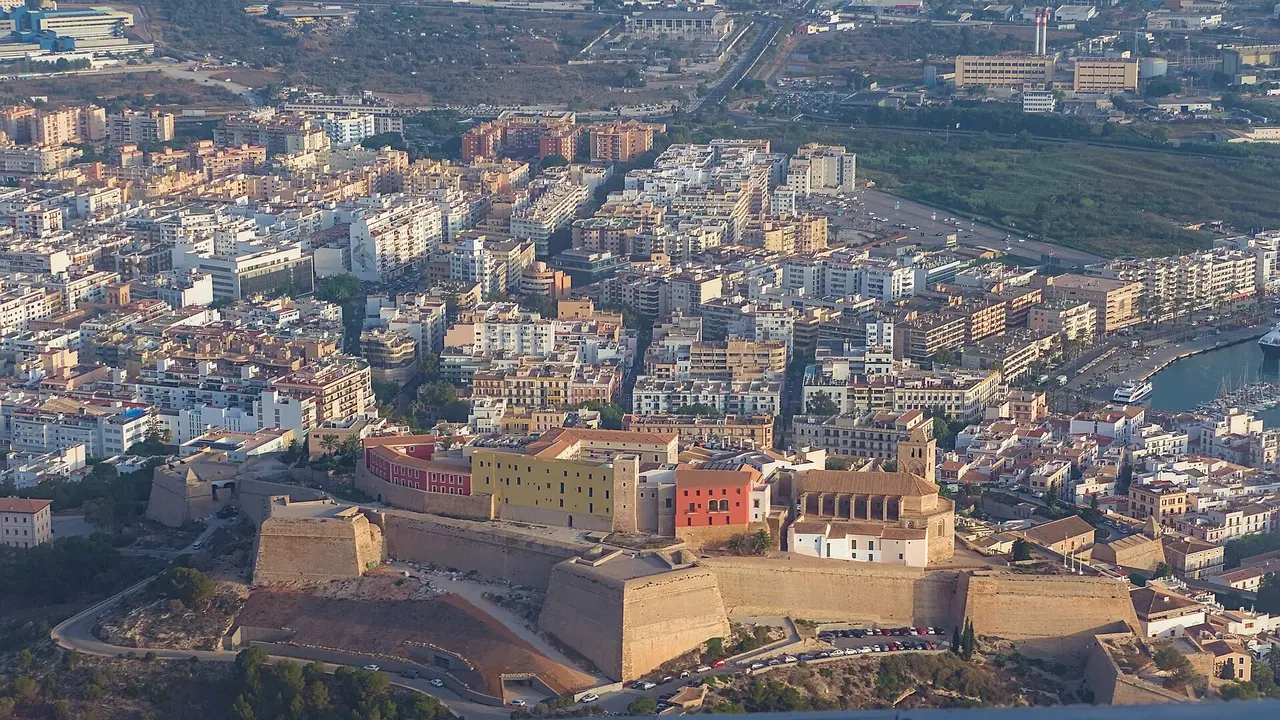
The Renaissance wall ringing Eivissa's upper town, to be walked from bastion to bastion, with views over the harbour and towards Formentera.

Eivissa Cathedral

A Gothic church at the top of Dalt Vila, reworked in the 18th century, whose terrace gives the widest panorama over the town and the sea.

Puig des Molins necropolis

A vast UNESCO-listed Phoenician and Punic cemetery with thousands of rock-cut tombs and a museum displaying the grave goods found on site.

Salt pans

Salt basins still worked in the south of the island, at the heart of Ses Salines nature park, where flamingos stop outside the summer season.

Es Vedrà at sunset

A sheer rocky islet rising opposite Cala d'Hort on the south-west coast, whose sunset silhouette is the island's most famous image.

Cala Comte

Rocky coves and small islets on the west coast, loved for their shallow turquoise water and their open view of the setting sun.

Ses Illetes

A slim sand spit in the north of Formentera, washed on both sides by clear water, reached by bike or bus from La Savina.

Las Dalias market

The historic hippie market of Sant Carles, open on Saturdays all year, with crafts, clothes and music in a flowering garden in the north-east.

Benirràs drums

Every Sunday in season, drummers salute the sunset on this northern cove, facing the rock nicknamed the finger of God.

Puig de Missa

A hill in Santa Eulària des Riu crowned by a white 16th-century fortified church, once a refuge from pirates, overlooking the east coast.

Sa Talaia summit

The island's highest point at 475 metres, reached by a track from Sant Josep, with a panorama over the whole west coast and out to sea.

Santa Agnès almond blossom

A north-western valley covered in white and pink blossom in late January and February, walked on a waymarked trail between farms.

What to see in Ibiza, area by area?

Dalt Vila and La Marina, the heart of Eivissa

Eivissa, the main town, is built on two levels. Up top, Dalt Vila shelters behind a 16th-century Renaissance wall, one of the best-preserved coastal fortifications in Mediterranean Spain. You enter through the Portal de ses Taules and climb in about thirty minutes to the cathedral, whose terrace looks down on the harbour. Below, La Marina and the Sa Penya quarter pack shops, bars and restaurants into narrow lanes. Allow half a day for the upper town, plus an evening for the port, which is far more pleasant after 7 pm once the heat drops.

Platja d'en Bossa and the club scene

The long beach of Platja d'en Bossa, a few kilometres south of Eivissa, concentrates club hotels and open-air parties; other big venues sit in Eivissa itself and around Sant Rafel, in the middle of the island. The season starts in late April or May with the opening parties and ends in early October with the closing parties. Outside that window, the big clubs are shut. Tickets are booked online, often far cheaper than at the door, and night buses link the main areas in summer. Nights rarely get going before midnight.

Sant Antoni and the sunset coast

Sant Antoni de Portmany, on the west coast 25 minutes from Eivissa by road, is the island's second town. Its Caló des Moro waterfront is known for bars facing the sunset, with crowds peaking in July and August. The rest of the bay is calmer than people think: Cala Salada to the north, and Cala Bassa and Cala Comte to the south-west, have very clear water. These coves fill up fast in summer, so arrive before 10 am or aim for the late afternoon slot. Buses leave from Sant Antoni harbour.

The protected south: Ses Salines and the Es Vedrà coast

The southern tip of the island belongs to Ses Salines nature park, shared with Formentera. The salt pans are still worked and host flamingos outside summer. Ses Salines and Es Cavallet beaches, 20 to 30 minutes by bus from Eivissa, are backed by protected dunes. Further west, the Sant Josep coast ends at the cliffs of Cala d'Hort, facing the rock of Es Vedrà. The trail to the Torre des Savinar takes about an hour there and back and gives the best sunset viewpoint; avoid it in the heat of a July afternoon.

The north and the interior: white villages and markets

North of a line from Sant Antoni to Santa Eulària, the island changes pace: pine-covered hills, terraced fields, whitewashed fortified churches. Santa Gertrudis, in the centre, is a good lunch stop; Sant Joan de Labritja leads to the coves of Portinatx and Cala Xarraca, 40 minutes' drive from Eivissa. Markets set the weekly rhythm: Las Dalias at Sant Carles on Saturdays, Punta Arabí at Es Canar on Wednesdays from April to October. Buses are infrequent here, and a car becomes almost essential to link two or three villages in a day.

Formentera, the neighbouring island

Formentera, the smallest of the four main Balearic islands, lies about 35 minutes from Eivissa by fast ferry, with frequent sailings from May to October. Bikes, scooters and cars can be hired at La Savina harbour. The essentials fit into one full day: the sand spit of Ses Illetes, Migjorn beach, and the lighthouses of Cap de Barbaria and La Mola. Its strikingly clear water owes much to the protected Posidonia meadows. A night on the island lets you enjoy it after the day-trippers leave, around 6 pm.

When to come and how to get there

The best window runs from mid-May to late June, then from September to early October: the sea between 19 and 25 °C and prices still reasonable. In August, Ibiza's hotels hit record rates and cove car parks overflow. Besides direct flights from several French cities, the island can be reached by ferry from Barcelona, at the cost of a night on board, or from Dénia and Valencia, which are closer. From November to March many beach hotels close: it is the season for Eivissa, hiking and the February almond blossom.

Sample itineraries

Three routes built around the time you actually have.
3daysRecommended

Ibiza in 3 days: Eivissa, Formentera and the west coast sunset

  1. Eivissa old town · 1 nights
  2. Formentera · 1 nights
  3. West coast: Cala Comte and Sant Antoni

Best for: The most rounded format for a first visit: a day in the old town, a boat day to Formentera and its clear water, and a final evening facing the sunset. Best from May to October, when ferries run often and the sea is warm enough.

How much it costs

Per person per day, excluding international travel.
Budget
78 €/ day
1 352 € for 2 people, 7 days, return flights included
Accommodation
38 €
Food
25 €
Local transport
7 €
Sights and activities
8 €
Comfort
165 €/ day
2 570 € for 2 people, 7 days, return flights included
Accommodation
70 €
Food
55 €
Local transport
15 €
Sights and activities
25 €
Premium
375 €/ day
5 510 € for 2 people, 7 days, return flights included
Accommodation
150 €
Food
100 €
Local transport
45 €
Sights and activities
80 €
Prices checked: Relevé octobre 2026, budget cadré sur l'intersaison (mai, fin septembre, octobre), séjour basé à Eivissa. Hébergement : tarif moyen hôtelier d'Ibiza et Formentera de 136,9 € par chambre en octobre 2025 et 269 € en 5 étoiles (IBESTAT, source antérieure à 2026 faute de série d'intersaison 2026 publiée) ; lits en dortoir à 30-45 € en intersaison (guides budget 2026). En août 2026, les tarifs moyens montent à 244,5 € en 3 étoiles, 253,3 € en 4 étoiles et 564,4 € en 5 étoiles (IBESTAT via La Voz de Ibiza, 29/09/2026) : compter le double en juillet-août. Repas et transports : combien-coute.net (mis à jour le 08/10/2026 : déjeuner 20 €, dîner 3 plats 40 €, ticket de bus 2,10 €), billets interurbains de 3,60 à 7 € selon la zone, ferry A/R pour Formentera 30 à 55 € selon la compagnie (agrégateurs 2026). Taxe de séjour des Baléares incluse dans les activités : 2 € par nuit en 1-3 étoiles, 3 € en 4 étoiles en haute saison (mai-octobre), réduite de 75 % de novembre à avril. Vol A/R Paris-Ibiza estimé 130 €/pers hors vacances scolaires (ou-et-quand.net : 118 € en moyenne en septembre ; partir.com : 124 € sur les vols directs). Chambre double partagée à deux pour comfort et premium, lit en dortoir pour backpacker. Les valeurs Numbeo et l'hôtellerie moyenne combien-coute.net (non saisonnalisée) n'ont pas été retenues.

Getting there

Airports serving Ibiza, from main hubs to secondary ones.
  • ACECésar Manrique-Lanzarote AirportSan BartoloméMain
  • AGPMálaga-Costa del Sol AirportMálagaMain
  • ALCAlicante-Elche Miguel Hernández AirportAlicanteMain
  • BCNJosep Tarradellas Barcelona-El Prat AirportBarcelonaMain
  • BIOBilbao AirportBilbaoMain
  • FUEFuerteventura AirportEl MatorralMain

Entry, health and safety

For FR travellers

Entry requirements

No visa for a tourist stay

Entrée libre avec un passeport ou une carte nationale d'identité en cours de validité. Les CNI délivrées à des majeurs entre 2004 et 2013 restent valables 5 ans après la date inscrite au verso, mais un passeport valide est recommandé, certaines compagnies aériennes étant strictes.

Health

Advised: Calendrier vaccinal français à jour, notamment diphtérie, tétanos, poliomyélite, coqueluche et rougeole (hausse des cas signalée).

Vigilance normale sur tout le pays. France Diplomatie signale une hausse des vols, parfois avec violence, aux Baléares, ainsi que des noyades et hydrocutions : prudence selon l'état de la mer. Orages d'automne possibles sur l'archipel. Carte européenne d'assurance maladie à demander au moins 20 jours avant le départ ; urgences des hôpitaux publics gratuites, cliniques privées très chères.

Safety

Normal precautions

Emergency

112

Checked in octobre 2026 against the official source. Entry rules change: check the official source before you travel, it alone is authoritative.

Ibiza travel tips

Languages and place names

Catalan and Spanish. Both the town and the island are called Eivissa in Catalan; Sant Antoni is also signposted San Antonio.

Tourist tax

The Balearic sustainable tourism tax, paid at the hotel: 2 to 3 € per adult per night depending on category in season, cut by 75% from November to April.

Ferry to Formentera

Departures from Eivissa harbour, about 35 minutes by fast boat, 30 to 55 € return depending on the company and season.

Taxis in summer

Scarce in July and August, with long queues outside the clubs: book a transfer or use the night buses.

Opening season

Big clubs open from late April to early October; many beach hotels and restaurants close from November to March.

Posidonia and anchoring

Posidonia seagrass meadows are protected: anchoring on them is forbidden, worth checking before hiring a boat.

Ibiza in pictures

Photo credits : UnFUG-Fabi, CC BY-SA 4.0, Wikimedia Commons ; David Holderbach, Public domain, Wikimedia Commons ; Gerda Arendt, CC0, Wikimedia Commons ; Gottfried Hoffmann -…, CC BY 3.0, Wikimedia Commons ; GanMed64, CC BY 2.0, Wikimedia Commons ; UnFUG-Fabi, CC0, Wikimedia Commons

Frequently asked questions about Ibiza

Can you enjoy Ibiza without going clubbing?
Yes, and outside July and August it is the most enjoyable way to visit. Dalt Vila, the northern markets, the west coast coves, Ses Salines and Formentera easily fill four days. Stay in Eivissa or an inland village rather than Platja d'en Bossa or Sant Antoni's West End.
When are Ibiza's club opening and closing parties?
Opening parties are spread from late April to late May depending on the club, and closing parties usually take place in late September and early October. Dates change every year, so check the clubs' schedules before booking flights.
Eivissa or Sant Antoni: where to stay on a first trip to Ibiza?
Eivissa suits most travellers: old town, restaurants, the ferry port for Formentera and buses to the whole island. Sant Antoni mainly attracts party-goers and sunset lovers. For peace and families, Santa Eulària des Riu on the east coast is an alternative.
Do you need to hire a car in Ibiza?
For a stay between Eivissa, Sant Antoni and Ses Salines, buses are enough. For the north, the interior and remote coves such as Cala d'Hort or Cala Xarraca, a car saves a lot of time. Book early in summer and expect full beach car parks around midday.
Can you see Formentera in a day from Ibiza?
Yes. The fast ferry links Eivissa harbour to La Savina in about 35 minutes. With a bike or scooter hired at the port, you can see Ses Illetes, Migjorn beach and a lighthouse in a day. Take the first morning boat and check the time of the last one back.
How much does a week in Ibiza cost for two?
Outside July and August, allow about 1,350 € for two in hostels and buses, 2,570 € in a three-star hotel with a few outings, and over 5,500 € for a high-end trip, return flights from Paris included. In peak summer, accommodation can cost twice as much.
Can you swim in Ibiza in October?
Yes, especially in the first half of the month. The sea still averages around 23 °C and afternoons reach 24 °C. On the other hand, the first autumn storms arrive, and many beach restaurants and clubs close as the month goes on.
Why is Ibiza so expensive in August?
August combines holidays across Europe with the height of club season. In August 2026, the average rate in Ibiza and Formentera hotels topped 285 € per room per night according to the Balearic statistics institute. September offers the same sea for much less.
Where to watch the sunset over Es Vedrà?
From Cala d'Hort beach, or better from the Torre des Savinar, an 18th-century watchtower reached by a trail of about half an hour. Arrive an hour before sunset in summer, as the car park is small and fills quickly.
Which days are Ibiza's hippie markets held?
The Punta Arabí market at Es Canar runs on Wednesdays from April to October. Las Dalias at Sant Carles opens on Saturdays all year, with extra night markets in summer. Both can be reached by bus from Santa Eulària des Riu.
Can you reach Ibiza by ferry from mainland Spain?
Yes. Ferries link Ibiza with Dénia, the shortest crossing, as well as Valencia and Barcelona, from where the trip is often overnight. Useful for bringing your own car or combining the island with a stay on Spain's Mediterranean coast.

Plan your trip to Ibiza

Build your day-by-day itinerary and manage budget, bookings and packing in PlanTripNow.
Aperçu de l'application PlanTripNow