Skip to content

Visiting Lille : what to do in the Old Town, museums and Braderie

Flemish facades of brick and carved stone, a Grand Place buzzing from morning to night, one of France's richest art museums and estaminets serving carbonade stew: Lille is best explored on foot over two or three days, with Roubaix and the mining basin to extend the trip.

Why visit Lille?

Lille packs 17th and 18th-century Flemish heritage, the Palais des Beaux-Arts and a hearty, distinctive local cuisine into a compact centre. Linked to Paris in an hour by TGV and to London and Brussels by Eurostar, it is ideal for a weekend. On the first weekend of September, its Braderie draws visitors from all over Europe.

Lille's must-sees

Leading museums, Flemish heritage and 20th-century architecture, in the city and across the metropolis.

Palais des Beaux-Arts

On Place de la République, one of the richest museums in France: Rubens, Goya, Delacroix and a rare collection of relief models of fortified towns in the basement.

Vieille Bourse

A Flemish building from 1653 set around a square courtyard, where booksellers and chess players gather every afternoon under the arcades, a step from the Grand Place.

Town hall belfry

A 104-metre UNESCO-listed tower, climbed partly by lift and then up about a hundred steps, for a complete panorama over Lille and the Flanders plain.

Vauban Citadel

A star-shaped fortress built from 1667 and still used by the army. The interior can only be seen on a guided tour, booked through the tourist office.

Hospice Comtesse

A former hospital founded in the 13th century by the Countess of Flanders, in the heart of Vieux-Lille, with its patients' hall, tiled Flemish kitchen and regional art.

De Gaulle's birthplace

The bourgeois house on Rue Princesse where Charles de Gaulle was born in 1890, furnished in period style, with a trail devoted to his Lille childhood.

La Piscine, Roubaix

An art and industry museum set in an Art Deco swimming pool, with sculptures around the basin, sunburst stained glass and textiles recalling Roubaix's industrial past.

Villa Cavrois

A modernist mansion designed by Robert Mallet-Stevens in the early 1930s in Croix, restored by the State and open to visitors with its original interiors recreated.

LaM

Villeneuve-d'Ascq's museum of modern, contemporary and outsider art, renowned for its art brut collection and its sculpture park beside a lake.

Louvre-Lens

The Louvre's outpost, opened in 2012 on a former colliery site, whose Gallery of Time displays masterpieces from the Paris museum in a long glass building.

What to see in Lille, neighbourhood by neighbourhood?

Vieux-Lille and its cobbled streets

North of the Grand Place, Vieux-Lille lines up 17th and 18th-century houses of red brick and white stone, often decorated with carved cornucopias and cherubs. Rue de la Monnaie, Rue Esquermoise and Place aux Oignons gather designer boutiques, pastry shops and estaminets. Allow half a day on foot, stepping into Notre-Dame-de-la-Treille cathedral, whose contemporary facade was only completed in 1999. It is the most sought-after urban weekend spot in northern France, and also the most expensive place to stay: book early.

Grand Place, Rihour and the town hall

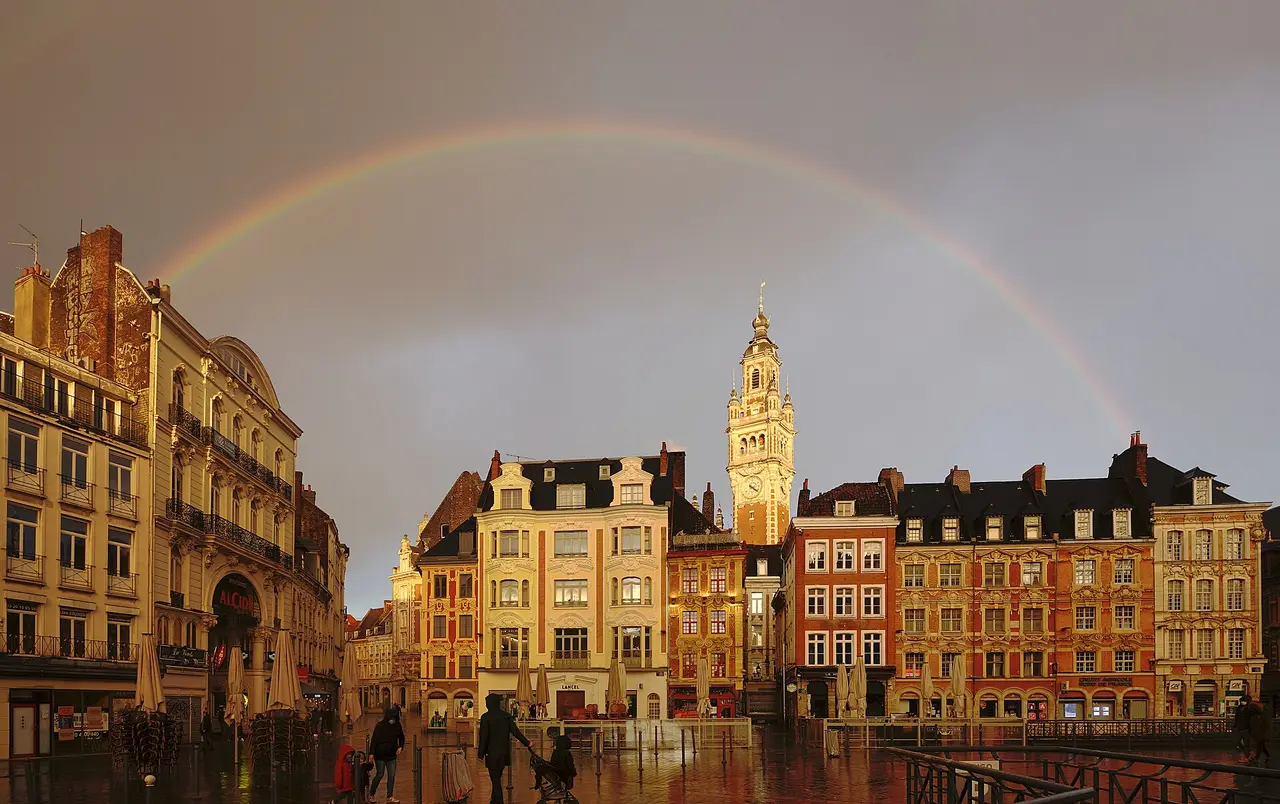
Place du Général-de-Gaulle, which every local calls the Grand Place, is framed by Flemish facades and the former headquarters of La Voix du Nord, topped by a gilded statue of the Three Graces representing the region's old provinces. Neighbouring Place Rihour houses the tourist office in a remnant of the palace of the Dukes of Burgundy. Further south, the 104-metre belfry of the town hall, listed by UNESCO with the belfries of Belgium and France, offers the best view over the metropolis. From late November to late December, a Christmas market fills Place Rihour and a big wheel turns on the Grand Place.

Wazemmes and the southern working-class districts

South-west of the centre, Wazemmes lives to the rhythm of its market, one of the busiest in the region, held on Tuesday, Thursday and above all Sunday mornings around the brick market hall. Expect northern cheeses, spices, second-hand clothes and rotisseries in a very mixed atmosphere. The district also has the Maison Folie, a cultural venue set in a former spinning mill. Allow two hours on a Sunday late morning, then carry on to Moulins, a former workers' district reinvented around the university faculties, where old textile factories now hold flats, workshops and performance halls.

Euralille and the station district

East of the centre, Euralille grew up in the 1990s around Lille-Europe station, served by TGV and Eurostar, about ten minutes on foot from the historic Lille-Flandres station. Designed under the direction of architect Rem Koolhaas, the district combines office towers, a shopping centre and chain hotels handy for a night before a train. The French capital is about an hour away, Brussels 35 minutes and London under an hour and a half. The VAL metro, the world's first automated metro when it opened in 1983, links both stations to the rest of the city.

The Deûle banks and the Bois de Boulogne

North-west of Vieux-Lille, the Deûle canal wraps around the city's largest green space: the Bois de Boulogne and the parkland surrounding the Citadel ramparts. Runners, cyclists and families gather there as soon as the weather turns fine, around the small municipal zoo and playgrounds. The landscaped quays make for a walk of about an hour between Square du Ramponneau and the centre. At weekends, come in the morning: in the afternoon the zoo area and lawns get very busy, especially from May to September.

Estaminets and Flemish cooking

The estaminet, a small Flemish café-restaurant with wooden benches and traditional games, remains the best place to try carbonade flamande stewed in beer, potjevleesch served cold in jelly, welsh rarebit with melted cheddar or maroilles cheese tart. Book on Friday and Saturday evenings, as dining rooms are often small. For something sweet, the vanilla-filled waffles of the Méert house on Rue Esquermoise, founded in 1761, are a Lille ritual. Beer, brewed by many microbreweries across the metropolis, accompanies almost every dish, and Rue de Gand lines up the most popular tables.

The Braderie and the year's big events

On the first weekend of September, the Braderie de Lille turns the centre into a gigantic flea market, with several dozen kilometres of stalls from Saturday morning to Sunday evening. Everyone eats moules-frites, and the empty shells pile up in front of the restaurants. Hotels are fully booked months ahead and prices rise sharply: book in spring, or stay in Roubaix or Tourcoing, linked by metro in about twenty minutes. Another highlight, the lille3000 seasons regularly stage large themed exhibitions across the metropolis, often in spring.

Roubaix, Villeneuve-d'Ascq and the mining basin

Some twenty minutes away by metro, Roubaix is home to La Piscine, an art and industry museum set in a 1930s Art Deco swimming pool, while neighbouring Croix preserves Robert Mallet-Stevens' Villa Cavrois. Villeneuve-d'Ascq hosts the LaM, a museum of modern art and art brut surrounded by a sculpture park. The Louvre-Lens is about 40 minutes away by regional train, in the heart of the UNESCO-listed mining basin. To continue to another historic city, Strasbourg and its Petite France can be reached by direct TGV in just under four hours.

Getting there

Airports serving Lille, from main hubs to secondary ones.
  • AGFAgen La Garenne airportAgenSecondary
  • AJAAjaccio Napoléon Bonaparte airportAjaccioSecondary
  • ANEAngers Marcé airportAngersSecondary
  • ANGAngoulême Brie-Champniers airportAngoulêmeSecondary
  • AUFAuxerre Branches airportAuxerreSecondary
  • AURAurillac airportAurillacSecondary

Practical information for Lille

Two stations

Lille-Flandres for regional trains and some TGVs to Paris, Lille-Europe for regional TGVs and Eurostar: allow about ten minutes on foot between them.

Airport

Lille-Lesquin, about ten kilometres south-east, linked to the centre by shuttle. Many travellers use Paris-CDG instead, about an hour by direct TGV from Lille-Europe.

Automated metro

Two VAL lines, plus the tram to Roubaix and Tourcoing, on the Ilévia network. Single tickets or day passes from station machines.

Lille City Pass

A 24, 48 or 72-hour pass including entry to many museums in the metropolis and, depending on the option, public transport.

Bike sharing

The V'Lille network has stations throughout the centre: handy for reaching the Citadel or Wazemmes, as the city is almost flat.

Weather

Cool oceanic climate: mild summers, grey winters and rain possible in any season. An umbrella and a warm jacket are useful from October to April.

Closing days

Museums in the metropolis do not all close on the same day, Monday or Tuesday depending on the venue: check before planning a long weekend.

Belgian border

Belgium starts about fifteen kilometres away: Kortrijk and Tournai are around half an hour by train, Brussels 35 minutes by TGV.

Eurostar to London

A passport and an Electronic Travel Authorisation (ETA) are required for the UK. Arrive at the Lille-Europe checks at least an hour before departure.

Lille in pictures

Photo credits : Velvet, CC BY-SA 4.0, Wikimedia Commons ; kallerna, CC BY-SA 4.0, Wikimedia Commons ; Pierre André Leclercq, CC BY 4.0, Wikimedia Commons ; Velvet, CC BY-SA 3.0, Wikimedia Commons

Frequently asked questions about Lille

How many days should you plan for Lille and Roubaix?
Two days are enough for Vieux-Lille, the Grand Place, the Palais des Beaux-Arts and Wazemmes. Add a day for La Piscine in Roubaix and Villa Cavrois, or for the Louvre-Lens, about 40 minutes away by train.
How far ahead should you book a hotel for the Braderie de Lille?
Several months ahead: on the first weekend of September the centre is saturated and rates soar. If everything is full, aim for Roubaix, Tourcoing or Villeneuve-d'Ascq, linked to the centre by the metro, which runs for much of Saturday night.
Where to eat welsh rarebit or carbonade in Vieux-Lille?
In the estaminets, plentiful around Place aux Oignons, Rue de Gand and Rue de la Monnaie. Book at weekends, as the rooms are small, and come hungry: the welsh, bread, ham and cheddar melted with beer, is a meal in itself.
Can you climb the Lille town hall belfry?
Yes, the visit combines a lift and about a hundred steps up to the top, over 100 metres high. Slots are limited: book through the tourist office, especially at weekends. On a clear day, the view stretches to the hills of Belgium.
Is the Palais des Beaux-Arts in Lille worth it on a short stay?
Yes, it is the museum not to miss: Flemish and European painting, Goya, Delacroix, and in the basement the relief models of the fortified towns of northern France. Allow two to three hours, and save time for the atrium and its monumental chandeliers.
Can you combine Lille and Brussels in one weekend?
Easily: the TGV links Lille-Europe to Brussels-Midi in about 35 minutes, and cheaper regional trains run via Tournai. A day in Brussels from Lille, or the other way round, is comfortable without changing hotels.
How do you get from Lille-Flandres to Lille-Europe with luggage?
On foot, about ten minutes through the Euralille shopping centre or along Rue Le Corbusier. The metro also links the two stations in one stop, on lines 1 and 2. Leave a margin if your Eurostar connection is tight.
What to do in Lille on a Sunday when shops are closed?
Start with the Wazemmes market in the morning, then head to the Citadel and the Bois de Boulogne. The major museums are open, and in Vieux-Lille some pastry shops and boutiques on Rue de la Monnaie stay open for part of the day.
Is the Louvre-Lens doable as a day trip from Lille?
Yes, the regional train reaches Lens in about 40 minutes, then a shuttle or a twenty-minute walk leads to the museum. The Gallery of Time takes about two hours; combine it with the nearby slag heaps and mining village.

Plan your trip to Lille

Build your day-by-day itinerary and manage budget, bookings and packing in PlanTripNow.
Aperçu de l'application PlanTripNow