Skip to content

Visit Manchester : what to see, how to get there and budget

Manchester tells its story in red brick: mills turned into lofts, canals lined with viaducts, neo-Gothic libraries and Northern Quarter bars. The city that launched the Industrial Revolution now lives on music, football and free museums, with the Peak District moors less than an hour away.

At a glance

Visa
None
7-day budget
€987
Per person, comfort profile, excluding international flights.

Why visit Manchester?

Manchester, the main city of north-west England in the United Kingdom, is the cradle of the Industrial Revolution and home to world-famous football clubs. Most of its major museums, from Science and Industry to the art gallery, are free. Allow two to four days, ideally from May to September, with a passport and, for many nationalities, an ETA.

When to visit Manchester

Temperatures, rainfall and crowds month by month, to pick your window.
When to visit Manchester
MonthTemperaturesRainCrowdsVerdict
January2 to 7 °C13 dQuietCool and grey: make the most of the free museums, from the John Rylands Library to the Science and Industry Museum.
February2 to 8 °C10 dQuietThe least rainy winter month, with some of the year's cheapest hotels outside match nights.
March3 to 10 °C12 dQuietShowers and sunny spells: bring a raincoat, the pubs and covered markets do the rest.
April5 to 13 °C11 dModerateThe Peak District moors turn green: a good time for a day hike from the city.
May7 to 16 °C10 dModerateThe most pleasant spring month, with terraces open in the Northern Quarter and Ancoats.
June10 to 19 °C11 dModerateLong evenings, but big stadium concerts push room prices up on some weekends.
July12 to 21 °C11 dBusyThe mildest month, barely 21 °C: ideal for the Castlefield canals, with a jacket within reach.
August12 to 20 °C12 dBusyManchester Pride in late August, a city in celebration and central hotels full that weekend.
September10 to 18 °C11 dModerateStudents and the football season return: book stadium tours early.
October7 to 14 °C14 dQuietAmong the rainiest months: art galleries and Ancoats cafés take over.
November4 to 10 °C14 dModerateFrequent rain, but the city-centre Christmas markets open around mid-November.
December2 to 8 °C14 dBusyChristmas markets packed on Saturdays: come on a weekday for mulled wine and the stalls.
Source: Normales 1991-2020 via climatestotravel.com, recoupées avec Weathermonth (réanalyse ERA5) et Holiday-Weather pour l'aéroport de Manchester, relevé novembre 2026. Ville de l'intérieur, sans température de mer.

Manchester's must-sees

Libraries, museums and districts that tell the city's story.

John Rylands Library

A late 19th-century neo-Gothic library with spectacular vaulted halls, free and open to the public.

Science and Industry Museum

A free museum on the site of the world's oldest passenger railway station.

Chetham's Library

A library founded in 1653, said to be the oldest public library in the English-speaking world, seen on guided tours.

Northern Quarter

A former textile warehouse district turned creative heart of the city, among vintage shops, record stores and street art.

Old Trafford

Manchester United's stadium, open for guided tours of the stands, dressing rooms and club museum.

Whitworth Gallery

The university's free art gallery, with collections of textiles, wallpapers and modern art, beside a park.

National Football Museum

A museum devoted to the history of English football, in a glass building near the cathedral.

The Lowry

An arts centre at Salford Quays devoted to the painter L. S. Lowry, with theatres and galleries facing the old docks.

What to discover in Manchester?

The Victorian centre and its libraries

The heart of the city keeps grand 19th-century buildings. The John Rylands Library, a neo-Gothic cathedral of books, is free to visit. Further north, Chetham's Library, founded in 1653, is said to be the oldest public library in the English-speaking world; it can be seen on a guided tour, to book ahead. The cathedral and the neo-Gothic town hall complete half a day on foot.

The Northern Quarter and Ancoats

The Northern Quarter, a former textile warehouse district, has become the haunt of vintage shops, record stores, cafés and painted walls. Just east, Ancoats, the world's first industrial suburb, has seen its mills converted into flats, restaurants and food halls such as Mackie Mayor. This is where people go out at night; expect a pub or cocktail bar every hundred metres.

Castlefield, the canals and industry

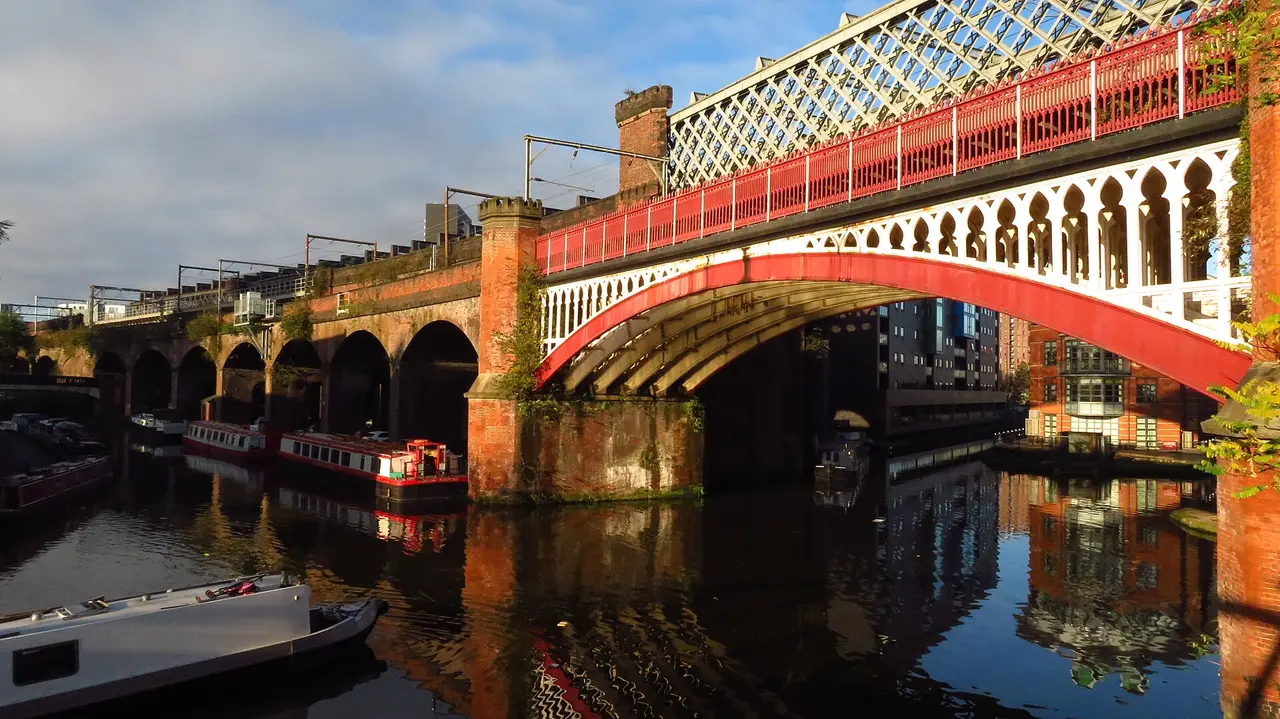
To the south-west, Castlefield mixes 18th-century canals, cast-iron railway viaducts and the remains of a Roman fort. The free Science and Industry Museum occupies the site of the world's oldest passenger station, opened in 1830. Allow three hours for the museum, then a walk along the Bridgewater Canal, pleasant even on a grey day. The towpath is flat and easy, even with children.

Football, Salford Quays and MediaCity

Both city clubs offer stadium tours, to book ahead and unavailable on match days: Old Trafford to the west, the Etihad to the east. The National Football Museum is in the centre. In Salford, at the end of the tram line, the old docks host The Lowry arts centre, the IWM North museum and the MediaCityUK studios, all within half a day.

The Peak District and Liverpool by train

Peak District National Park starts fifty minutes away by train: from Edale, the Kinder Scout plateau makes a loop of about five hours. To the west, Liverpool, its docks and the Beatles heritage are under an hour away, with trains roughly every half hour. These two trips make Manchester a good base for northern England. Bring waterproof boots for the moors.

How much it costs

Per person per day, excluding international travel.
Budget
81 €/ day
1 474 € for 2 people, 7 days, return flights included
Accommodation
40 €
Food
30 €
Local transport
6 €
Sights and activities
5 €
Comfort
141 €/ day
2 314 € for 2 people, 7 days, return flights included
Accommodation
58 €
Food
55 €
Local transport
10 €
Sights and activities
18 €
Premium
325 €/ day
4 890 € for 2 people, 7 days, return flights included
Accommodation
130 €
Food
110 €
Local transport
30 €
Sights and activities
55 €
Prices checked: Relevé novembre 2026 : Numbeo (mis à jour le 13/11/2026) pour repas, cafés, transports et taxis ; Budget Your Trip, Momondo et HotelsCombined pour l'hébergement (lit en auberge env. 40 €, 3 étoiles env. 115 € la chambre, 5 étoiles env. 260 € la chambre). Lit en dortoir pour backpacker, chambre double partagée à deux pour comfort et premium. Vol A/R Paris-Manchester env. 170 € par personne (moyennes Cheapflights de 120 à 179 £ selon le mois), hors vacances scolaires. Prévoir en plus l'autorisation électronique ETA à 20 £ par personne. Livre sterling convertie en euros, sensible au change ; la plupart des grands musées sont gratuits.

Getting there

Airports serving Manchester, from main hubs to secondary ones.
  • ADXLeuchars Station AirfieldLeuchars, FifeSecondary
  • BBSBlackbushe AirportCamberley, SurreySecondary
  • BEBBenbecula AirportBalivanichSecondary
  • BEQRAF HoningtonBury Saint Edmunds, SuffolkSecondary
  • BEXRAF BensonWallingford, OxfordshireSecondary
  • BHDGeorge Best Belfast City AirportBelfastSecondary

Entry, health and safety

For FR travellers

Entry requirements

No visa for a tourist stay

Passeport valide obligatoire : la carte d'identité n'est acceptée que pour les titulaires du statut de résident. Pas de visa pour le tourisme, jusqu'à six mois maximum, mais une autorisation de voyage électronique (ETA) est exigée : 20 £, valable deux ans ou jusqu'à l'expiration du passeport, à demander sur le site officiel du gouvernement britannique ou l'application UK ETA.

Health

Royaume-Uni en vigilance normale ; menace terroriste évaluée à 4 sur 5 (Severe) par les autorités britanniques. Vols et agressions sur la voie publique : ne pas exposer bijoux ni liquidités et éviter de marcher seul la nuit dans certains quartiers. Privilégier les VTC accrédités la nuit. Méfiance envers les sites commerciaux qui facturent l'ETA plus cher que le tarif officiel.

Safety

Normal precautions

Emergency

999 ou 112 (urgences), 101 (police hors urgence), 111 (conseil médical NHS)

Checked in novembre 2026 against the official source. Entry rules change: check the official source before you travel, it alone is authoritative.

Practical information for Manchester

Passport and ETA

A passport is required and many visitors, including EU citizens, need an Electronic Travel Authorisation (ETA) costing £20, valid two years. Check the rules for your nationality.

Free museums

The Science and Industry Museum, art gallery, Whitworth, Manchester Museum and John Rylands are free; a donation is suggested at the entrance.

Metrolink trams

Trams link the airport, the centre, Salford Quays and Old Trafford; contactless payment is capped per day.

From the airport

Direct trains to Piccadilly station in about twenty minutes, or the tram, slower but cheaper.

Match days

Stadium tours are suspended on match days and central hotels cost more: check the fixtures before booking.

Rain

Frequent showers in every season: a light waterproof beats an umbrella, often blown inside out by the wind.

Pubs

Order and pay at the bar; there is no table service and no tip expected in pubs.

Power plugs

Type G three-pin sockets, 230 V: an adapter is essential for continental European devices.

Manchester in pictures

Photo credits : Colin Park, CC BY-SA 2.0, Wikimedia Commons ; Doyle of London, CC BY-SA 4.0, Wikimedia Commons ; Samuel Vincent, CC BY-SA 4.0, Wikimedia Commons ; Ardfern, CC BY-SA 4.0, Wikimedia Commons

Frequently asked questions about Manchester

Do you need an ETA to visit Manchester?
EU citizens, including the French, need a valid passport and an Electronic Travel Authorisation, the ETA, which costs £20 and is valid for two years. Apply on the official UK government website or the UK ETA app, and beware of sites charging more. Check the rules for your own nationality.
Can you tour a football stadium in Manchester?
Yes, Old Trafford and the Etihad Stadium offer guided tours of the stands, dressing rooms and club museum, bookable online. They are suspended on match days. To watch a game, tickets are scarce and sold first to club members.
Manchester or Liverpool: which one to choose?
Both combine easily, under an hour apart by train. Manchester for free museums, nightlife and industrial architecture; Liverpool for its listed docks, waterfront and Beatles heritage. With three days, do Manchester plus a day in Liverpool.
How do you get from London to Manchester?
By direct train from Euston, about two and a quarter hours, with much lower fares when booked ahead. From continental Europe, a direct flight to Manchester avoids the detour via London, but Eurostar then the train remains a flight-free option.
What can you do in Manchester when it rains?
It is a local speciality: the John Rylands Library, the Science and Industry Museum, the art gallery and the Manchester Museum are free and indoors. Add the Ancoats food halls, the Northern Quarter record shops and a Victorian pub, and the rain becomes a detail.
Where can you hike near Manchester?
The Peak District is the classic outing: train to Edale in about fifty minutes, then a loop to Kinder Scout, about five hours. Hayfield and Castleton are other starting points. Bring waterproof boots, as the moorland is often muddy.
What is the best area to stay in Manchester?
The centre, between Piccadilly and Deansgate, puts everything within walking distance. The Northern Quarter and Ancoats suit those who go out at night, Castlefield those seeking calm by the canals. Salford Quays is handy for the stadiums but further out.

Plan your trip to Manchester

Build your day-by-day itinerary and manage budget, bookings and packing in PlanTripNow.
Aperçu de l'application PlanTripNow