Seville is covered on foot in three days: the largest Gothic cathedral in the world, the Alcázar and its gardens, the maze of Santa Cruz, Triana across the river. The city lives outdoors, at dusk, around a glass of fino. Avoid July and August, when the thermometer tops 40 degrees.
Discover
Why visit Seville?
Seville is the gateway to Andalusia and one of the most visited cities in Spain. Its historic centre, one of the largest in Europe, packs three UNESCO-listed sites within five minutes' walk of each other. It is under two hours by air from Paris and three hours by train from Madrid.
Seville's must-sees
Listed monuments, squares and flamenco venues, nearly all within walking distance in the centre.
Cathedral and Giralda
The largest Gothic cathedral in the world, Columbus's tomb and the climb up the Giralda by ramps to 70 metres.
Real Alcázar
A royal palace still in use, Mudéjar mosaics, the Ambassadors' Hall and terraced gardens; a timed ticket is essential.
Plaza de España
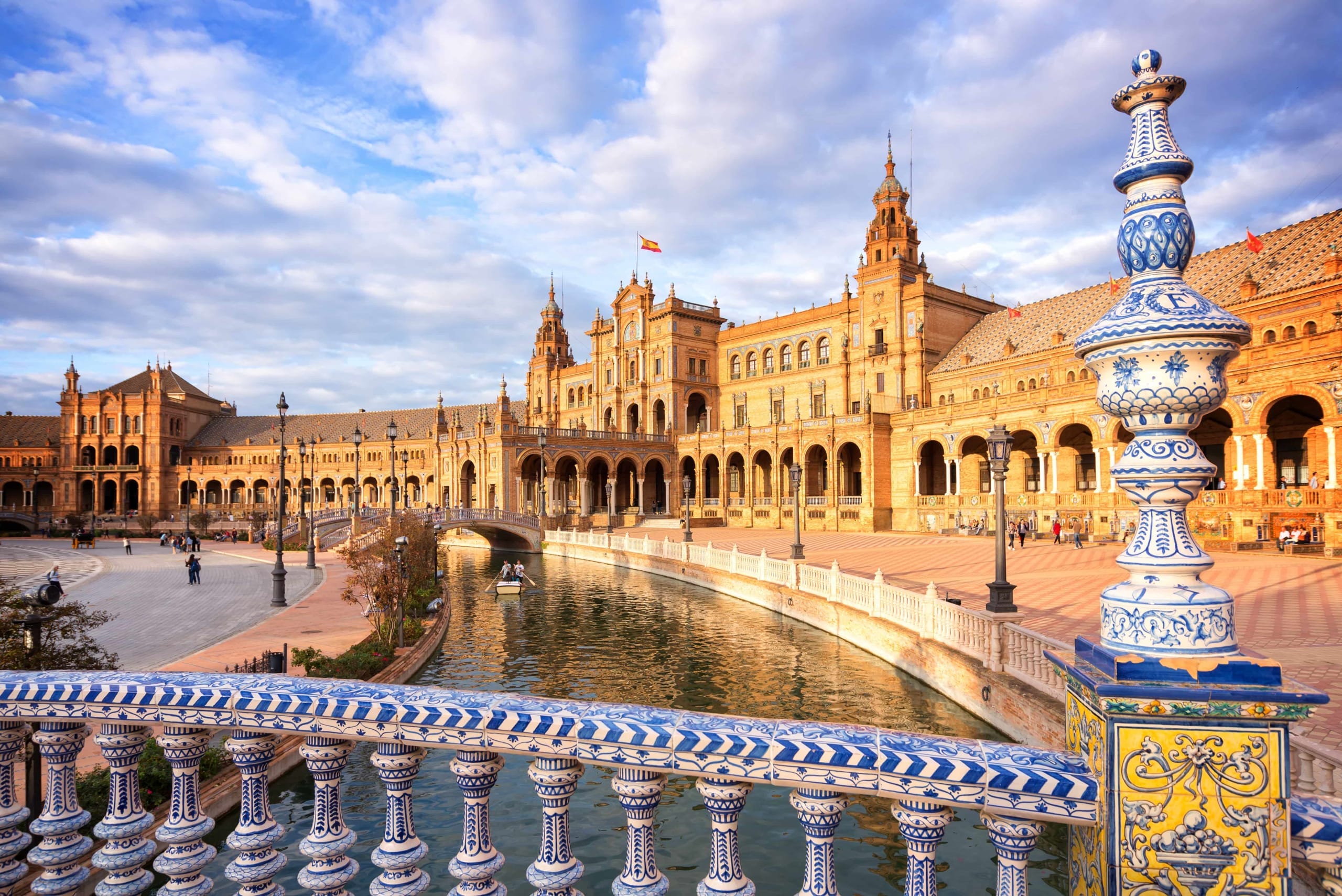
A 1929 brick-and-tile crescent, a canal you can row and benches illustrating the provinces of Spain.
Metropol Parasol
A wooden structure nicknamed the Setas, a rooftop panoramic walkway and Roman remains in the basement.
Torre del Oro
A 13th-century Almohad watchtower on the Guadalquivir, housing a small maritime museum.
Archivo de Indias
A former 1585 merchants' exchange holding the archives of Spain's colonisation of the Americas, free entry.
Hospital de los Venerables
A former baroque almshouse in Santa Cruz with a sunken courtyard, a painted church and the Focus centre's Velázquez collection.
Casa de Pilatos
A 16th-century palace blending Mudéjar and Italian Renaissance, around a fountain courtyard still lived in by the dukes.
Palacio de las Dueñas
A House of Alba residence where the poet Antonio Machado was born, courtyards, azulejos and orange gardens.
Maestranza bullring
An 18th-century oval ring in white and ochre stone, visitable with a museum outside bullfight days.
Basilica of La Macarena
The shrine of the most followed Virgin of Holy Week, with its museum of embroidered robes and processional floats.
What to discover in Seville, neighbourhood by neighbourhood?
The monumental centre: cathedral and Alcázar
The heart of Seville fits in 400 metres. The cathedral, built on the former Almohad mosque, holds the tomb of Christopher Columbus and is extended by the Giralda, a former minaret climbed by 35 stepless ramps. Right opposite, the Real Alcázar blends Mudéjar, Gothic and Renaissance palaces around gardens where Dorne was filmed for Game of Thrones. Book both online with a timed slot: on-site queues often exceed an hour in season.
Santa Cruz, the former Jewish quarter
Northeast of the Alcázar, the old Jewish quarter has become a lattice of white lanes, flower-filled courtyards and shaded little squares. You get lost on purpose between Plaza de Doña Elvira, Plaza de Santa Marta and the Murillo Gardens. The quarter is very touristy by day and quiet at night; the best tapas bars hide on Calle Mateos Gago, Calle Santa María la Blanca and at the edges of the quarter, towards Calle Mesón del Moro.
El Arenal and the river
Between the centre and the Guadalquivir, El Arenal was the port from which galleons sailed for the Americas. What remains is the Torre del Oro, a 13th-century watchtower, and the Real Maestranza bullring, among the oldest in Spain, which can be visited outside bullfight days. In the evening, the riverside walk and the Triana bridge give the best light on the city, with terraces along the quay.
Triana
Across the Isabel II bridge, Triana is the claimed birthplace of flamenco and of Sevillian ceramics. The covered market, built on the ruins of the Inquisition castle, holds a small interpretation centre; Calle Betis, along the river, lines up bars facing the historic centre. This is the district to see less staged flamenco, in a peña or at Casa Anselma, which does not open before midnight and takes no bookings.
La Macarena and the Alameda
To the north, the Macarena quarter keeps a stretch of the Almohad walls and its basilica, which holds the city's most venerated Virgin during Holy Week. Further south, the Alameda de Hércules, a former tree-lined promenade, has become the centre of alternative nightlife, with brunches, bars and vintage shops. This is the Seville of locals, fifteen minutes' walk from the Metropol Parasol.
María Luisa Park and the Plaza de España
South of the centre, María Luisa Park, given by the infanta in 1893, forms a 40-hectare garden of fountains and pavilions. It wraps around the Plaza de España, a brick-and-tile crescent built for the 1929 exhibition, with a canal where you can rent a rowing boat. Come early morning or at sunset for the raking light on the ceramics, and allow an hour to walk it.
Yes, it is as much a cultural as a religious event: baroque sculptures carried on shoulders, brass bands, streets silent on the night from Maundy Thursday to Good Friday. However the city is saturated, blocked-street routes change by the hour, and getting around takes twice as long.
Do you need to book the Real Alcázar in advance?
Yes, essential in high season. Timed tickets sell out days ahead for morning slots, and the queue without a booking often exceeds an hour in the sun. Take the first 9:30am slot to have the gardens almost to yourself.
How many days do you need to visit Seville?
Three full days are enough for the cathedral, the Alcázar, Santa Cruz, Triana and the Plaza de España without rushing. A fourth day allows a trip to Córdoba or Cádiz, or simply time for the terraces and a flamenco show.
Can you visit Seville in August?
You can, but it is hard going: over 40 degrees in the afternoon, many restaurants and shops closed for holidays, empty streets between 3pm and 8pm. Do the sights early, book air-conditioned lodging with a pool, and keep the evenings for going out.
What is the difference between the Feria de Abril and Holy Week?
Holy Week, the week before Easter, is made of solemn processions across the city. The Feria, two weeks later, is a secular party: private casetas, ruffled dresses, horses and a funfair, on a dedicated fairground in Los Remedios. Both fill the city.
Where can you see a real flamenco show in Seville?
For intense, barely staged flamenco, aim for the Triana peñas, the Casa de la Memoria in the centre, or Casa Anselma, which opens after midnight with no booking. The central tourist tablaos are decent but formatted and expensive.
Can you do Córdoba as a day trip from Seville?
Yes, Córdoba is 45 minutes away by high-speed train. Take an early departure, book the Mezquita for opening before the groups, and keep the afternoon for the Judería and the Roman bridge before heading back for dinner in Seville.
Can you visit Seville cathedral for free?
Yes, on Monday afternoon, on a slot to book online a few days ahead as places go fast. The rest of the week, the paid ticket includes the Giralda, the Church of the Saviour and gives skip-the-line access at a set time.
Should you stay in Santa Cruz or Triana?
Santa Cruz puts every monument within ten minutes' walk but can be noisy and pricey. Triana, across the river, offers a more local feel, good bars and slightly gentler prices, at the cost of a bridge to cross each day.
Is a boat trip on the Guadalquivir worth it?
The one-hour cruise from the Torre del Oro is restful late in the day but stays minor: it mostly runs past tree-lined banks. A walk or cycle along the river, between the Triana and Barqueta bridges, gives you as much.
Plan your trip to Seville
Build your day-by-day itinerary and manage budget, bookings and packing in PlanTripNow.