Skip to content

Visit Oslo : what to see, when to go and what budget to plan

Oslo surprises with its human scale: you walk on the Opera House roof, plunge into the fjord after a floating sauna, move from Munch to the polar ships of Bygdøy, then the metro climbs in twenty minutes to the forests and trails of Holmenkollen.

At a glance

Visa
None
7-day budget
€1,442
Per person, comfort profile, excluding international flights.

Why visit Oslo?

Oslo, the capital of Norway, packs the Munch museum, the National Museum, the Vigeland sculpture park and the polar museums of Bygdøy into a few kilometres. The fjord and the Nordmarka forest are reachable by public transport. Two to four days are enough, ideally from May to September; the city is expensive, so budget at least a hundred euros a day.

When to visit Oslo

Temperatures, rainfall and crowds month by month, to pick your window.
When to visit Oslo
MonthTemperaturesRainCrowdsVerdict
January-5 to 0 °C10 dVery quietSix hours of daylight and frequent snow: cross-country skiing on Nordmarka's lit trails, by metro.
February-5 to 1 °C8 dQuietThe driest winter month, with Norway's winter break emptying the city towards the mountains.
March-2 to 5 °C7 dQuietDaylight returning fast and ski jumping at Holmenkollen: winter at its most pleasant.
April2 to 11 °C8 dQuietEaster closes shops and museums for several days, check opening hours before booking.
May7 to 17 °C9 dModerateNational Day on 17 May, children's parades in costume and a city in celebration: a unique moment.
June11 to 20 °C10 dBusyNearly 19 hours of daylight: Aker Brygge terraces and fjord islands until midnight.
July13 to 23 °C11 dBusyThe fjord tops 18 °C for swimming, and business hotels cut prices during the Norwegian holidays.
August13 to 21 °C11 dBusyThe warmest sea of the year and open-air festivals, but more frequent showers.
September9 to 16 °C9 dModerateGolden Nordmarka forests and empty trails: the best season for hiking at the city's edge.
October4 to 10 °C11 dQuietGrey and rainy, but no queues at the museums, from Munch to the National Museum.
November0 to 4 °C11 dVery quietThe darkest month before the snow: best kept for the harbour's floating saunas and museums.
December-4 to 1 °C10 dModerateChristmas markets and the Nobel Peace Prize ceremony at City Hall on the 10th.
Source: Normales 1991-2020 de la station Oslo-Blindern (Seklima, Institut météorologique norvégien), recoupées avec Weather Atlas ; température de l'Oslofjord seatemperature.info recoupée avec Weather Atlas et climatestotravel.com, relevé novembre 2026

Oslo's must-sees

Architecture, art and nature, the visits that sum up the capital.

Oslo Opera House

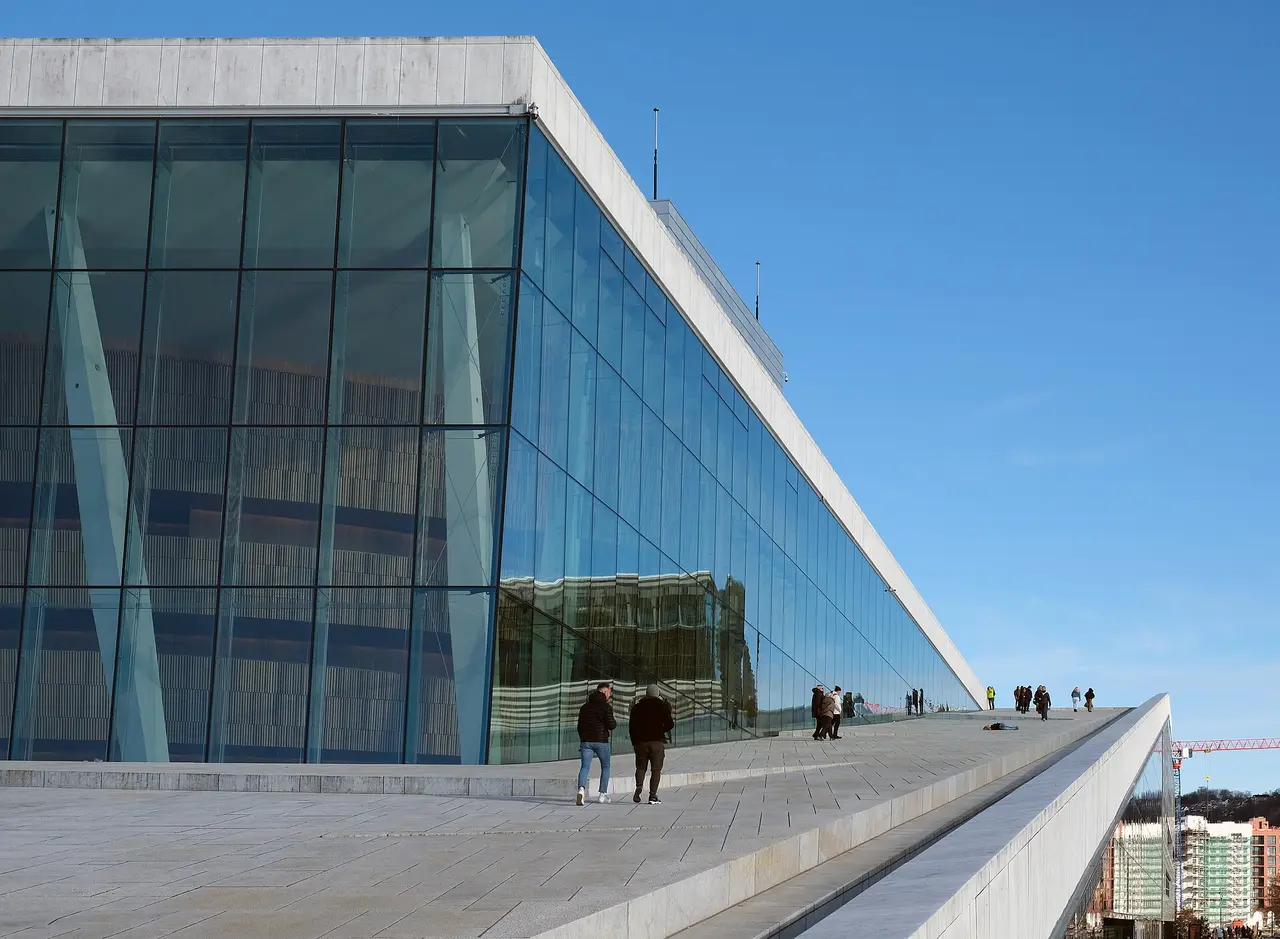
A white marble building on the fjord whose roof you can walk up for free to a panoramic terrace.

Munch Museum

A 13-storey tower devoted to Edvard Munch, with several versions of The Scream and a harbour view from the top floor.

National Museum

The largest art museum in the Nordic countries, opened in 2022, from Norwegian painters to contemporary design.

Vigeland Park

More than 200 bronze and granite sculptures in a free Frogner park, open day and night.

Akershus Fortress

A medieval castle turned royal fortress, with free ramparts offering views of the harbour and the Opera House.

Fram Museum

A polar ship preserved whole, visited on board, at the heart of the maritime museums of Bygdøy.

Holmenkollen Ski Jump

A ski jump towering over the city, with a ski museum and a viewing platform at the top.

Oslo City Hall

A large brick building with fresco-covered halls, where the Nobel Peace Prize is awarded every year.

What to discover in Oslo?

Bjørvika, the new waterfront

The old industrial port has become the city's showcase. You can walk freely on the sloping white marble roof of the Opera House up to its terrace over the fjord. Next door, the Munch museum fills a 13-storey tower whose top floor offers a panoramic view of the harbour. The floating saunas along the quays are booked by the hour, with a dip in the fjord between sessions, even in winter.

The centre, from Akershus to Aker Brygge

Akershus Fortress, dating from the 13th century, overlooks the harbour and its ramparts are free to visit. City Hall, where the Nobel Peace Prize is awarded every 10 December, opens its painted halls to the public. Further west, the Aker Brygge and Tjuvholmen quays line up terraces, the Astrup Fearnley contemporary art museum and the National Museum, opened in 2022, the largest art museum in the Nordic countries.

Frogner and Grünerløkka, two residential faces

To the west, upmarket Frogner is home to Vigeland Park, free and open day and night, with more than 200 sculptures by Gustav Vigeland around its monolith. To the east, Grünerløkka, a former working-class district, thrives on vintage shops, cafés and craft breweries. The Mathallen food hall and the walk along the Akerselva river, lined with old mills, link the area to the centre in an hour on foot.

Bygdøy and the fjord islands

The Bygdøy peninsula, twenty minutes away by bus or by boat in summer, gathers the maritime museums: the Fram, the polar expedition ship, Thor Heyerdahl's Kon-Tiki and the open-air Norwegian Folk Museum. In the fjord, Hovedøya and Gressholmen are reached by ferry from Vippetangen on an ordinary transport ticket. Allow a day per area, and a picnic for the islands.

Holmenkollen and the Nordmarka forest

Metro line 1 climbs in half an hour to the Holmenkollen ski jump, whose platform and ski museum overlook the whole city. Beyond it begins Nordmarka, a huge forest of lakes and trails. In winter, hundreds of kilometres of cross-country ski tracks, some of them lit, start from metro stations. In summer, Lake Sognsvann, at the end of line 5, makes a 3.3 km loop.

How much it costs

Per person per day, excluding international travel.
Budget
104 €/ day
1 776 € for 2 people, 7 days, return flights included
Accommodation
50 €
Food
35 €
Local transport
9 €
Sights and activities
10 €
Comfort
206 €/ day
3 204 € for 2 people, 7 days, return flights included
Accommodation
92 €
Food
70 €
Local transport
14 €
Sights and activities
30 €
Premium
440 €/ day
6 480 € for 2 people, 7 days, return flights included
Accommodation
190 €
Food
140 €
Local transport
40 €
Sights and activities
70 €
Prices checked: Relevé novembre 2026 : Numbeo (mis à jour le 13/11/2026) pour repas, cafés, transports et taxis ; Hostelz, Skyscanner et Momondo pour l'hébergement (lit en auberge env. 50 €, 3 étoiles env. 185 € la chambre, 5 étoiles env. 380 € la chambre). Lit en dortoir pour backpacker, chambre double partagée à deux pour comfort et premium. Vol A/R Paris-Oslo env. 160 € par personne (moyenne Liligo 144 € sur 3 mois, Kayak, PartirOu jusqu'à 190 €), hors vacances scolaires. Couronne norvégienne convertie en euros, sensible au change ; alcool fortement taxé.

Getting there

Airports serving Oslo, from main hubs to secondary ones.
  • AESÅlesund AirportÅlesundMain
  • BGOBergen Airport, FleslandBergenMain
  • BOOBodø AirportBodøMain
  • EVEHarstad/Narvik AirportEvenesMain
  • KRSKristiansand AirportKristiansandMain
  • OSLOslo-Gardermoen International AirportOsloMain

Entry, health and safety

For FR travellers

Entry requirements

No visa for a tourist stay

La Norvège fait partie de l'espace Schengen : passeport ou carte nationale d'identité en cours de validité. Les autorités norvégiennes ne reconnaissent pas la prolongation de validité des cartes d'identité délivrées entre 2004 et 2013 : avec une carte périmée, le passeport est indispensable.

Health

Assurance couvrant les frais médicaux indispensable avant le départ. Vigilance normale sur tout le territoire ; à Oslo, prudence contre les vols autour de la gare centrale et à l'est de celle-ci, surtout à Noël, Pâques et en juillet. Risque d'avalanche de décembre à mai en montagne.

Safety

Normal precautions

Emergency

112 (police), 113 (urgences médicales), 110 (pompiers)

Checked in novembre 2026 against the official source. Entry rules change: check the official source before you travel, it alone is authoritative.

Practical information for Oslo

Documents

Schengen area: a valid passport or EU identity card; French identity cards extended beyond their printed date are refused, so bring a passport. Check the rules for your nationality.

Ruter ticket

One ticket covers metro, tram, bus and ferries to the islands; buy it in the Ruter app, the 24-hour pass pays off quickly.

Cashless payment

Cards are accepted everywhere, even for tiny amounts; some shops no longer take cash at all.

Alcohol

Wine and spirits are sold only in the state-run Vinmonopolet shops, closed on Sundays; supermarket beer is not sold after 8pm on weekdays.

Tap water

Excellent and free: no need to buy bottled water, refill a bottle anywhere.

Floating saunas

One to two hour sessions to book online on the Bjørvika and Aker Brygge quays, with a fjord dip included.

Daylight

Under six hours of daylight in December and almost nineteen in June: plan outdoor visits around the season.

Sundays

Most shops are closed on Sundays, but museums, cafés and convenience stores stay open.

Power plugs

230 V with type C and F sockets, the same as continental Europe.

Pickpocketing

Crime is low, but stay alert around the central station and the area east of it, especially in summer.

Oslo in pictures

Photo credits : kallerna, CC BY-SA 4.0, Wikimedia Commons ; Christian David, CC BY-SA 4.0, Wikimedia Commons ; Pudelek (Marcin Szala), CC BY-SA 4.0, Wikimedia Commons ; Qwesy, CC BY 3.0, Wikimedia Commons

Frequently asked questions about Oslo

Is Oslo really that expensive?
Yes, it is one of Europe's most expensive capitals: a simple restaurant meal costs around 20 euros and a beer about 10. You save with supermarkets, tap water, free sights such as Vigeland or the Opera roof, and the 24-hour transport pass.
Munch Museum or National Museum: which one to choose?
If you come for Munch, the Munch Museum holds the artist's largest collection, with several versions of The Scream. The National Museum also shows a famous version of the painting, but it mainly covers Norwegian art and design as a whole. With two days, do both.
Can you swim in the fjord in Oslo?
Yes, in summer the water exceeds 18 °C in July and August. The easiest spots are the Opera House steps, Sørenga beach and Huk beach on Bygdøy. All year round, the harbour's floating saunas allow a cold plunge between hot sessions.
How do you get from Gardermoen Airport to central Oslo?
The Flytoget airport express links the airport to the central station in about twenty minutes, with very frequent departures. Vy regional trains make the same trip a little slower and cheaper. A taxi is very expensive over these fifty or so kilometres.
Oslo, Bergen or the fjords: what to choose for a first trip?
Oslo suits museums and an easy city break; Bergen, about seven hours away by train, is the gateway to the great western fjords. With a week, people often combine both via the Bergen Line, one of the country's most beautiful rail journeys.
Can you combine Oslo with Stockholm or Copenhagen?
Yes. Stockholm is about five hours by train, and an overnight ferry links Oslo to Copenhagen in around fifteen hours with a cabin. By air, both capitals are under an hour and a half away, allowing a ten-day Scandinavian circuit.

Plan your trip to Oslo

Build your day-by-day itinerary and manage budget, bookings and packing in PlanTripNow.
Aperçu de l'application PlanTripNow