Skip to content

Visit Reykjavík : districts, northern lights and day trips

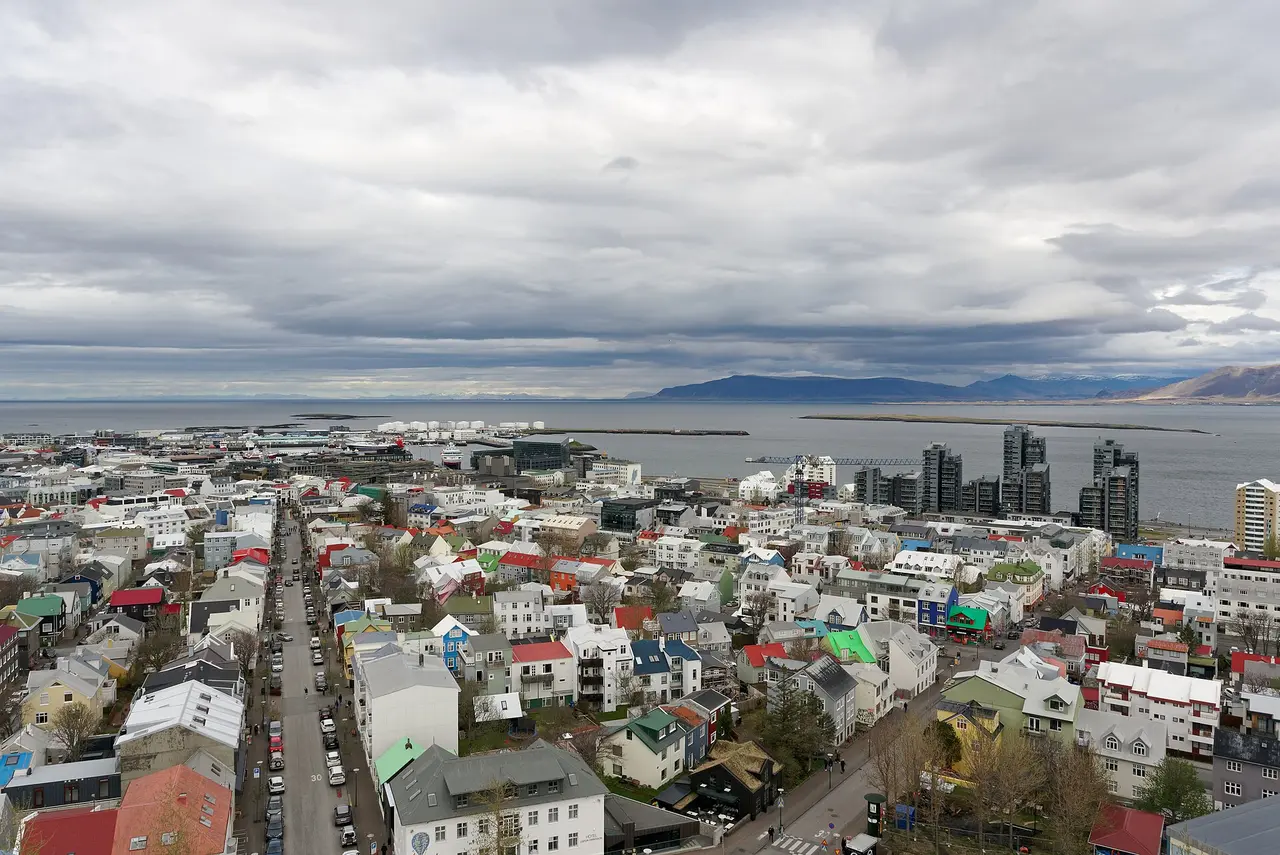
Between Faxaflói Bay and Mount Esja, Reykjavík can be explored on foot in a day, from the Hallgrímskirkja tower to the harbour where boats leave to see whales. Above all it is a base camp: the Golden Circle, the south coast and the geothermal lagoons are all less than three hours away by road.

At a glance

Visa
None
Tourist stay of up to 90 days
7-day budget
€1,995
Per person, comfort profile, excluding international flights.
Recommended length
3 days
For a first trip, without rushing.

Why visit Reykjavík?

Reykjavík is the capital of Iceland and the northernmost capital of a sovereign state; nearly two thirds of Icelanders live in its metropolitan area. People come for its compact centre, its geothermally heated pools and its position as a starting point for the Golden Circle, the south coast and the northern lights, visible from September to April.

When to visit Reykjavík

Temperatures, rainfall and crowds month by month, to pick your window.
When to visit Reykjavík
MonthTemperaturesRainCrowdsVerdict
January-2 to 3 °C15 dQuietSunrise comes around 11 am: you come for the heated pools and the auroras, not for strolling.
February-2 to 3 °C15 dModerateVetrarhátíð lights up Hallgrímskirkja and the centre in early February, with aurora tours almost every night.
March-1 to 4 °C14 dModerateTwelve hours of daylight at the equinox and still real nights: the best winter month for the capital.
April1 to 7 °C12 dQuietAffordable hotels around Easter, but an icy wind on the seafront and snow possible until mid-April.
May4 to 10 °C11 dModerateBoats to the Lundey puffins from mid-May, ahead of the big summer wave of visitors.
June7 to 13 °C9 dBusyThe driest month, almost no night and 17 June parades, but rooms cost top price.
July9 to 15 °C10 dPackedThe warmest month at 15 °C at best, with Laugavegur packed with cruise passengers at midday.
August9 to 14 °C12 dPackedReykjavík Pride in early August, then Menningarnótt and its fireworks: the city parties, so book very early.
September6 to 11 °C15 dModerateThe first auroras return and rates drop, at the cost of more frequent showers than in summer.
October3 to 8 °C13 dQuietOn 9 October the Imagine Peace Tower on Viðey lights up: a good off-peak month despite the gales.
November0 to 5 °C14 dQuietRock-bottom rates, except on the Iceland Airwaves weekend when the concert venues sell out.
December-2 to 3 °C15 dModerateBarely four hours of daylight, but New Year brings the most spectacular fireworks in the North.
Source: Normales 1991-2020 de la station de Reykjavík, Institut météorologique islandais (Veðurstofa Íslands), recoupées avec climatestotravel.com (minimales, maximales, jours de précipitations et température de la mer au large de Reykjavík), relevé octobre 2026. Affluence et prix estimés d'après la saisonnalité hôtelière de la capitale (pic de juin à août, creux en novembre et janvier) et les grands événements de la ville : Vetrarhátíð en février, fête nationale le 17 juin, Menningarnótt en août, Iceland Airwaves en novembre, Nouvel An.

Reykjavík's must-sees

Ten places to grasp the Icelandic capital, from the church tower to the seafront.

Hallgrímskirkja

The church with basalt-column lines towers 74 metres over the city; the paid lift up the tower gives the finest view over the rooftops.

Harpa concert hall

A honeycomb glass facade designed with artist Ólafur Elíasson, opened in 2011, whose foyer can be visited freely and at no cost.

Sólfar sculpture

A steel skeleton evoking a ship facing Mount Esja on the seafront, one of the most photographed spots at sunset.

Perlan dome

A museum of Icelandic natural wonders set on hot water tanks, with a man-made ice cave and a panoramic viewing deck.

Sky Lagoon

A geothermal lagoon in Kópavogur, 15 minutes from the centre, with an infinity pool facing the ocean and a seven-step bathing ritual.

Höfði House

The white seafront villa where Reagan and Gorbachev met in 1986; it can only be seen from the outside.

National Museum of Iceland

The country's history since Viking settlement, with the carved Valþjófsstaður door and medieval religious objects.

Viðey island

A car-free island a few minutes away by ferry, where Yoko Ono's Imagine Peace Tower shines from 9 October to 8 December.

Lake Tjörnin

A pond in the centre lined with colourful houses and the city hall, home to swans and geese and often frozen in winter.

Kolaportið market

A covered flea market near the harbour, open at weekends, where you can taste fermented shark and dried fish.

What to discover in Reykjavík?

Miðborg, the centre around Laugavegur

The heart of the city, nicknamed "101" after its postcode, fits into a rectangle of about two kilometres between Lake Tjörnin and the seafront. Laugavegur and Skólavörðustígur concentrate wool shops, cafés and bars; Parliament and the city hall line the lake. A day on foot is enough. In January the sun rises around 11 am, so keep the museums for after dark.

The Old Harbour and the Grandi district

Whale-watching trips leave the Old Harbour all year round, for about three hours at sea; from mid-May to mid-August, shorter boats circle the puffin islets. Further west, Grandi has turned its fishing warehouses into places to visit: Whales of Iceland, the Marshall House and food halls. Book the trip the day before, as cancellations for strong winds are frequent in winter.

Laugardalur and the pool culture

The Laugardalur valley, 3 km east of the centre, brings together the city's largest pool, a botanical garden and a small family zoo. Municipal pools are the locals' true living room: hot tubs up to 44 °C and entry around 1,200 ISK, far from lagoon prices. A full shower without a swimsuit before bathing is compulsory and checked by staff.

Vesturbær, Seltjarnarnes and the Grótta point

West of the harbour, Vesturbær lines up colourful corrugated-iron houses and quiet streets as far as Seltjarnarnes. At its tip, Grótta lighthouse, 15 minutes by car from the centre, is the best urban spot for the northern lights, away from street lighting. The islet can only be reached on foot at low tide and is closed from 1 May to 15 July for nesting birds.

Day trips from the capital

Reykjavík is the starting point for almost every trip around Iceland: the Golden Circle is a day loop of about 300 km, best started before 9 am to beat the coaches. The Reykjanes peninsula, home to the Blue Lagoon, has seen repeated eruptions since 2023: check site openings on safetravel.is. Icelandair stopovers also make it easy to combine the capital with Norway or Denmark.

Sample itineraries

Three routes built around the time you actually have.
3daysRecommended

Reykjavík in 3 days: the capital, the Golden Circle and Perlan

  1. Day 1: the historic centre and Lake Tjörnin
  2. Day 2: the Golden Circle (Þingvellir, Geysir, Gullfoss)
  3. Day 3: Perlan, Nauthólsvík and Laugardalslaug

Best for: The ideal format for a first stay: a day in town, the classic loop to Þingvellir, Geysir and Gullfoss, then a day of museums and pools. The Golden Circle needs a car or a coach tour.

How much it costs

Per person per day, excluding international travel.
Budget
106 €/ day
1 984 € for 2 people, 7 days, return flights included
Accommodation
45 €
Food
45 €
Local transport
6 €
Sights and activities
10 €
Comfort
285 €/ day
4 490 € for 2 people, 7 days, return flights included
Accommodation
120 €
Food
90 €
Local transport
15 €
Sights and activities
60 €
Premium
605 €/ day
8 970 € for 2 people, 7 days, return flights included
Accommodation
250 €
Food
160 €
Local transport
45 €
Sights and activities
150 €
Prices checked: Relevé octobre 2026 : repas et transports d'après Numbeo Reykjavík (mise à jour du 7 octobre 2026 : repas bon marché 27,74 €, dîner de milieu de gamme pour deux 109 €, cappuccino 6 €, bière 12,40 €, ticket de bus 5 €, taxi 6 € de prise en charge puis 2,50 €/km). Ticket Strætó porté à 690 ISK au 6 janvier 2026 (straeto.is). Navette Flybus aéroport de Keflavík-BSÍ à 3 999 ISK l'aller, 7 298 ISK l'aller-retour (Icelandia, 2026), comptée dans le transport. Hébergement : moyennes combien-coute.net du 28 septembre 2026 pour deux personnes (auberge 156 €, hôtel 3 étoiles 242 €, 4 étoiles 298 €, 5 étoiles 709 €) et lit en dortoir autour de 45 € (budgetyourtrip.com). Activités : piscine municipale et tour de Hallgrímskirkja vers 1 200 ISK, Sky Lagoon dès 14 470 ISK, sortie baleines au départ du vieux port autour de 100 $. Hébergement par nuit et par personne : lit en dortoir pour backpacker, chambre double partagée à deux pour comfort et premium. Séjour en ville sans voiture de location. Prix hors haute saison : de juin à août l'hébergement grimpe nettement. Vol A/R Paris-Reykjavík estimé à 250 € par personne (Liligo : moyenne de 248 € sur les trois derniers mois, 147 € en moyenne avec easyJet, 226 € avec Icelandair), hors vacances scolaires. Couronne islandaise : montants convertis au taux d'octobre 2026, sensibles au change.

Getting there

Airports serving Reykjavík, from main hubs to secondary ones.
  • AEYAkureyri International AirportAkureyriMain
  • KEFKeflavik International AirportReykjavíkMain
  • BIUBildudalur AirportBildudalurSecondary
  • EGSEgilsstaðir AirportEgilsstaðirSecondary
  • GRYGrímsey AirportGrímsey/SandvíkSecondary
  • HFNHornafjörður AirportHöfnSecondary

Entry, health and safety

For FR travellers

Entry requirements

No visa for a tourist stay

L'Islande fait partie de l'espace Schengen : les Français y circulent librement sans visa pour un séjour de moins de trois mois, avec une carte nationale d'identité ou un passeport valable pendant toute la durée du séjour. Au-delà de trois mois, il faut s'enregistrer auprès du registre national islandais.

Stay allowed for up to 90 days.

Health

Advised: Vaccinations du calendrier français à jour, notamment diphtérie, tétanos, poliomyélite, coqueluche et rougeole.

Demandez la carte européenne d'assurance maladie au moins 15 jours avant le départ et prévoyez une assurance couvrant l'évacuation. Compléments de vitamine D recommandés pour un long séjour d'hiver. Tout le territoire est en vigilance normale ; petite délinquance et vols à la tire sur les sites touristiques. Risque volcanique concentré sur le sud et la péninsule de Reykjanes, et routes fermées rapidement par la météo, jusqu'à perturber l'aéroport de Keflavík : suivez safetravel.is. Ambassade de France à Reykjavík : +354 546 0256.

Safety

Normal precautions

Emergency

112

Checked in octobre 2026 against the official source. Entry rules change: check the official source before you travel, it alone is authoritative.

Practical information for Reykjavík

From Keflavík airport

50 km west: the Flybus shuttle to the BSÍ terminal takes 45 minutes, 3,999 ISK one way. There is no train.

Strætó city buses

Single ticket at 690 ISK since January 2026, paid through the Klappið app. Few buses after midnight.

Pool rule

A full shower without a swimsuit is compulsory before entering the pool, and staff check it.

Tap water

Cold water is excellent and free. Hot water is geothermal and smells of sulphur: this is normal and harmless.

Buying alcohol

Only in the state-run Vínbúðin shops, with limited hours. Bars run happy hours in the late afternoon.

Payment

Cards are accepted everywhere, even for a coffee; there is no need to withdraw Icelandic krónur (ISK).

Tipping

Service is included in prices and tips are not expected.

Power sockets

Types C and F, 230 V, as in mainland Europe.

Reykjavík City Card

A 24, 48 or 72-hour pass including buses, pools, municipal museums and the Viðey ferry.

Reykjavík in pictures

Photo credits : Jakub Hałun, CC BY-SA 4.0, Wikimedia Commons ; Jakec, CC BY-SA 3.0, Wikimedia Commons ; Preserved Light Photography, CC BY-SA 3.0, Wikimedia Commons ; john.purvis, CC BY 2.0, Wikimedia Commons

Frequently asked questions about Reykjavík

How many days should you spend in Reykjavík before the Ring Road?
Two days are enough for the centre, Harpa, the harbour and a pool. Three days let you add a Golden Circle day trip. Beyond that, it is better to rent a car and head for the south coast or Snæfellsnes than to stay in town.
Can you see the northern lights from central Reykjavík?
It is possible during strong activity, but city lighting dims them. Go to Grótta lighthouse, 15 minutes away by car, or take a coach tour inland. The season runs from September to April, on clear nights.
Sky Lagoon or Blue Lagoon when staying in Reykjavík?
Sky Lagoon is 15 minutes from the centre and easy to fit in at the end of a day. The Blue Lagoon, about 50 minutes away, pairs well with arriving at or leaving Keflavík, but it closes temporarily during eruptions on the Reykjanes peninsula.
Do you need a car for a stay in Reykjavík?
Not for the city: everything is walkable, with the Flybus from the airport and Strætó buses. A car becomes useful for the Golden Circle or the south coast; otherwise you need to book coach tours leaving from the centre.
Is the Reykjavík City Card worth it?
It pays off if you combine several municipal museums, a pool and the Viðey ferry on the same day. For a stay built around the Golden Circle or boat trips, which it does not include, paying at the door often works out cheaper.
Why does the shower water smell of rotten eggs in Reykjavík?
Hot tap water comes straight from geothermal boreholes and contains a little sulphur, hence the smell. It is harmless. Cold water comes from springs and is drinkable without a filter, so there is no need to buy bottled water.
Where can you see puffins near Reykjavík?
From mid-May to mid-August, boats leave the Old Harbour for the islets of Akurey and Lundey, a few minutes away, on trips of about an hour. Outside this period, the puffins have left the coast and spend the winter at sea.
What daily budget should you plan for Reykjavík?
Allow about 106 € per person per day in a hostel, 285 € in a three-star hotel with restaurant meals, and 605 € for a premium trip with guided tours, based on our October 2026 price checks, excluding flights. Prices rise sharply from June to August.

Plan your trip to Reykjavík

Build your day-by-day itinerary and manage budget, bookings and packing in PlanTripNow.
Aperçu de l'application PlanTripNow