Skip to content

Visit Saint-Tropez : harbour, beaches and gulf villages

Ochre facades lining the Old Port, a market beneath the plane trees of Place des Lices, granite coves along the coastal path and, just behind, the hilltop villages of Gassin and Ramatuelle: Saint-Tropez is best enjoyed on foot, ideally outside July and August.

Why visit Saint-Tropez?

Saint-Tropez is a small port in the Var, at the tip of the gulf that bears its name, which drew post-impressionist painters before becoming a famous seaside resort in the 1950s. Its centre can be explored on foot in a day, while the Pampelonne beaches and the coastal path easily fill two or three more.

Saint-Tropez highlights

A town where museums are small but distinctive, and where local festivals matter as much as the beaches.

Saint-Tropez Citadel

An early 17th-century fortress overlooking the gulf, it houses a maritime history museum devoted to local sailors, with a view across the whole bay.

Musée de l'Annonciade

Set in a former chapel by the harbour, it gathers canvases by Signac, Matisse, Bonnard and Derain, painters who turned Saint-Tropez into an artistic hub.

Gendarmerie and Cinema Museum

In the old police station made famous by Louis de Funès films, it traces the history of filming in Saint-Tropez and of the gendarme's profession.

Church of Notre-Dame-de-l'Assomption

Its ochre and pink bell tower defines the harbour skyline; inside, the bust of Saint Tropez is carried through town every May during the Bravade.

Sainte-Anne Chapel

A small 17th-century chapel on a hill south of town, surrounded by pines, valued for its sailors' votive offerings and its view over the gulf.

Paillas Windmills

On the heights between Gassin and Ramatuelle, this restored windmill offers, on clear days, a full panorama of the gulf, Pampelonne and the Maures hills.

The May Bravade

A centuries-old religious and military festival in mid-May, with a procession of Saint Tropez's bust, period costumes and blunderbuss salvos in the streets.

Les Voiles de Saint-Tropez

In late September and early October, this regatta gathers classic and modern sailing yachts in the gulf, turning the harbour into a floating museum.

What to discover in Saint-Tropez, from harbour to hills?

The Old Port and Quai Suffren

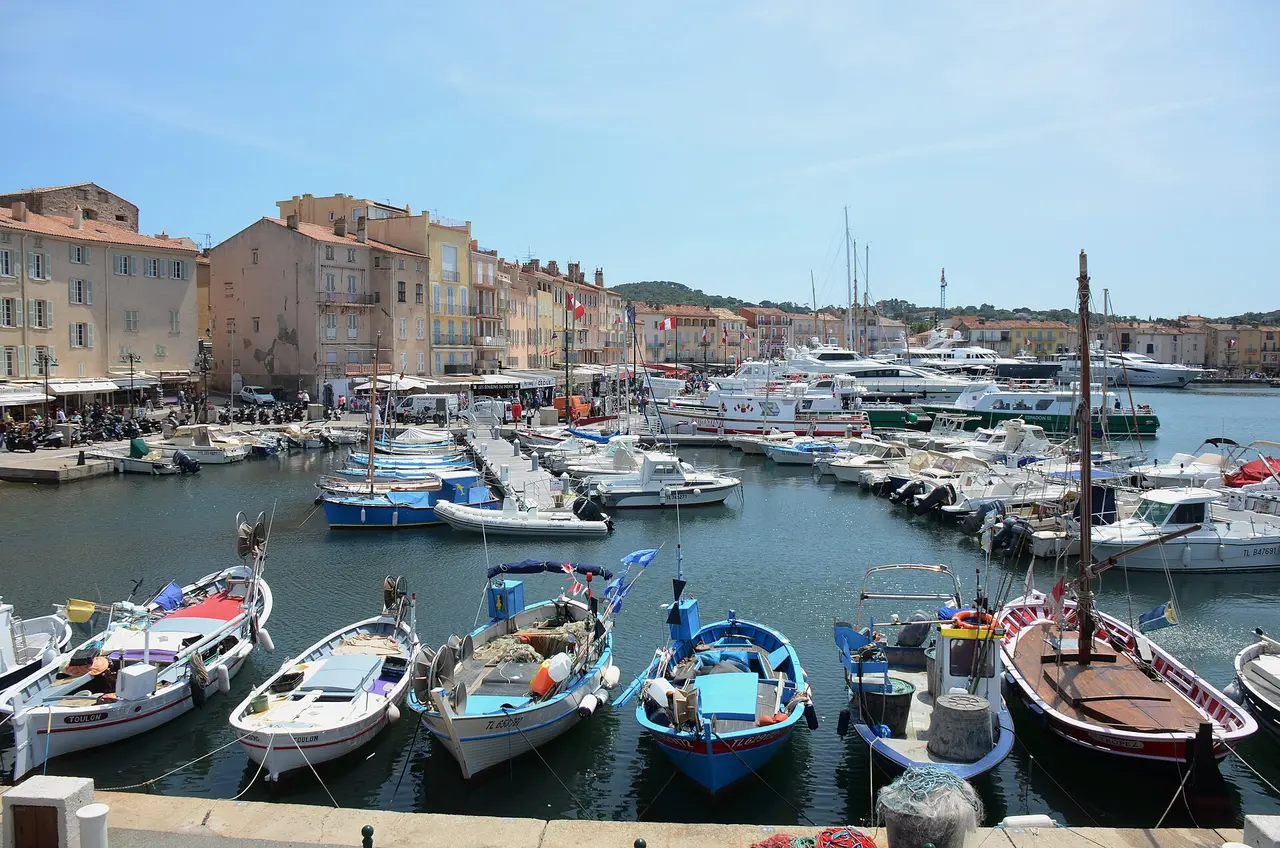
The Old Port sums up Saint-Tropez: pastel houses, terraces facing the water and, in summer, large yachts moored a few metres from the tables. Quai Suffren and Quai Jean-Jaurès can be walked in twenty minutes, but the scene changes with the hour. Come early in the morning, when fishermen return and cafés open, or late in the day for the low light over the gulf. In July and August, waterfront terrace prices are among the highest on the coast: a café one street back costs noticeably less.

La Ponche and the fishermen's lanes

Behind the Portalet tower, La Ponche is the oldest district in town: cobbled lanes, vaulted passages and a small beach where the traditional fishing boats, the pointus, are still hauled ashore. This is where you grasp that Saint-Tropez was first a sailors' village. An hour is enough to wander, then climb towards the church and its ochre bell tower. Before 10 am the lanes are almost empty, even in high summer, and the little Ponche beach is ideal for a quick swim.

Place des Lices and the upper town

Set back from the harbour, Place des Lices is where locals gather: games of pétanque under the plane trees and a large Provençal market on Tuesday and Saturday mornings. Arrive before 9 am to move freely between stalls of fruit, cheese and table linen. From there, a climb of about fifteen minutes leads to the citadel, which overlooks the gulf and the town. The upper town is also where to try the tarte tropézienne, a cream-filled brioche created here in the 1950s.

Pampelonne and the Ramatuelle beaches

The big sandy beaches are not in Saint-Tropez itself but in neighbouring Ramatuelle, about fifteen minutes away by car. Pampelonne Bay stretches for roughly 4.5 km, with private beach clubs and wide public, free sections. Since the 2019 reorganisation, beach establishments are dismantled every winter and their number has been reduced. Further south, L'Escalet and La Briande offer quieter rocky coves. In summer the paid car parks fill up by 11 am: set off early.

The coastal path

The coastal path loops around the peninsula from the harbour. The most popular stretch starts at Graniers beach, passes Les Canebiers and Pointe de la Rabiou, then reaches Les Salins beach: allow about three hours of walking with time for swims. The trail alternates pine woods, granite rocks and small coves reachable only on foot. Bring water and closed shoes, and avoid the hottest hours in July and August, as shade is scarce on some sections.

Gassin, Ramatuelle and the hilltop villages

Less than 15 km from the harbour, two hilltop villages show another side of the peninsula. Gassin, listed among the Most Beautiful Villages of France, looks over the gulf from its promontory and restaurant terraces. Ramatuelle coils around its former castle, surrounded by Côtes de Provence vineyards. Between the two, the Paillas windmills offer one of the finest viewpoints in the area. Half a day covers both villages, ideally in late afternoon when the heat eases.

Getting there and around the gulf

Saint-Tropez has no railway station and a single main road leads in: in July and August, traffic jams from La Foux often exceed an hour. Ferry shuttles from Sainte-Maxime, about twenty minutes, or from Port Grimaud bypass the bottleneck. Trains stop at Saint-Raphaël, where coaches and seasonal boats depart, and summer boat links also run from the Croisette in Cannes. From Marseille, allow about two hours by road off-peak. For a first Riviera stay in France, two to three nights are enough.

Getting there

Airports serving Saint-Tropez, from main hubs to secondary ones.
  • AGFAgen La Garenne airportAgenSecondary
  • AJAAjaccio Napoléon Bonaparte airportAjaccioSecondary
  • ANEAngers Marcé airportAngersSecondary
  • ANGAngoulême Brie-Champniers airportAngoulêmeSecondary
  • AUFAuxerre Branches airportAuxerreSecondary
  • AURAurillac airportAurillacSecondary

Practical information for Saint-Tropez

Road access in summer

A single main road serves the town from the La Foux junction: in July and August, arrive before 9 am or after 7 pm to avoid jams of over an hour.

Ferry shuttles

Regular boats from Sainte-Maxime (about 20 minutes) and Port Grimaud, seasonal links from Saint-Raphaël and Cannes.

Nearest airports

Toulon-Hyères about 50 km away, Nice Côte d'Azur about 100 km away, roughly 1 h 30 to 2 h by road off-season.

Train

No station in Saint-Tropez: get off at Saint-Raphaël, then take the regional coach or, in season, the boat.

Place des Lices market

Tuesday and Saturday mornings, all year round. Come before 9 am in summer.

Parking

Paid car parks at the harbour and Les Lices, often full by late morning in summer; Pampelonne beach car parks are also paid.

Public and private beaches

At Pampelonne the sand is freely accessible between establishments; private beach loungers and parasols should be booked ahead in high season.

Tourist tax

Charged by accommodation on top of the room rate, depending on the establishment's rating.

Power sockets

Type E, 230 V, as everywhere in France.

Saint-Tropez in pictures

Photo credits : Henk Monster, CC BY 3.0, Wikimedia Commons ; Zteditwiz, CC BY-SA 3.0, Wikimedia Commons ; Starus, CC BY-SA 3.0, Wikimedia Commons ; Rolf Kranz, CC BY-SA 4.0, Wikimedia Commons

Frequently asked questions about Saint-Tropez

Is Pampelonne really in Saint-Tropez?
No, Pampelonne Bay lies in the municipality of Ramatuelle, about fifteen minutes from the harbour by car. Saint-Tropez itself only has small beaches, such as La Ponche, Les Graniers or Les Canebiers. Without a car, shuttles and taxis link the town to the beaches in season.
Is it better to take the boat from Sainte-Maxime in August?
Yes, it is often the calmest option. The crossing from Sainte-Maxime takes around twenty minutes and lands right at the Old Port, whereas the access road can be jammed for more than an hour. Park in Sainte-Maxime in the morning and book your return if possible.
Which days is the Place des Lices market held?
The market runs on Tuesday and Saturday mornings, all year round. You will find Provençal produce, cheese and flowers, as well as linen and second-hand goods. In summer, crowds build quickly from 10 am: come at opening time to enjoy the stalls and the shade of the plane trees.
What is there to see in Saint-Tropez off-season?
From October to April the harbour regains its calm and the Annonciade and citadel museums can be visited without queues. The coastal path is then very pleasant. Some restaurants and beach clubs close in winter, but Les Voiles de Saint-Tropez, in late September, offers a last highlight before the quiet season.
What is the Saint-Tropez Bravade?
It is a traditional festival held every year in mid-May in honour of Saint Tropez, the town's patron. For three days, the saint's bust is carried in procession, escorted by residents in costume firing blunderbuss salvos. Accommodation is in high demand during this period.
Can you reach Saint-Tropez from Nice without a car?
Yes, but the journey is long. The simplest route is the train to Saint-Raphaël, then the regional coach or, in season, the boat to Saint-Tropez. Allow at least two and a half hours in total. Once there, the town is entirely walkable, and shuttles serve the beaches.
Where does the tarte tropézienne come from?
This brioche filled with a light cream was created in Saint-Tropez by a pastry chef of Polish origin in the 1950s, and its name is said to have been suggested during a film shoot with Brigitte Bardot. It is sold in the town's bakeries, notably near Place des Lices.

Plan your trip to Saint-Tropez

Build your day-by-day itinerary and manage budget, bookings and packing in PlanTripNow.
Aperçu de l'application PlanTripNow