Skip to content

Visiting Split : what to see, when to go and what to budget

In Split, you drink your coffee between Roman columns: Diocletian's Palace is not a museum but a neighbourhood lived in for seventeen centuries. The city is also the home port for Hvar, Brač, Trogir and the Krka waterfalls, all within an hour and a half.

At a glance

Visa
None
Tourist stay of up to 90 days
7-day budget
€945
Per person, comfort profile, excluding international flights.
Recommended length
3 days
For a first trip, without rushing.

Why visit Split?

Split is Croatia's second city, with around 160,000 inhabitants, and the main port of the Dalmatian coast. Its historic centre, built inside the palace Emperor Diocletian raised around 300 AD, is UNESCO-listed. The city blends Roman heritage, urban beaches and daily connections to the islands.

When to visit Split

Temperatures, rainfall and crowds month by month, to pick your window.
When to visit Split
MonthTemperaturesRainCrowdsVerdict
January6 to 11 °C11 dVery quietA biting bora wind is possible and the Riva is deserted: you have Diocletian's Palace to yourself, but the islands are half asleep.
February6 to 12 °C9 dVery quietCarnival livens up the streets, hotels are at their cheapest and a 12 °C sea rules out any swim.
March9 to 15 °C10 dQuietWalks on Marjan hill at 15 °C between rainy days, with no queue at all for the palace cellars.
April12 to 18 °C10 dQuietTerraces reopen and afternoons reach 18 °C, but there are still ten rainy days and the water is at 14 °C.
May16 to 23 °C9 dModerateThe feast of Saint Domnius, the city's patron, on 7 May, and 23 °C by day: a good time for the old town.
June20 to 28 °C8 dBusyA 21 °C sea and Bačvice beach already busy; catamarans to Hvar and Brač fill up, so book them.
July23 to 31 °C5 dPacked31 °C, palace lanes packed at midday and rates at their peak: sightsee early, swim in the afternoon.
August23 to 31 °C5 dPackedThe driest month and the warmest sea, at 24 °C, but also the year's most congested ferry port.
September18 to 25 °C8 dBusyWater still at 22 °C and 25 °C by day, with low-season ferry fares from late in the month: the month to aim for.
October15 to 21 °C9 dQuiet20 °C and a 19 °C sea for the hardy; several island links already cut back their timetables.
November11 to 16 °C12 dVery quietTwelve rainy days and closed beach restaurants: only the old town keeps its bustle.
December7 to 12 °C12 dQuietAdvent lights up the Riva and the Peristyle, with 12 °C in the afternoon but frequent rain.
Source: Normales officielles 1991-2020 de la station Split-Marjan (DHMZ, service météorologique croate), reprises dans le tableau climatique de Wikipédia (article Split, Croatia) et identiques à celles déjà retenues pour la Croatie (NOAA NCEI). Jours de pluie = jours à précipitations ≥ 0,1 mm, arrondis à l'unité. Température de la mer : moyennes mensuelles du même tableau, arrondies au degré. Relevé octobre 2026.

Split's must-sees

Nine stops, from the Roman city to the neighbouring islands.

Peristyle

The palace's colonnaded courtyard, where actors dressed as legionaries pose in summer.

Palace cellars

Intact vaulted halls that reveal the layout of Diocletian's apartments.

Saint Domnius Cathedral

One of the oldest buildings still used as a cathedral, set in the emperor's mausoleum.

Riva

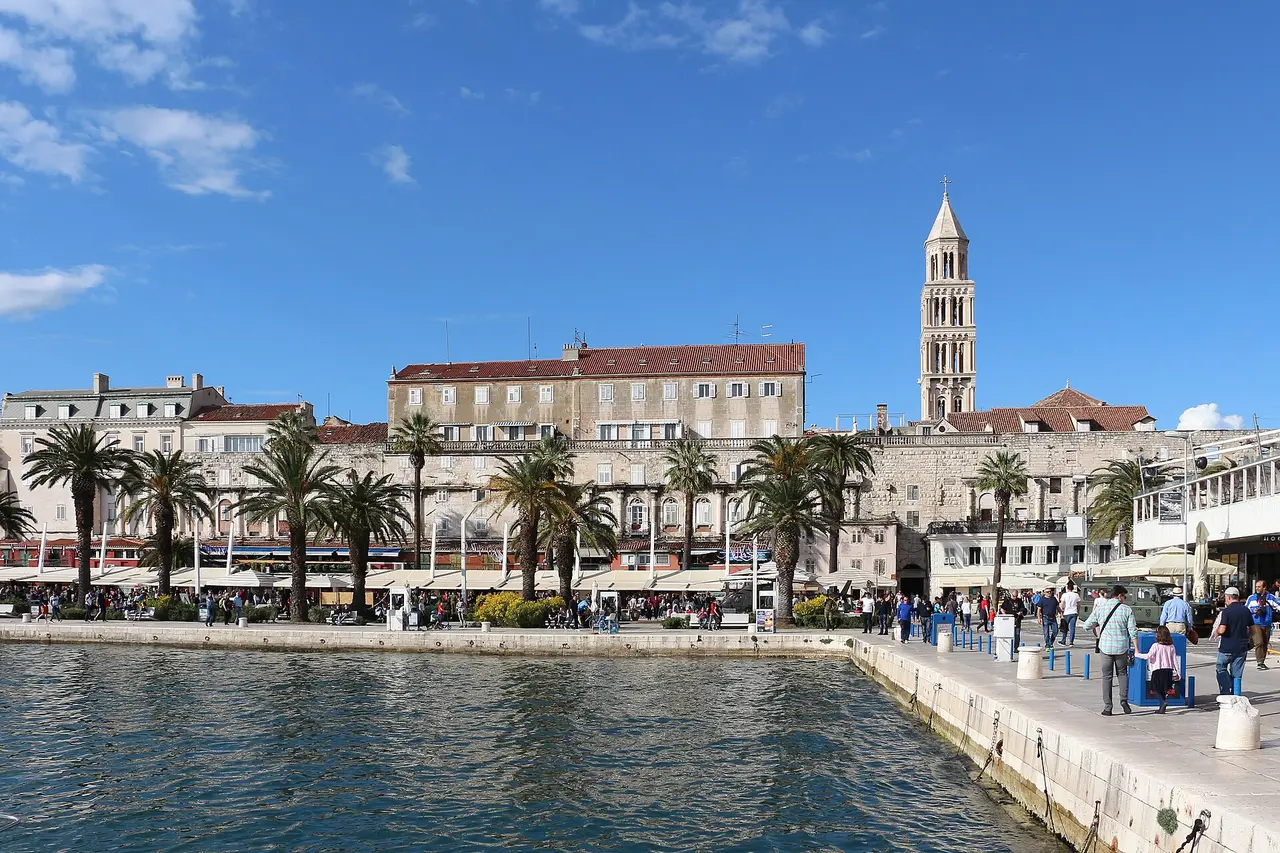
The palm-lined promenade between the palace and the port, lively from morning to night.

Gregory of Nin statue

Ivan Meštrović's bronze by the Golden Gate, whose toe people rub for luck.

Marjan hill

A forest park with viewpoints, chapels and coves for a quieter swim.

Bačvice beach

Fine sand right in the centre, and picigin played by the locals.

Trogir

A UNESCO-listed medieval town on an islet, half an hour away by road.

Hvar

The neighbouring island, its Spanish fortress and coves, an hour away by catamaran.

What to discover in Split?

A Roman palace turned neighbourhood

Diocletian's Palace covers nearly a third of the old town: lanes, shops and flats have settled inside its walls over the centuries. You enter through the Bronze Gate on the sea side, which leads into the vaulted cellars (10 euros in 2026), whose layout mirrors the vanished imperial apartments. At the centre, the Peristyle and its columns lead to Saint Domnius Cathedral, once the emperor's mausoleum. Climb the bell tower, 5 euros, before 10 am to beat the heat and the groups.

Marjan, Varoš and local life

West of the centre, the old fishermen's quarter of Varoš climbs in steps towards Marjan hill, the city's wooded lung. A first viewpoint, a quarter of an hour on foot, looks over the roofs and the islands; trails carry on to small chapels and the coves of Kašjuni and Bene. In the morning, the Pazar market and the fish market show a Split that does not live from tourism alone. Bring water, as shade is scarce at the top.

Beaches and swimming in town

Bačvice, five minutes from the station, is the busiest sandy beach, famous for picigin, a ball game played ankle-deep in the water. Quieter pebble coves at the foot of Marjan can be reached on foot or by bike. The sea reaches 21 °C in June and 24 °C in August, then stays at 22 °C in September according to the Split station normals. From November to April the water drops below 16 °C and most beach bars close.

Islands and day trips from the port

Split's port is the starting point for catamarans to Hvar, about an hour, and Jadrolinija ferries to Brač or Stari Grad (5.90 euros off-season, 8.40 euros in summer). By road, Trogir, a small UNESCO-listed medieval town, is some thirty kilometres away, Klis fortress twenty minutes and the Krka waterfalls about 1 h 15. Overnight ferries also link Split with Ancona, to carry on to Italy.

Season, budget and good habits

July and August top 30 °C, with lanes packed at midday and the highest prices. May, June and September offer the best balance. Allow about 62 euros a day on a budget and 135 euros for comfort; a cheap meal costs 15 euros (Numbeo, October 2026). The return flight from Paris takes about two hours and costs around 200 euros outside school holidays. Croatia is at normal vigilance, but watch for pickpockets in season. To plan the rest of the trip, see our Croatia guide.

Sample itineraries

Three routes built around the time you actually have.
3daysRecommended

Split in 3 days: old town, Trogir and the island of Hvar

  1. Day 1: Diocletian's Palace and the Riva
  2. Day 2: Trogir and Kaštela
  3. Day 3: Hvar by catamaran

Best for: The most balanced stay: a day in the palace, one by bus to Trogir, one by catamaran to Hvar. It leaves out Marjan hill and the hinterland.

How much it costs

Per person per day, excluding international travel.
Budget
62 €/ day
1 268 € for 2 people, 7 days, return flights included
Accommodation
30 €
Food
20 €
Local transport
4 €
Sights and activities
8 €
Comfort
135 €/ day
2 290 € for 2 people, 7 days, return flights included
Accommodation
55 €
Food
45 €
Local transport
10 €
Sights and activities
25 €
Premium
310 €/ day
4 740 € for 2 people, 7 days, return flights included
Accommodation
120 €
Food
85 €
Local transport
35 €
Sights and activities
70 €
Prices checked: Relevé octobre 2026. Repas et transports : Numbeo Split, mise à jour du 2 octobre 2026 (repas bon marché 15 €, dîner de milieu de gamme pour deux 66,20 €, ticket de bus 1,50 €, taxi 3,32 € de prise en charge puis 1,86 €/km). Hébergement : combien-coute.net, octobre 2026 (hôtel 3 étoiles 108 € la nuit, 5 étoiles 237 €), lit en dortoir autour de 32 $ (budgetyourtrip.com) ; par personne, chambre double partagée à deux pour comfort et premium. Activités : caves du palais 10 €, clocher de la cathédrale 5 €, cathédrale 8 € (tarifs 2026), ferry Jadrolinija Split-Stari Grad 5,90 € hors saison et 8,40 € en saison, catamaran pour Hvar 15 à 25 €. Vol A/R Paris-Split estimé à 200 € par personne hors juillet-août et hors vacances scolaires (Kayak : prix habituels 145 à 286 €, juin le mois le moins cher à 143 € en moyenne, vols directs Transavia, easyJet et Croatia Airlines d'environ 2 h). Prix hors haute saison : en juillet-août l'hébergement grimpe nettement. Taxe de séjour en sus.

Getting there

Airports serving Split, from main hubs to secondary ones.
  • DBVDubrovnik Ruđer Bošković AirportDubrovnikMain
  • PUYPula AirportPulaMain
  • RJKRijeka AirportRijekaMain
  • SPUSplit Saint Jerome AirportSplitMain
  • ZADZadar AirportZadarMain
  • ZAGZagreb Franjo Tuđman International AirportVelika GoricaMain

Entry, health and safety

For FR travellers

Entry requirements

No visa for a tourist stay

La Croatie est membre de l'Union européenne et de l'espace Schengen : les Français y entrent sans visa pour un séjour de moins de trois mois, avec un passeport ou une carte nationale d'identité valable pendant toute la durée du séjour.

Stay allowed for up to 90 days.

Health

Advised: Mise à jour des vaccinations habituelles ; selon le séjour, hépatite A, fièvre typhoïde, encéphalite à tiques (zones boisées, au printemps et en été) et rage pour les jeunes enfants en zone rurale.

Contrôles d'identité systématiques aux frontières croates, y compris pour les citoyens de l'UE, avec des attentes plus longues en saison. Les cartes d'identité délivrées entre 2004 et 2013 restent valables cinq ans après la date affichée, mais le passeport est recommandé. Carte européenne d'assurance maladie à demander 15 jours avant le départ. Les feux de forêt sont dangereux l'été sur le littoral ; présence ponctuelle de la fièvre du Nil occidental, d'où la protection contre les moustiques.

Safety

Normal precautions

Emergency

112

Checked in octobre 2026 against the official source. Entry rules change: check the official source before you travel, it alone is authoritative.

Practical information for Split

From the airport

The airport is about 25 km from the centre, towards Trogir: shuttle bus to the bus station, or a taxi.

Getting around

Bus ticket 1.50 euros (Numbeo, October 2026); the old town is entirely walkable.

Ferries

Jadrolinija to Stari Grad 5.90 euros off-season and 8.40 euros from late May to late September; catamarans to Hvar 15 to 25 euros.

Taxi

About 3.32 euros flag fall then 1.86 euros per km (Numbeo, October 2026).

Typical prices

Cheap meal 15 euros, mid-range dinner for two 66 euros, local beer 4.25 euros, cappuccino 2.48 euros.

Currency

The euro, used in Croatia since January 2023.

Emergencies

European emergency number 112.

Split in pictures

Photo credits : Bernard Gagnon, CC BY-SA 4.0, Wikimedia Commons ; Falk2, CC BY-SA 4.0, Wikimedia Commons ; TimeTravelRome, CC BY 2.0, Wikimedia Commons ; dronepicr, CC BY 2.0, Wikimedia Commons

Frequently asked questions about Split

How many days do you need in Split?
Two days cover Diocletian's Palace, the Riva and Marjan hill. With three days you can add Trogir and a day on Hvar; four days and a car also let you see the Krka waterfalls and the island of Brač.
When is the best time to visit Split?
May, June and September, with afternoons of 23 to 28 °C and a sea between 17 and 22 °C. July and August top 30 °C and bring the biggest crowds and prices; from November to February it rains almost one day in three.
How much does a day in Split cost?
About 62 euros a day on a budget, in a dorm bed, and 135 euros for comfort, sharing a double room. A return flight from Paris costs around 200 euros outside July and August; accommodation rises sharply in high season.
How do you get from Split to Hvar?
Catamarans reach Hvar town in about an hour, for 15 to 25 euros. The slower Jadrolinija ferry to Stari Grad also carries cars. In summer, buy your return ticket as soon as you arrive, as the last boats often sell out.
Can you swim in Split?
Yes, right in town: Bačvice sandy beach is five minutes from the station, and pebble coves line Marjan hill. The sea stays above 20 °C from June to October, peaking at 24 °C in August.
Do I need a passport to visit Split?
EU citizens can travel with a national ID card, as Croatia is in the Schengen area. Border checks in Croatia are systematic, including for Europeans, so make sure your document is valid for the whole stay; other nationalities should check their own rules.
Is Split a safe city?
France's foreign ministry rates Croatia at normal vigilance, and crime is limited. Pickpockets mainly target the old town and the port in summer. The main seasonal hazard is forest fires along the coast; the emergency number is 112.

Plan your trip to Split

Build your day-by-day itinerary and manage budget, bookings and packing in PlanTripNow.
Aperçu de l'application PlanTripNow