Skip to content

Visiting Toulouse : neighbourhoods, budget and how many days to plan

Brick facades that turn pink at sunset, crowded terraces around the Capitole, and Garonne quays where the whole city gathers in the evening. Toulouse can be seen on foot in two days, but its aerospace sites and day trips to Albi or Carcassonne easily justify one or two more.

At a glance

Visa
None
7-day budget
€833
Per person, comfort profile, excluding international flights.
Recommended length
3 days
For a first trip, without rushing.

Why go to Toulouse?

The fourth-largest city in France, Toulouse combines a UNESCO-listed Romanesque basilica, the start of the Canal du Midi and a rare chance to visit both a space park and Airbus assembly lines. The centre is walkable, living costs are lower than in Paris or Nice, and June and September bring 25 °C without the summer crowds.

When to visit Toulouse

Temperatures, rainfall and crowds month by month, to pick your window.
When to visit Toulouse
MonthTemperaturesRainCrowdsVerdict
January3 to 10 °C9 dVery quietGrey, damp and often swept by the autan wind; hotels fill mainly with conference guests on weekdays.
February3 to 11 °C8 dVery quietThe cheapest month, and the Toulouse violet fills the stalls for its February festival.
March6 to 15 °C8 dQuietFifteen degrees in the afternoon is enough to cycle the Canal du Midi without meeting many people.
April8 to 18 °C9 dModerateEaster holidays and frequent showers: keep the Cité de l'espace as a plan for wet days.
May11 to 21 °C10 dModerateThe wettest month of the year despite the mild air, bank holidays included: the pink brick glows between storms.
June15 to 26 °C7 dBusyOur favourite month: long evenings on the Daurade quays and festivals before the real heat.
July17 to 28 °C6 dBusyHot and dry, with peaks sometimes above 35 °C; sightsee early and save the afternoon for shady cloisters.
August17 to 29 °C6 dModerateLocals leave and business hotels slash their rates, but some restaurants close for two or three weeks.
September14 to 25 °C7 dBusyStill 25 °C, a lively student return and trade fairs: book your hotel early.
October11 to 20 °C8 dModerateA fine late season for open-air markets and for cassoulet returning to the menus.
November6 to 14 °C10 dQuietTen rainy days on average, the dreariest month; best kept for museums and rugby matches.
December4 to 10 °C9 dQuietThe Christmas market sets up its chalets on Place du Capitole, for a cold but rarely freezing break.
Source: Normales 1991-2020 Météo-France, station Toulouse-Blagnac (07630), via Infoclimat, recoupées avec le tableau climatologique de l'article Wikipédia Toulouse (627 mm de pluie par an). Affluence et prix : estimation éditoriale d'après le calendrier des vacances scolaires et des grands événements toulousains. Relevé octobre 2026.

Toulouse must-sees

Eleven sites covering the city's three faces: medieval brick, the Garonne and aerospace.

Place du Capitole

The heart of the city with its 18th-century neoclassical facade; step inside the city hall for the Salle des Illustres and its paintings, free of charge.

Basilica of Saint-Sernin

A great Romanesque pilgrimage church in brick and stone with an octagonal bell tower, UNESCO-listed as part of the Routes of Santiago de Compostela.

Jacobins Convent

A Dominican Gothic church where one column fans out its ribs like a palm tree, with a peaceful cloister and the relics of Thomas Aquinas; closed Mondays.

Pont-Neuf

The city's oldest bridge despite its name, completed in 1632, with openings pierced through its piers to let the Garonne floods pass.

Augustins Museum

A former convent reopened in December 2025 after six years of work, famous for its Romanesque capitals and gargoyles displayed around the cloister.

Hôtel d'Assézat

The finest of the woad mansions, built in the 16th century for merchant Pierre d'Assézat, with a Renaissance courtyard of stacked columns.

Victor Hugo Market

A covered market of butchers, cheesemongers and fishmongers, open mornings except Monday, with upstairs restaurants for a lunch of fresh produce.

Cité de l'espace

A space discovery park with an Ariane 5 replica, a walk-through Mir station and a planetarium; allow a full day and an adult ticket from 29 euros.

Aeroscopia Museum

A Blagnac hangar where you can board two Concordes and other historic aircraft, and the starting point for Airbus factory tours booked in advance.

Halle de la Machine

Giant mechanical creatures by the La Machine company, including the Asterion minotaur that carries passengers along the old Aéropostale runway.

Pierre-Baudis Japanese Garden

A Japanese-style garden in the Compans-Caffarelli district, with a red bridge, tea pavilion and carp pond, free entry and calm on weekdays.

What to discover in Toulouse?

The Capitole and the historic core

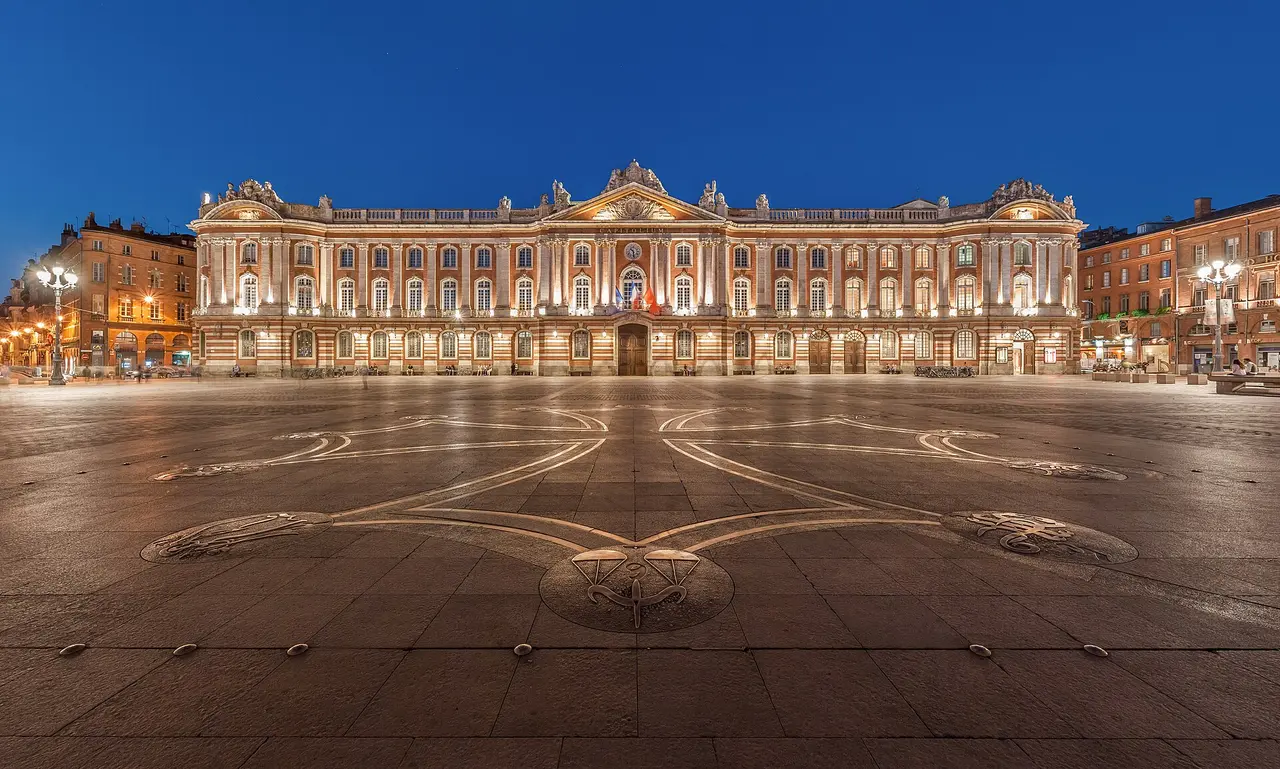
Everything starts at Place du Capitole, with its long brick and stone facade and the Occitan cross set into the paving. The city hall can be visited for free, Salle des Illustres included, and also houses the opera house. Around it, the pedestrian Rue Saint-Rome and Rue du Taur lead within ten minutes to the Garonne or Saint-Sernin. It is the handiest area for a first stay, but also the noisiest at weekends: ask for a courtyard-facing room if you sleep near Place Wilson or Place Saint-Georges. In the evening, the floodlit facade and the arcades of the square make a good starting point for a first walk.

Saint-Sernin and Arnaud-Bernard

North of the centre, the Basilica of Saint-Sernin towers over a working-class, student neighbourhood. A stop on the Way of St James, it takes about 45 minutes to visit, with an extra fee for the crypt and its treasury. On Sunday mornings, a flea and antique book market sets up around the apse. Just behind, Place Arnaud-Bernard gathers cheap bars, world grocery shops and one of the last old-suburb atmospheres in the centre. The Saint-Raymond museum, devoted to the region's Roman antiquities, faces the basilica, a ten-minute walk from the Capitole along Rue du Taur.

Les Carmes, Saint-Étienne and the woad city

South of Rue de Metz, the lanes of Les Carmes and Saint-Étienne hold the mansions built in the 16th century by woad merchants, the blue dye that made the city rich for less than a century. The Hôtel d'Assézat, completed around 1557, is the model. Saint-Étienne cathedral surprises with a nave whose two parts are not on the same axis. Allow half a day, adding the Carmes covered market, open in the mornings from Tuesday to Sunday, and the nearby Jardin des Plantes. The district itself can be crossed on foot in a quarter of an hour.

Saint-Cyprien and the left bank

The Pont-Neuf, completed in 1632 despite its name, links the centre to Saint-Cyprien, the old flood-prone district on the left bank. Here you will find the copper dome of La Grave hospital, the Les Abattoirs modern art museum, open Wednesday to Sunday, and the Prairie des Filtres, where locals picnic facing the river. The district revolves around Place Saint-Cyprien and its daily market. Come in the late afternoon: the low light then hits the Daurade quays opposite, and the brick takes on its pinkest shade.

The canals: from the Midi to Brienne

The UNESCO-listed Canal du Midi leaves Toulouse at the Port de l'Embouchure to reach the Mediterranean some 240 kilometres away. In the city, its plane-tree-lined banks form a green corridor you can follow on foot or by self-service bike to Ramonville in under an hour. The shorter Canal de Brienne runs along the Garonne to the Amidonniers district. Between the Port de l'Embouchure and Port Saint-Sauveur, allow about three kilometres of shaded banks. For a different outing, sightseeing boats leave from the Daurade quay and Port Saint-Sauveur in season.

Blagnac and Montaudran, the aerospace city

Toulouse is the city of Airbus and of the French space agency, and you can visit both. In Blagnac, to the north-west, the Aeroscopia museum displays two Concordes and is the starting point for guided tours of the assembly sites, to be booked several weeks ahead with photo ID. To the east, the Cité de l'espace needs a full day. To the south-east, the old Aéropostale runway in Montaudran hosts the Halle de la Machine and its giant minotaur, and L'Envol des Pionniers, a museum devoted to Mermoz and Saint-Exupéry. These three hubs are far apart: plan no more than two sites a day.

Cassoulet, violets and covered markets

Toulouse cooking comes down to a few products: Toulouse sausage, duck, Lautrec pink garlic and cassoulet, which the city disputes with Castelnaudary and Carcassonne. The best place to taste it all is the Victor Hugo covered market, whose small upstairs restaurants serve lunch menus for 12 to 18 euros. On the sweet side, look for candied violets, the city's emblem celebrated every February on Place du Capitole, and fénétra, an apricot and almond cake. Restaurants in the centre often close on Sunday evenings.

Around Toulouse: Albi, Carcassonne and the Pyrenees

Toulouse makes a good car-free base. Albi and its brick cathedral are an hour away by regional train, the Cité of Carcassonne 45 minutes by TGV or Intercités and an hour by regional train: two World Heritage sites that work as day trips. With a car, Cordes-sur-Ciel is about an hour and a half away, and the central Pyrenees ski resorts around two hours. To continue to the Atlantic coast and the vineyards, Bordeaux is just over two hours away by train. Car rental firms operate at Matabiau station and at the airport.

Sample itineraries

Three routes built around the time you actually have.
3daysRecommended

Toulouse in 3 days: the old town, the Cité de l'espace and Airbus

  1. Day 1: Place du Capitole, Saint-Sernin and the Canal du Midi
  2. Day 2: Cité de l'espace
  3. Day 3: Aeroscopia and the Airbus tour in Blagnac

Best for: The plan for families and aviation buffs: one day in the centre, then two days devoted to what makes Toulouse unique in Europe, space and aircraft. The left bank and the small museums are dropped for two big sites on the outskirts, reachable by public transport.

How much it costs

Per person per day, excluding international travel.
Budget
59 €/ day
1 046 € for 2 people, 7 days, return flights included
Accommodation
25 €
Food
24 €
Local transport
4 €
Sights and activities
6 €
Comfort
119 €/ day
1 886 € for 2 people, 7 days, return flights included
Accommodation
48 €
Food
45 €
Local transport
8 €
Sights and activities
18 €
Premium
240 €/ day
3 580 € for 2 people, 7 days, return flights included
Accommodation
80 €
Food
90 €
Local transport
25 €
Sights and activities
45 €
Prices checked: Relevé octobre 2026. Hébergement : Hostelworld (dortoirs à partir de 18 à 25 EUR à Toulouse, consulté en octobre 2026) et combien-coute.net d'après Booking et hotels.com (mise à jour du 28/09/2026 : 3 étoiles 95 EUR la nuit en moyenne, 4 étoiles 131 EUR, 5 étoiles 176 EUR). Prix par nuit et par personne : lit en dortoir pour backpacker, chambre double partagée à deux pour comfort et premium. Repas : menus du midi relevés entre 12 et 18 EUR dans les guides de voyage 2026. Transports : ticket Tisséo à 1,90 EUR depuis le 1er juillet 2026 (Le Bonbon Toulouse, 25 juin 2026). Activités : Cité de l'espace à partir de 29 EUR plein tarif (Tourisme Occitanie, 2026). Vol Paris-Toulouse aller-retour : 134 EUR en moyenne sur trois mois chez liligo, 101 à 102 EUR en octobre-novembre chez ou-et-quand.net, easyJet autour de 71 EUR ; valeur retenue 110 EUR par personne hors vacances scolaires. Prix hors juin-septembre et hors grands salons professionnels, où les hôtels du centre montent nettement.

Getting there

Airports serving Toulouse, from main hubs to secondary ones.
  • AGFAgen La Garenne airportAgenSecondary
  • AJAAjaccio Napoléon Bonaparte airportAjaccioSecondary
  • ANEAngers Marcé airportAngersSecondary
  • ANGAngoulême Brie-Champniers airportAngoulêmeSecondary
  • AUFAuxerre Branches airportAuxerreSecondary
  • AURAurillac airportAurillacSecondary

Entry, health and safety

For FR travellers

Entry requirements

No visa for a tourist stay

Trajet intérieur, sans formalité d'entrée pour un ressortissant français. En avion vers Toulouse-Blagnac, il faut une carte nationale d'identité, un passeport, un titre de séjour ou un permis de conduire où l'on est reconnaissable ; depuis le 24 juin 2026, la carte d'identité numérique de l'application France Identité est aussi acceptée au dépôt des bagages et à l'embarquement. Livret de famille et justificatif de demande de papiers, sans photo, sont refusés.

Health

Checked in octobre 2026 against the official source. Entry rules change: check the official source before you travel, it alone is authoritative.

Practical information for Toulouse

Getting there from Paris

Direct TGV from Montparnasse in 4 h 30 to 5 h, or a flight of about 1 h 15 to Toulouse-Blagnac; around 110 euros return by air outside school holidays.

Airport to centre

Tisséo shuttle between the airport and Matabiau station in about 25 minutes; a taxi takes around 20 minutes depending on traffic.

Tisséo ticket

1.90 euros per journey since July 2026, valid on the metro (lines A and B), tram and buses.

Bikes

VélôToulouse self-service bikes, handy for the banks of the Canal du Midi and the Garonne.

Closing days

The Jacobins and the Victor Hugo market close on Mondays, Les Abattoirs on Mondays and Tuesdays: avoid starting a long weekend on a Monday.

Autan wind

A dry, warm south-easterly wind that sometimes blows for several days, mainly in spring and autumn; pack a windproof jacket.

Rugby

Stade Toulousain plays at the Ernest-Wallon stadium and its big fixtures at the Stadium; tickets go fast, so book as soon as sales open.

Daily budget

About 59 euros in a dorm with lunch menus, 119 euros for comfort, 240 euros for premium, per person.

Best time to go

June and September: 25 °C highs, festivals and terraces; August is quiet but some restaurants close.

Accommodation

Book early in September and during trade fairs, when central hotels fill up with business travellers.

Region

Occitanie, capital of the Haute-Garonne department.

Toulouse in pictures

Photo credits : Benh LIEU SONG, CC BY-SA 3.0, Wikimedia Commons ; PierreSelim, CC BY 3.0, Wikimedia Commons ; Didier Descouens, CC BY-SA 4.0, Wikimedia Commons ; kallerna, CC BY-SA 4.0, Wikimedia Commons ; Christian Ferrer, CC BY 4.0, Wikimedia Commons

Frequently asked questions about Toulouse

How many days for Toulouse and the Cité de l'espace?
Allow two days for the centre on foot, from the Capitole to Saint-Cyprien, plus a full extra day for the Cité de l'espace. If you also want Aeroscopia or an Airbus tour, plan a fourth day, as Blagnac is on the opposite side of the city.
Can you visit the Airbus assembly lines in Toulouse?
Yes, guided tours leave from the Aeroscopia museum in Blagnac. They must be booked several weeks ahead, especially during school holidays, and valid photo ID is required to enter the industrial site. Combine the tour with the museum on the same day.
Why is Toulouse called the pink city?
With no stone in the Garonne plain, the city was built from local fired clay brick, known as brique foraine. Its colour ranges from red to orange and looks pink at the end of the day. The best viewpoint is the Daurade quay at sunset.
Does cassoulet come from Toulouse or Castelnaudary?
Both towns, along with Carcassonne, claim the dish. The Toulouse version stands out for its Toulouse sausage and often duck confit. To compare, taste it in Toulouse and then stop in Castelnaudary on the railway line to Carcassonne.
Is it better to travel from Paris to Toulouse by train or plane?
The direct TGV takes 4 h 30 to 5 h station to station, from Montparnasse to Matabiau in the city centre. The flight lasts about 1 h 15, but you must add the trip to the airports of Paris and the Blagnac shuttle. Overall, the gap shrinks to about an hour.
Should you stay near the Capitole or in Saint-Cyprien?
The Capitole and Les Carmes are handiest for doing everything on foot, but pricier and lively late at weekends. Saint-Cyprien, across the Pont-Neuf, is quieter, often cheaper and a ten-minute walk from Place du Capitole.
Can you cycle along the Canal du Midi from Toulouse?
Yes, a path follows the canal from the city centre, towards Port Saint-Sauveur, then Ramonville and the Lauragais. A half-day loop is enough to enjoy it. VélôToulouse self-service bikes suit the city; to go further, rent a bike for the day.
Can you do Albi and Carcassonne on the same day?
It is not advisable: the two towns are on different lines, to the north-east and south-east, with no direct link between them. Each deserves a day, about an hour by train from Matabiau. Leave early for Carcassonne to beat the groups on the ramparts.
What is the autan wind in Toulouse?
It is a dry and often warm south-easterly wind that can blow hard for several days, mainly in spring and autumn. It makes terraces less pleasant and tires some visitors. On the other hand it clears the sky, sometimes revealing a view of the Pyrenees.
How can you see a Stade Toulousain match?
The club, the most successful in French rugby, plays at home at the Ernest-Wallon stadium in the north-west of the city and moves its biggest fixtures to the Stadium on the Île du Ramier. Buy seats on the official ticketing site as soon as they go on sale, as big matches sell out fast.

Plan your trip to Toulouse

Build your day-by-day itinerary and manage budget, bookings and packing in PlanTripNow.
Aperçu de l'application PlanTripNow