Visit Bordeaux

Listed facades, redesigned quays and a vineyard less than an hour away: Bordeaux is mostly walked and ridden by tram. Plan 2 to 3 days for the city, one more for Saint-Emilion, the Medoc or Arcachon Bay.

Why visit Bordeaux?

Bordeaux holds the largest UNESCO-listed urban area in France, a nearly car-free centre and a world-renowned vineyard reachable in 40 minutes by train. The city is worth visiting year-round, with a peak in crowds and prices from May to September and during the harvest.

Bordeaux's must-sees

Nine places that sum up the city, from the postcard quays to the neighborhood markets.

Place de la Bourse

The royal 18th-century facade and its water mirror, the largest in the world, flooded from April to early November.

Grand Theatre

A neoclassical 1780 opera house with a colonnade of twelve statues, open for daytime visits outside rehearsals and shows.

Saint-Andre Cathedral

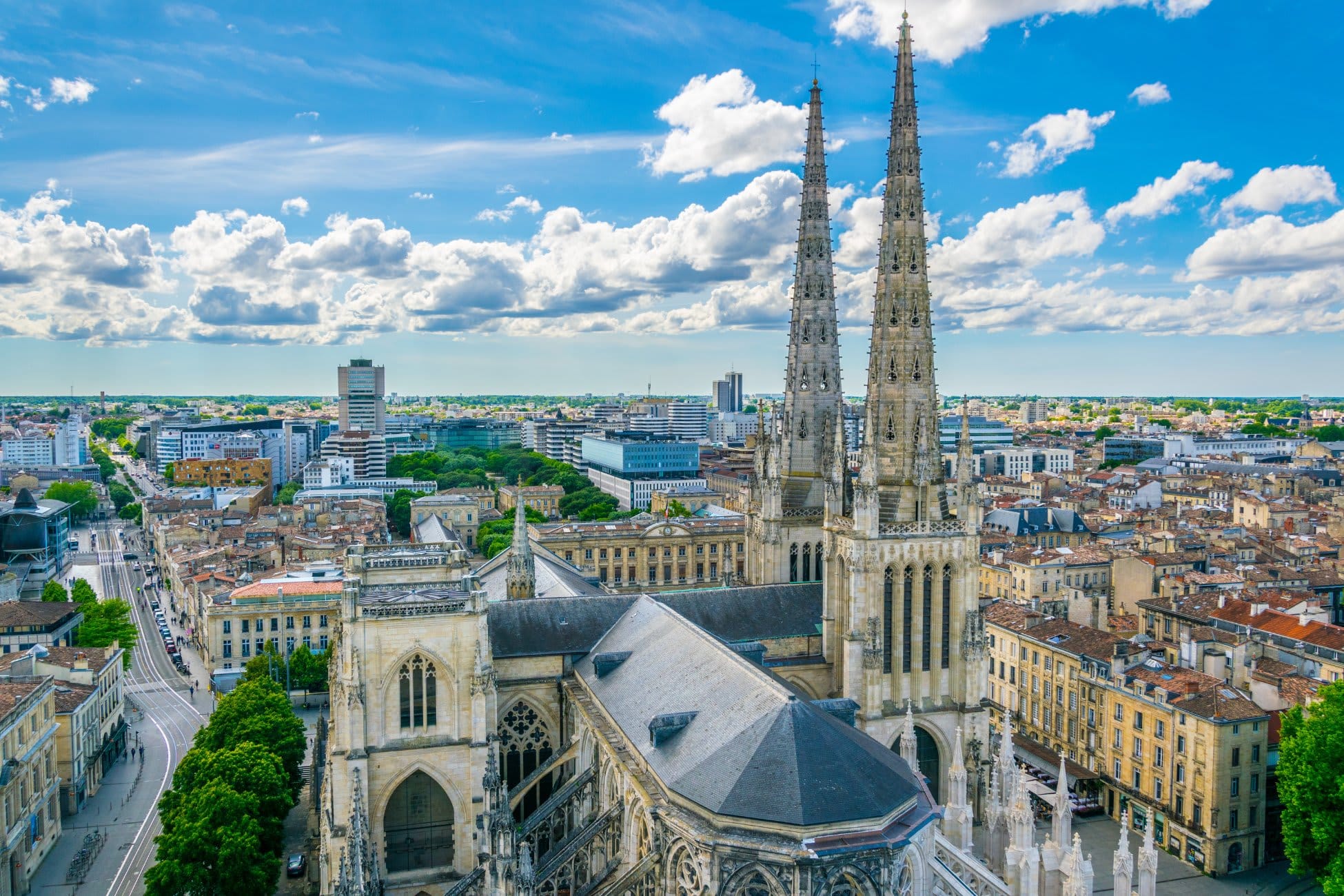
The Gothic church where Eleanor of Aquitaine was married, beside the Pey-Berland tower and its 231 steps.

La Cite du Vin

A golden contemporary building by the Garonne, an immersive journey through the world's vineyards and a panoramic tasting.

Porte Cailhau

A former city gate from 1495 standing 35 metres tall, with a small museum inside and a view of the Pont de Pierre.

Capucins market

Bordeaux's great covered market, oysters and seafood at the counter on weekends, closed on Monday.

Saint-Michel spire

A free-standing bell tower of 114 metres, the tallest in southern France, with a city panorama from the top of the steps.

Pont de Pierre

Bordeaux's first bridge, ordered by Napoleon, its 17 arches echoing the letters of his name.

Girondins monument

A 43-metre column and bronze fountains on Place des Quinconces, honouring the Girondin deputies guillotined in 1793.

What to see in Bordeaux?

The Golden Triangle and Quinconces

Bounded by cours Clemenceau, cours de l'Intendance and allees de Tourny, the Golden Triangle concentrates the 18th-century mansions, the great wine-trade houses and the neoclassical facade of the Grand Theatre. Rue Sainte-Catherine, a 1.2-kilometre shopping street, runs south from it. Nearby, Place des Quinconces is one of the largest squares in Europe at almost 12 hectares, edged by the Girondins monument and its basin. The Christmas market sets up along allees de Tourny in December.
Saint-Pierre and old Bordeaux

This is medieval and Renaissance Bordeaux, a tangle of lanes between the Garonne and the cathedral. Porte Cailhau, a triumphal arch from 1495 standing 35 metres tall, opens onto Place du Palais; the square, cobbled Place du Parlement lines up terraces. People come mainly to dine: the district has the city's highest concentration of restaurants, often full after 8pm on weekends. Allow a good hour to walk it, city gates included.

Chartrons and the left-bank quays

A former quarter of wine merchants, Chartrons keeps its converted warehouses, the antiques shops of rue Notre-Dame, and a Sunday-morning market on the quays. The redesigned promenade runs almost 4.5 kilometres from the Pont de Pierre to the Chaban-Delmas bridge, on foot or by shared bike. At its northern end, La Cite du Vin offers a visit of about two hours, rooftop tasting included, for a ticket around 22 euros.

Saint-Michel and the Capucins

More working-class and cosmopolitan, this area centres on the Saint-Michel basilica and its free-standing spire of 114 metres, the tallest in southern France, whose steps can be climbed from April to October. The Capucins market, the belly of Bordeaux, opens at dawn Tuesday to Sunday and closes on Monday: it is the place for a dozen oysters at the counter on a Saturday morning. Around it, the Place Saint-Michel flea market and affordable tables run by the North African and Portuguese communities.

La Bastide and the right bank

Linked to the centre by the Pont de Pierre and tram line A in about ten minutes, the right bank gives the best distance on the listed facade of the quays. The free botanical garden unfolds its themed plots there; the submarine base, a German bunker from the Second World War, hosts immersive digital exhibitions in its concrete bays. The long-industrial district is changing fast around the station and the Euratlantique quarter.

Around Bordeaux: vineyards and Arcachon Bay

Bordeaux is an ideal base without a car. Saint-Emilion, a UNESCO-listed wine village, is 40 minutes away by direct train; Arcachon Bay and the Dune du Pilat, the tallest in Europe, 55 minutes. The Medoc chateaux route, by contrast, needs a car and half a day at least. The city is one of the main gateways to south-west France; for a comparable stop, also turned toward its vineyard, Colmar plays the same part on the Alsace wine road.

Bordeaux in pictures

Similar destinations

Other cities you might like as much as Bordeaux.

Frequently asked questions about Bordeaux

Can you visit Bordeaux without a car?
Yes, the city is done on foot and by tram, and the main day trips, Saint-Emilion and Arcachon Bay, are served by direct train from Saint-Jean station. Only the Medoc chateaux route really needs a car or an organised excursion.
Does the Place de la Bourse water mirror run all year?
No: it is flooded roughly from April to early November, then drained for winter and during frosts. In season it alternates a reflecting sheet and a cloud of mist every few minutes, and is best enjoyed at the end of the day.
How do you get to Saint-Emilion from Bordeaux?
A direct train links Bordeaux Saint-Jean to Saint-Emilion in about forty minutes, with a few round trips a day. The station is two kilometres from the village, a twenty-minute uphill walk or a shuttle depending on the season.
Is La Cite du Vin worth the ticket?
For anyone interested in wine and its history, yes: the immersive route takes about two hours and the ticket includes a rooftop tasting with a city view. Travellers in a hurry will prefer a chateau visit out in the vineyard.
Can you reach the Dune du Pilat by train from Bordeaux?
The train reaches Arcachon in 55 minutes; from there a seasonal bus serves the Dune du Pilat, otherwise it is a taxi or a bike. A full day is needed to combine Arcachon, oysters and the climb up the dune.
Which area should you stay in in Bordeaux?
The Golden Triangle and Saint-Pierre to do everything on foot, Chartrons for a quieter neighborhood feel and good restaurants, the area around Saint-Jean station for prices and train departures, less so for charm.
Is there a pass for Bordeaux's monuments and museums?
The Bordeaux Metropole City Pass, valid 24, 48 or 72 hours, covers TBM transport, several museums and monuments and a guided tour. It pays off from two or three paid visits a day.

Plan your trip to Bordeaux

Build your day-by-day itinerary and manage budget, bookings and packing in PlanTripNow.
Aperçu de l'application PlanTripNow