Visiting the Amalfi Coast: when to go, budget and itinerary

Fifty kilometres of cliffs between Positano and Vietri sul Mare, thirteen villages linked by a single hairpin road, the SS163. People come for the hiking, the majolica-domed churches, the lemon-forward cooking and the sunsets over the Tyrrhenian Sea. Allow at least three nights.

Why visit the Amalfi Coast?

The Amalfi Coast packs a UNESCO-listed landscape, cliff-perched villages such as Ravello and Positano, and one of Italy's finest hiking trails, the Path of the Gods, into a narrow strip. It also works as a base for Capri, Pompeii and the temples of Paestum, all reachable in a day.

What to discover on the Amalfi Coast?

Positano and the western coast

Positano closes the coast to the west: pastel houses in tiers, stepped alleys and Spiaggia Grande at the foot of the village. It is the most expensive and most photographed stop, pleasant for two nights but quickly overrun from June to September. Nearby, Praiano is quieter and better placed for the Path of the Gods, and Marina di Praia keeps its fishing boats. From Positano, boats serve the Li Galli islets and reach Capri in forty minutes. The rest of Campania is then explored from Naples or Salerno.
Amalfi, Atrani and the central coast

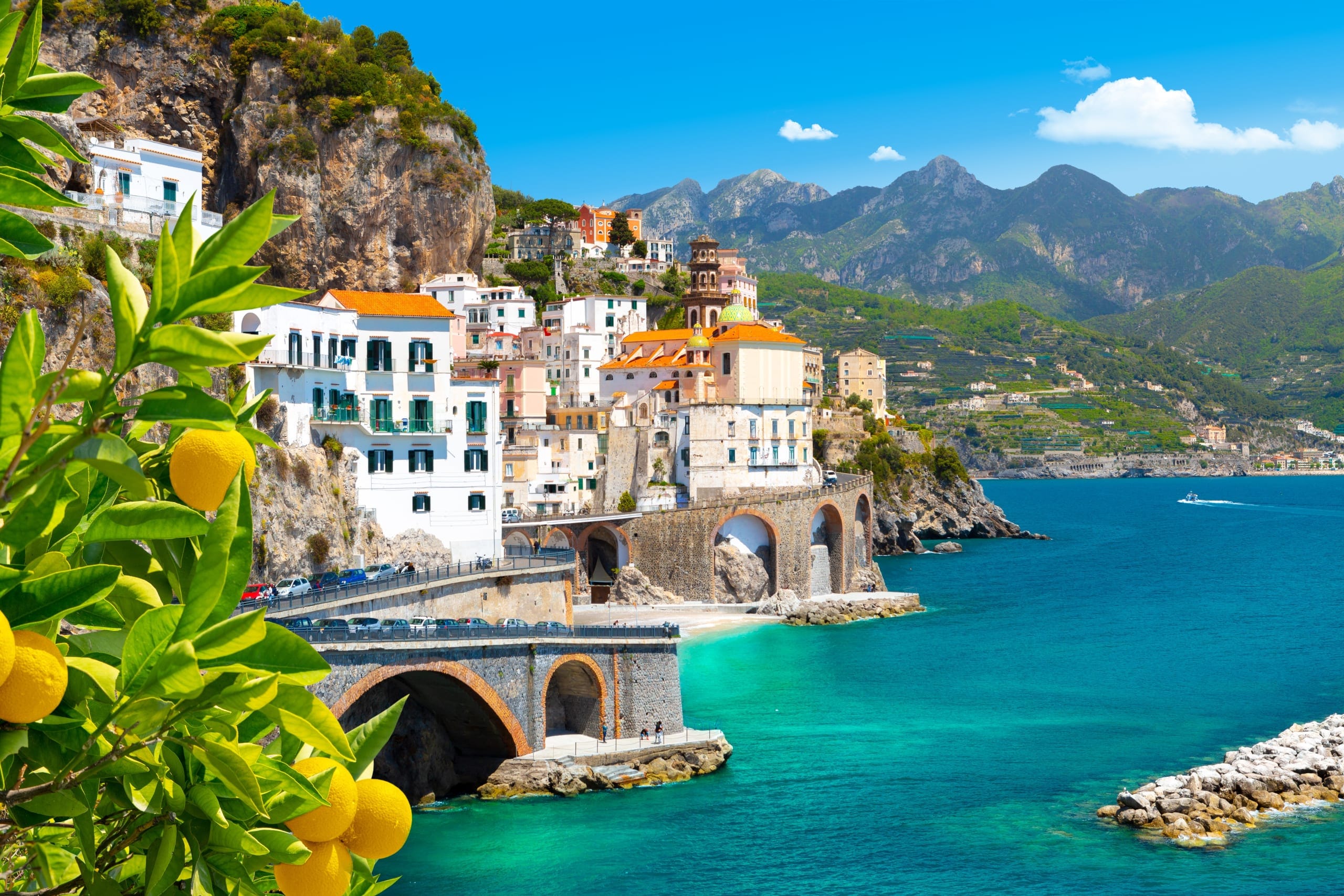
Amalfi, a former maritime republic, sits at the centre of the coast and acts as the hub of the SITA buses. The Sant'Andrea cathedral rises above the square at the top of its wide staircase; the Cloister of Paradise and the Paper Museum take about an hour. Ten minutes away on foot, along the path around the headland, Atrani stays a genuine fishing village with no luxury shops, gathered around its small square. This is the most practical area to stay without a car: ferries to Salerno and Positano, buses both ways, and a direct link to Ravello.

Ravello and the hilltop villages

Three hundred metres above Amalfi, Ravello is reached by a hairpin road or a thirty-minute bus. People come for two hanging gardens: Villa Rufolo, whose terrace hosts the Ravello Festival concerts from July to September, and Villa Cimbrone with its Terrace of Infinity. Higher up, Scala and Pontone open trails into the Valle delle Ferriere, a damp reserve of giant ferns. These villages are markedly less busy than the shoreline and keep their prices reasonable even in August.

Hiking the Path of the Gods

The Path of the Gods links Bomerano, a hamlet of Agerola, to Nocelle above Positano: about seven kilometres, three hours of walking, little climbing but little shade. The final descent to Positano adds fifteen hundred steps. Take the early bus to Bomerano and walk west to east, sun behind you. Other trails run from Ravello to the Valle delle Ferriere or from Amalfi to Pogerola. For a comparable network of coastal paths, see the Cinque Terre in Liguria.

Capri, Pompeii and day trips

The Amalfi Coast lends itself to days spent elsewhere. Capri is reached by ferry from Positano or Amalfi between April and October; allow a full day for the Blue Grotto, Monte Solaro and Anacapri. Pompeii is thirty-five minutes by train from Sorrento on the Circumvesuviana, Herculaneum slightly before. To the south, Paestum and its three Doric temples take half a day from Salerno. Sorrento, off the coast proper, makes an alternative base better connected to Naples and its airport.

Cities to visit in Amalfi Coast

Featured destinations appear first.
Coming soon.

Amalfi Coast in pictures

What to see on the Amalfi Coast

The sights that justify the trip on their own, from the ridge trail to the sea cave.

Path of the Gods

Ridge trail between Agerola and Nocelle, sheer views over the coast, three hours of walking with no technical difficulty.

Amalfi cathedral

Sant'Andrea and its wide staircase, striped Arab-Norman facade, Cloister of Paradise with interlacing arches.

Villa Rufolo

Ravello's hanging garden open onto the Gulf of Salerno, stage for the Ravello Festival concerts in summer.

Villa Cimbrone

Terrace of Infinity lined with marble busts, one of the most famous viewpoints in southern Italy.

Grotta dello Smeraldo

Green-lit sea cave at Conca dei Marini, a few minutes by rowing boat, entry around six euros.

Positano

Village in an amphitheatre on the cliff, stepped alleys, ceramics and Spiaggia Grande at the foot of the houses.

Furore fjord

Narrow cleft in the cliff spanned by a road bridge, a tiny beach and old fishermen's houses.

Atrani

The smallest village in southern Italy by area, central square and majolica dome away from the crowds.

Cetara

Village of tuna fishermen and of colatura di alici, a fish sauce descended from Roman garum.

Similar regions

Other regions you might like as much as Amalfi Coast.

Similar destinations

Other countries you might like as much as Amalfi Coast.

Frequently asked questions about the Amalfi Coast

Positano or Amalfi, where to stay on the Amalfi Coast?
Amalfi is the best choice without a car: it is the hub for buses and ferries, with a direct link to Ravello. Positano is prettier but pricier and more out of the way. Praiano is a quiet compromise between the two.
How many days should I plan for the Amalfi Coast?
Three nights are enough for Amalfi, Ravello and a half-day hike. Five nights let you add Positano, the full Path of the Gods and a boat trip. Beyond that, you branch out to Capri, Pompeii and Paestum.
Can you visit the Amalfi Coast without a car?
Yes, and it is even recommended. SITA buses and ferries link every village, the road is narrow and parking is scarce and expensive. A car only helps for the Agerola hinterland or the Cilento.
Is the Path of the Gods hard?
Not technically: seven kilometres, three hours, little climbing if you start from Bomerano towards Nocelle. The difficulty comes from the heat and lack of shade in summer, and the fifteen hundred steps down to Positano.
How do you get to Capri from the Amalfi Coast?
By ferry from Positano or Amalfi between April and October, about forty minutes. Take the first departure to see the Blue Grotto before the crowds, and plan a full day as crossings thin out in the late afternoon.
Is the Amalfi Coast worth it in October?
Yes for the villages, gardens and hiking, with 18 degrees by day and few people. The sea stays swimmable until mid-month. However, the large hotels and part of the ferry network close towards the end of October.
Where can you swim for free on the Amalfi Coast?
Free beaches exist but are small: Fornillo in Positano, Marina di Praia in Praiano, Duoglio below Amalfi reached by a staircase or a shuttle boat. Elsewhere the beach is carved into paid lidos.
Is the Grotta dello Smeraldo as good as Capri's Blue Grotto?
It is more modest and less spectacular, but far easier to reach: a lift or staircase from the road at Conca dei Marini, no long wait in a boat. A good option if Capri is not on your plan.

Plan your trip to Amalfi Coast

Day-by-day itinerary, budget, bookings and packing in a single app.
Aperçu de l'application PlanTripNow