Skip to content

Visit Montpellier : what to see, where to swim and when to go

Montpellier lives outdoors: cafés on Place de la Comédie, the sloping lanes of the Écusson, sunsets over the Promenade du Peyrou. A young, sunny city where you move from a 17th-century mansion to a contemporary tower, then to the lagoons and beaches in half an hour.

At a glance

Visa
None
7-day budget
€861
Per person, comfort profile, excluding international flights.

Why visit Montpellier?

Montpellier, the prefecture of Hérault in southern France, is home to the oldest medical school still operating in the world and the country's first botanical garden, founded in 1593. The city combines a pedestrian medieval centre, the Musée Fabre and contemporary architecture, ten kilometres from the sea. Allow two to four days, ideally in May, June or September.

When to visit Montpellier

Temperatures, rainfall and crowds month by month, to pick your window.
When to visit Montpellier
MonthTemperaturesRainCrowdsVerdict
January3 to 12 °C6 dVery quietMild and often sunny, with an occasionally icy tramontane wind: ideal for museums and the Écusson without crowds.
February4 to 13 °C4 dVery quietAlmond trees blossoming in the hinterland and hotel prices at their lowest of the year.
March6 to 16 °C5 dQuietThe first terraces on Place de la Comédie, but the sea is still too cold for swimming.
April9 to 19 °C6 dModerateIdeal for hiking Pic Saint-Loup before the heat, but watch out for the Easter holidays.
May13 to 23 °C5 dModerateThe best month for the city: 23 °C, gardens in bloom and the Comédie du Livre book fair in the streets.
June17 to 27 °C4 dModerateThe Montpellier Danse festival and first swims at Palavas, before the July crowds.
July19 to 30 °C2 dPackedThe driest and hottest month: packed beaches and peak hotel prices, book early.
August19 to 29 °C4 dPackedThe warmest sea at 22 °C, but a stifling centre in the afternoon and full beach car parks.
September15 to 25 °C5 dModerateSea still at 20 °C and emptier beaches, but the first Cévennes storm episodes can hit late in the month.
October12 to 21 °C7 dQuietThe rainiest month, with violent storms in a few hours: follow Météo-France warnings.
November7 to 16 °C6 dVery quietCalm and mild between showers, perfect for the Musée Fabre and the new Languedoc wines.
December4 to 13 °C6 dQuietChristmas market on the Esplanade and 12 °C afternoons, a mild alternative to winter up north.
Source: Normales 1991-2020 de Météo-France, station Montpellier-Aéroport (fiche climatologique 34154001), recoupées avec climatestotravel.com et climatsetvoyages.com ; température de la mer climatestotravel.com, relevé novembre 2026

Montpellier's must-sees

Heritage, gardens and architecture, the stops not to miss.

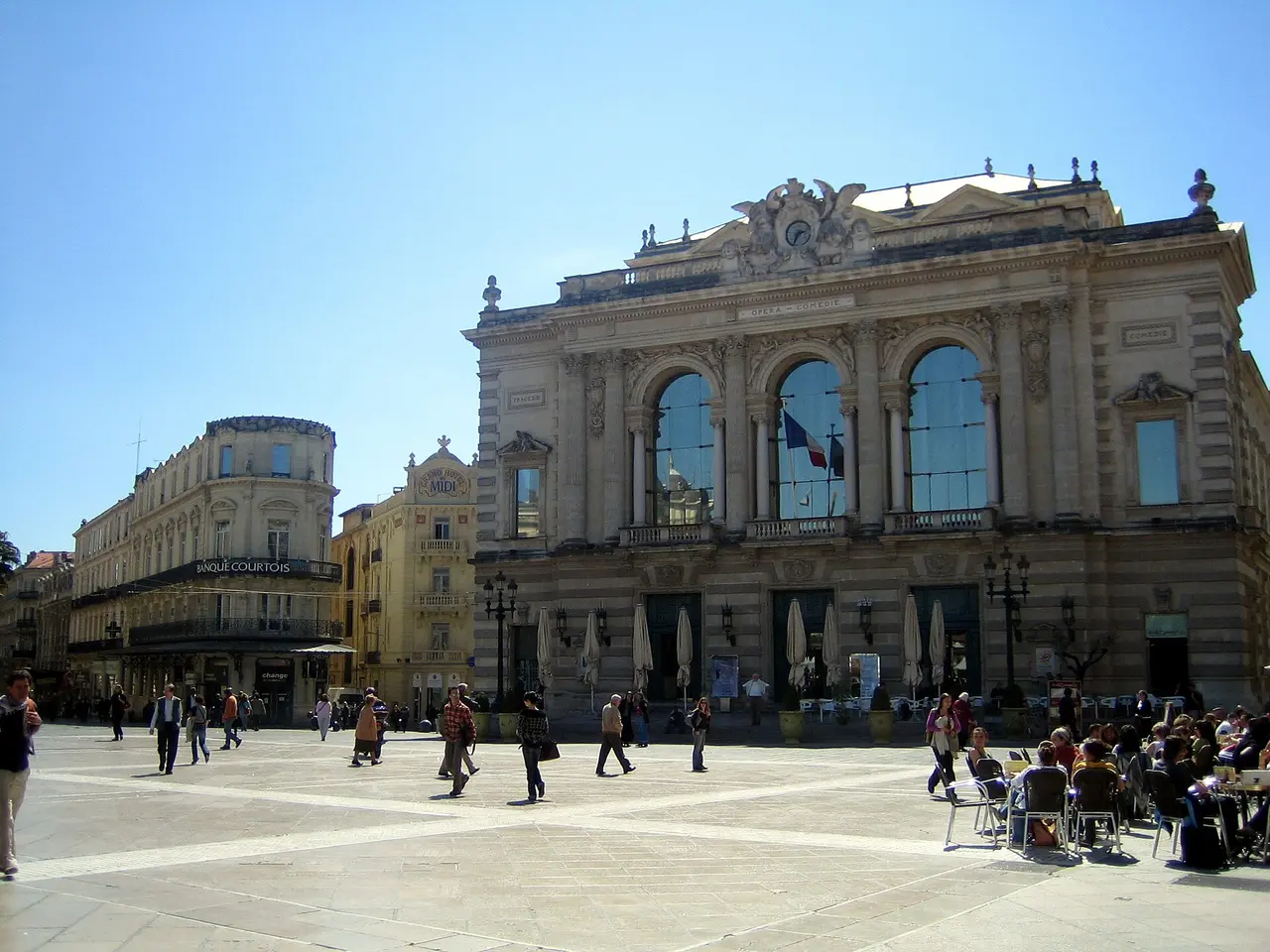
Place de la Comédie

A vast pedestrian square around the Opera House and the Three Graces fountain, the natural starting point of any visit.

Musée Fabre

A major fine arts museum, from early European painting to a room devoted to Pierre Soulages; closed on Mondays.

Promenade du Peyrou

A royal terrace with a statue of Louis XIV, a water tower and views of the Saint-Clément aqueduct at sunset.

Jardin des plantes

France's oldest botanical garden, founded in 1593 for the medical school, free and shady.

Saint-Pierre Cathedral

A Gothic cathedral with a massive porch held up by two conical pillars, next to the medical school.

Antigone District

Ricardo Bofill's neoclassical ensemble, about a kilometre long, linking the centre to the banks of the Lez.

Saint-Guilhem-le-Désert

A medieval village in the Hérault gorges around Gellone Abbey, a stop on the Way of St James.

What to discover in Montpellier?

The Écusson, the medieval heart

The historic centre owes its name to its shield-like shape. Pedestrian, hilly and dense, it takes half a day to explore between Place de la Comédie and Saint-Pierre Cathedral. The doors of 17th and 18th-century mansions often hide courtyards and grand staircases, opened during the Heritage Days. The Musée Fabre, closed on Mondays, is its great cultural stop. Plan a full morning there if you love painting.

The Peyrou and the Jardin des plantes

West of the Écusson, the royal Promenade du Peyrou, a 17th-century terrace, offers the city's best sunset, with the Saint-Clément aqueduct below. Just north, the Jardin des plantes, founded in 1593, is France's oldest botanical garden, free and shady. Allow an hour for both, ideally in late afternoon in summer. The Arceaux market sets up under the aqueduct on Tuesday and Saturday mornings.

Antigone and Port Marianne, today's city

Ten minutes' walk from the Comédie, Ricardo Bofill's Antigone district lines up 1980s neoclassical columns and squares down to the Lez river. Further east, Port Marianne gathers the contemporary city hall and the Arbre Blanc tower with its fanned-out balconies. The 56 km tram network links these districts to the centre for 1.90 euros a ride. Allow two hours on foot for the whole walk.

The lagoons, beaches and hinterland

The sea is half an hour away by tram then bus: Palavas-les-Flots for a lively scene, Maguelone and its cathedral isolated on the sandbar for wild beaches. Sète is twenty minutes by train. To the north, Pic Saint-Loup, 658 m, takes three hours return among vineyards, and Saint-Guilhem-le-Désert is fifty minutes away by car. Bring water and set off early in summer.

How much it costs

Per person per day, excluding international travel.
Budget
69 €/ day
1 346 € for 2 people, 7 days, return flights included
Accommodation
35 €
Food
25 €
Local transport
4 €
Sights and activities
5 €
Comfort
123 €/ day
2 102 € for 2 people, 7 days, return flights included
Accommodation
50 €
Food
50 €
Local transport
8 €
Sights and activities
15 €
Premium
300 €/ day
4 580 € for 2 people, 7 days, return flights included
Accommodation
125 €
Food
100 €
Local transport
25 €
Sights and activities
50 €
Prices checked: Relevé novembre 2026 : Numbeo (mis à jour le 10/11/2026) pour repas, cafés, tramway (1,90 € le trajet, gratuité réservée aux résidents de la métropole) et taxis ; Hostelz, Skyscanner, Momondo et Tophotels pour l'hébergement (lit en auberge env. 35 €, 3 étoiles env. 100 € la chambre, 5 étoiles env. 250 € la chambre). Lit en dortoir pour backpacker, chambre double partagée à deux pour comfort et premium. Trajet depuis Paris en TGV plutôt qu'en avion : env. 95 € l'aller par personne en moyenne (Liligo, Omio), soit 190 € l'aller-retour, nettement moins en réservant tôt ou en Ouigo. Hors juillet et août.

Getting there

Airports serving Montpellier, from main hubs to secondary ones.
  • AGFAgen La Garenne airportAgenSecondary
  • AJAAjaccio Napoléon Bonaparte airportAjaccioSecondary
  • ANEAngers Marcé airportAngersSecondary
  • ANGAngoulême Brie-Champniers airportAngoulêmeSecondary
  • AUFAuxerre Branches airportAuxerreSecondary
  • AURAurillac airportAurillacSecondary

Entry, health and safety

For FR travellers

Entry requirements

No visa for a tourist stay

Trajet intérieur, sans formalité d'entrée pour un ressortissant français. En avion vers Montpellier-Méditerranée, il faut une carte nationale d'identité, un passeport, un titre de séjour ou un permis de conduire où l'on est reconnaissable ; la carte d'identité numérique de l'application France Identité est aussi acceptée au dépôt des bagages et à l'embarquement. Livret de famille et justificatif de demande de papiers, sans photo, sont refusés.

Health

Checked in novembre 2026 against the official source. Entry rules change: check the official source before you travel, it alone is authoritative.

Practical information for Montpellier

From Paris

Direct TGV in just over three hours; booking early or on Ouigo brings the one-way fare well below the average of about 95 euros.

Tram

Five lines and 56 km of network, 1.90 euros a ride; free travel applies only to residents of the metropolitan area.

Getting to the beaches

Tram line 3 then bus to Palavas and Carnon; in summer, park-and-ride car parks at the termini avoid coastal traffic jams.

Driving in the Écusson

A pedestrian centre with underground car parks full on Saturdays: leave the car at an outlying tram car park.

Mondays

The Musée Fabre and several museums close on Mondays, so plan your culture day for another day.

Cévennes storms

From September to November, violent storms can cause flash floods: follow Météo-France warnings.

Mosquitoes

The coastal lagoons attract mosquitoes from May to September, so bring repellent for evenings by the sea.

Tramontane

A cold, dry north-westerly wind, common in winter and spring, that makes the beach unpleasant despite the sun.

Local specialities

Sète tielle pie, Bouzigues oysters, Pézenas little pies and Pic Saint-Loup wines, to try at the Halles Castellane.

Markets

The Arceaux market under the aqueduct on Tuesday and Saturday mornings, the city's most pleasant.

Taxis

Flag fall around 3.25 euros and 1.11 euros per kilometre according to Numbeo; few cruising taxis, so book by phone or app.

Montpellier in pictures

Photo credits : Andreas Sandberg, CC BY-SA 3.0, Wikimedia Commons ; Zairon, CC BY-SA 4.0, Wikimedia Commons ; Txllxt TxllxT, CC BY-SA 4.0, Wikimedia Commons ; Christian Ferrer, CC BY-SA 4.0, Wikimedia Commons ; Esculapio, CC BY-SA 3.0, Wikimedia Commons

Frequently asked questions about Montpellier

Which beach near Montpellier can you reach without a car?
Palavas-les-Flots is the easiest, by tram line 3 then bus, but it is very busy in summer. For a wilder beach, continue by bike or on foot along the lagoons to Maguelone, about four kilometres, with the cathedral isolated on the sandbar behind you.
Montpellier or Sète: where to stay for a seaside break?
Montpellier if you want museums, restaurants and nightlife, with the sea as a day trip. Sète if you prefer the port, the canals and a daily swim, twenty minutes by train from Montpellier. Many travellers stay in the city and spend a day in Sète.
What can you see in Montpellier in one day?
Place de la Comédie, the lanes of the Écusson and Saint-Pierre Cathedral in the morning, the Musée Fabre in early afternoon, except on Mondays, then the Jardin des plantes and the Promenade du Peyrou for sunset. All on foot, within a kilometre.
Can you combine Montpellier with Marseille or Toulouse?
Yes, by train: Marseille is about one hour forty by TGV, Toulouse just over two hours by Intercités or TER. Montpellier makes a good central stop for a car-free tour of southern France.
Is Montpellier pleasant in summer?
Mornings and evenings are, with festivals and terraces, but July and August afternoons often top 30 °C in the stone-built centre and the beaches are packed. May, June and September offer the best balance of warmth, swimming and crowds.

Plan your trip to Montpellier

Build your day-by-day itinerary and manage budget, bookings and packing in PlanTripNow.
Aperçu de l'application PlanTripNow