Skip to content

Visit Oxford : what to see, how to get there from London and when to go

Oxford is explored on foot among the silent quads of its colleges, the dome of the Radcliffe Camera and the wood-panelled rooms of the Bodleian. Between free museums, you hire a punt on the Cherwell, cross a meadow grazed by horses, then end up in a 17th-century pub.

At a glance

Visa
None
7-day budget
€1,225
Per person, comfort profile, excluding international flights.

Why visit Oxford?

Oxford, home to the oldest university in the English-speaking world in the United Kingdom, gathers some forty colleges, the Bodleian Library and free museums such as the Ashmolean. The city is about an hour by train from London. Two to four days are enough, ideally in May, June or September, with a passport and, for many nationalities, an ETA.

When to visit Oxford

Temperatures, rainfall and crowds month by month, to pick your window.
When to visit Oxford
MonthTemperaturesRainCrowdsVerdict
January2 to 8 °C12 dQuietA quiet winter between university terms: free museums and fireside pubs.
February2 to 9 °C9 dQuietThe least rainy winter month, with hotels cheaper than in summer.
March4 to 11 °C9 dModerateDaffodils in the college gardens and the Boat Race rowing contest in London, late March or early April.
April5 to 15 °C9 dModerateThe Botanic Garden in bloom and the first punts on the Cherwell on sunny days.
May8 to 18 °C10 dBusyChoir singing from Magdalen Tower at dawn on 1 May, but exams close some colleges.
June11 to 21 °C8 dBusyAmong the driest months: punting, Port Meadow and picnics, but college visits limited during exams.
July13 to 23 °C8 dPackedThe warmest and busiest month: school groups and tourists fill the centre, book everything.
August13 to 22 °C9 dPackedColleges open to visitors during the vacation, but crowds and hotel prices at their peak.
September11 to 19 °C9 dModerateThe best compromise: 19 °C and a calmer city before the October start of term.
October8 to 15 °C11 dModerateGowned students back for term and golden leaves on the quads, with more rain.
November5 to 11 °C12 dQuietGrey and damp, ideal for the big free museums such as the Ashmolean and Pitt Rivers.
December2 to 8 °C12 dModerateChristmas market on Broad Street and carol services in the college chapels.
Source: Normales 1991-2020 de la station météorologique Radcliffe de l'université d'Oxford (School of Geography), recoupées avec climatestotravel.com, relevé novembre 2026. Ville de l'intérieur, sans température de mer.

Oxford's must-sees

Libraries, colleges and museums behind the city's legend.

Bodleian Library

One of Europe's oldest libraries, visited on guided tours, including the Divinity School with its carved Gothic vault.

Radcliffe Camera

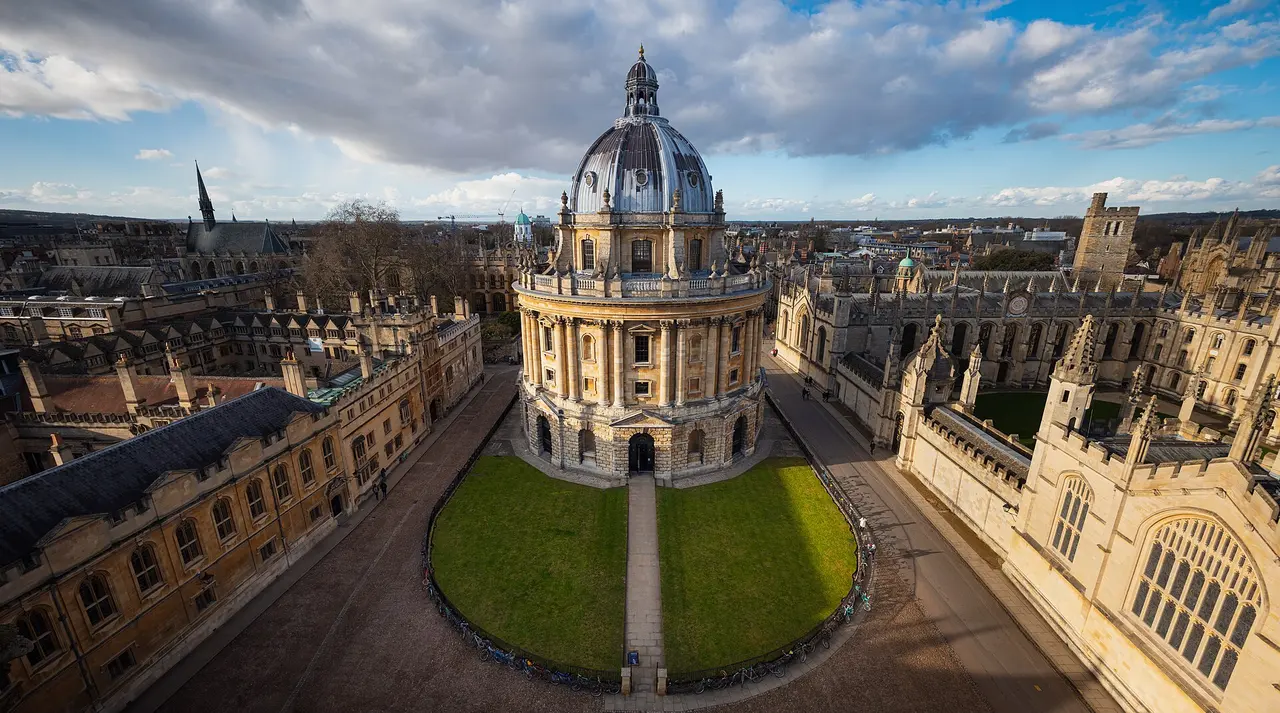
An 18th-century Palladian rotunda at the centre of Radcliffe Square, a reading room that became the city's symbol.

Christ Church

Oxford's largest college, with its cathedral, great hall and riverside meadow.

Ashmolean Museum

A free museum founded in 1683, from Egyptian archaeology to Renaissance and modern painting.

Natural History Museum

A free museum under a neo-Gothic glass roof, with dinosaur skeletons and the remains of the famous dodo.

Pitt Rivers Museum

An anthropology collection with display cases crammed with objects from around the world, reached through the Natural History Museum.

Sheldonian Theatre

The university's ceremonial hall designed by Christopher Wren, whose cupola offers a view over the rooftops.

Bridge of Sighs

A covered skyway linking two Hertford College buildings over New College Lane.

Magdalen College

A college on the Cherwell with its tower, cloister and a park where deer live.

Botanic Garden

Britain's oldest botanic garden, founded in 1621 on the Cherwell, opposite Magdalen.

Blenheim Palace

A UNESCO-listed baroque palace, birthplace of Winston Churchill, surrounded by a vast landscaped park.

What to discover in Oxford?

Radcliffe Square and the Bodleian

The heart of the university fits into one square. The Radcliffe Camera, an 18th-century rotunda, is a reading room reserved for students; its interior can only be seen on a guided tour. The neighbouring Bodleian Library opens its Divinity School, a Gothic hall with a carved vault, and Duke Humfrey's Library on tours of thirty to ninety minutes, bookable online. The tower of the University Church of St Mary offers the best view of the whole for a few pounds.

The colleges, from Christ Church to Magdalen

Oxford has some forty self-governing colleges, each with its chapel, hall and gardens. Christ Church, the largest, combines a cathedral, a great hall and a riverside meadow; entry is paid and hours vary with college life. New College and Magdalen, with its deer park, are among the most beautiful. Many partly close during the May and June exams: check their websites for hours before you come.

The free museums

Oxford offers an exceptional density of free museums. The Ashmolean, opened in 1683, covers archaeology, painting and decorative arts from ancient Egypt to the Renaissance. The Natural History Museum, under a neo-Gothic glass roof, houses dinosaur skeletons and the remains of the dodo, and leads into the Pitt Rivers, an anthropology collection with crowded display cases. Allow half a day for the Ashmolean and as long for the other two, closed on some holidays.

Rivers, punts and meadows

Two rivers surround the city, the Cherwell and the Thames, here called the Isis. Flat-bottomed punts are hired by the hour at Magdalen Bridge or Folly Bridge from April to September; you push with a pole, which takes a little practice. The Botanic Garden, the oldest in the country, founded in 1621, borders the Cherwell. To the west, Port Meadow, a huge common, leads on foot to the riverside pubs of Wolvercote.

Jericho, the Covered Market and the pubs

The Jericho district, north-west of the centre, lines up Victorian houses, cafés and small restaurants along the Oxford Canal. In the centre, the Covered Market, open since the 18th century, houses butchers, bakers and cafés. Historic pubs, tucked down narrow lanes like the Turf Tavern, are part of the trip. Allow an evening to discover them; most serve simple food until early evening.

Blenheim and the Cotswolds

Blenheim Palace, UNESCO-listed and birthplace of Winston Churchill, is half an hour north by bus. Allow a day for the palace and its landscaped park. To the west begin the Cotswolds, hills dotted with honey-coloured stone villages such as Burford and Bibury, about an hour away by road. Without a car, an organised day tour avoids the infrequent rural buses.

How much it costs

Per person per day, excluding international travel.
Budget
100 €/ day
1 900 € for 2 people, 7 days, return flights included
Accommodation
48 €
Food
35 €
Local transport
5 €
Sights and activities
12 €
Comfort
175 €/ day
2 950 € for 2 people, 7 days, return flights included
Accommodation
70 €
Food
65 €
Local transport
10 €
Sights and activities
30 €
Premium
460 €/ day
6 940 € for 2 people, 7 days, return flights included
Accommodation
230 €
Food
130 €
Local transport
30 €
Sights and activities
70 €
Prices checked: Relevé novembre 2026 : Numbeo (mis à jour le 10/11/2026) pour repas, cafés, bus et taxis ; Momondo, Booking.com, Skyscanner et Trip.com pour l'hébergement (lit en auberge env. 48 €, 3 étoiles env. 140 € la chambre, 5 étoiles env. 460 € la chambre). Lit en dortoir pour backpacker, chambre double partagée à deux pour comfort et premium. Trajet depuis Paris : Eurostar jusqu'à Londres (prix moyen Liligo env. 160 €, dès 44 € l'aller en réservant tôt) puis train Londres-Oxford d'environ une heure (20 à 30 £ en moyenne selon Trip.com), soit env. 250 € l'aller-retour retenu par personne. Prévoir l'ETA à 20 £. Entrées payantes de certains collèges comprises dans les activités. Livre sterling convertie, sensible au change.

Getting there

Airports serving Oxford, from main hubs to secondary ones.
  • ADXLeuchars Station AirfieldLeuchars, FifeSecondary
  • BBSBlackbushe AirportCamberley, SurreySecondary
  • BEBBenbecula AirportBalivanichSecondary
  • BEQRAF HoningtonBury Saint Edmunds, SuffolkSecondary
  • BEXRAF BensonWallingford, OxfordshireSecondary
  • BHDGeorge Best Belfast City AirportBelfastSecondary

Entry, health and safety

For FR travellers

Entry requirements

No visa for a tourist stay

Passeport valide obligatoire : la carte d'identité n'est acceptée que pour les titulaires du statut de résident. Pas de visa pour le tourisme, jusqu'à six mois maximum, mais une autorisation de voyage électronique (ETA) est exigée : 20 £, valable deux ans ou jusqu'à l'expiration du passeport, à demander sur le site officiel du gouvernement britannique ou l'application UK ETA.

Health

Royaume-Uni en vigilance normale ; menace terroriste évaluée à 4 sur 5 (Severe) par les autorités britanniques. Vols et agressions sur la voie publique : ne pas exposer bijoux ni liquidités et éviter de marcher seul la nuit dans certains quartiers. Privilégier les VTC accrédités la nuit. Méfiance envers les sites commerciaux qui facturent l'ETA plus cher que le tarif officiel.

Safety

Normal precautions

Emergency

999 ou 112 (urgences), 101 (police hors urgence), 111 (conseil médical NHS)

Checked in novembre 2026 against the official source. Entry rules change: check the official source before you travel, it alone is authoritative.

Practical information for Oxford

Passport and ETA

A passport is required and many visitors, including EU citizens, need a £20 Electronic Travel Authorisation (ETA), valid two years. Check the rules for your nationality.

From Paris

Eurostar to London, then a train from Paddington or Marylebone, about an hour, with cheaper tickets booked ahead.

College hours

Each college sets its own hours and fees, and some close for exams or ceremonies: check their websites the day before.

Bodleian tours

Guided tours of thirty to ninety minutes have limited places: book online several days ahead.

Driving

The centre is almost pedestrian and parking is scarce: use the park-and-ride car parks on the outskirts, linked to the centre by bus.

Cycling

The students' favourite way to get around; plenty of rentals, but watch out for buses in the narrow central streets.

Punting

Hire by the hour from April to September at Magdalen Bridge and Folly Bridge; a deposit is often required.

Pubs

Order and pay at the bar, no tip expected; kitchens often close early in the evening in small pubs.

Power plugs

Type G three-pin sockets, 230 V: an adapter is essential for continental European devices.

Accommodation

Central hotels are limited and expensive in summer; some colleges rent out student rooms during the university vacations.

Oxford in pictures

Photo credits : Julian Herzog ( Website ), CC BY 4.0, Wikimedia Commons ; Txllxt TxllxT, CC BY-SA 4.0, Wikimedia Commons ; Michael D Beckwith, CC0, Wikimedia Commons ; Ian S, CC BY-SA 2.0, Wikimedia Commons

Frequently asked questions about Oxford

Can you visit Oxford as a day trip from London?
Yes, the train from Paddington or Marylebone takes about an hour. In a day you can see Radcliffe Square, a college such as Christ Church, the Ashmolean and a riverside walk. For a guided Bodleian tour and an evening in the pub, two days are better.
Which college should you visit if you only see one?
Christ Church for its cathedral, great hall and scale, if you accept the price and the crowds. For more calm, New College and its medieval walls, or Magdalen and its deer park on the Cherwell. Check opening hours, which vary with college life.
How do you go punting on the Cherwell?
Hire a punt by the hour at Magdalen Bridge or Folly Bridge, from April to September. You push it standing at the back with a long pole: the first ten minutes are wobbly, then it becomes easy. Chauffeured punts are also available for those who prefer to sit back.
Oxford or Cambridge: which one to choose?
Oxford is larger and more urban, with its big free museums and Blenheim nearby; Cambridge, smaller, centres on the river and its waterside colleges. Oxford combines easily with London and Bath, about an hour and a half away by train.
Where should you stay in Oxford on a reasonable budget?
The centre is expensive and fills up fast in summer. The Jericho and Cowley Road areas, walkable or cyclable from the centre, offer more affordable guesthouses. During university vacations, some colleges rent out student rooms, an unusual experience at a fair price.
Can you combine Oxford and Manchester?
Yes, by direct train or with one change, about two and a half hours. Manchester brings industrial history, music and football, Oxford the university heritage: together they make a good one-week circuit of England via London.

Plan your trip to Oxford

Build your day-by-day itinerary and manage budget, bookings and packing in PlanTripNow.
Aperçu de l'application PlanTripNow