Chubu travel guide: what to see in the Japanese Alps, when to go

Chubu occupies the centre of Honshu, between Tokyo and Kyoto: it is the region of 3,000 m peaks, thatched mountain villages, Edo-era paved post roads and one city, Kanazawa, that stayed clear of the wars and kept its old centre intact.

Why visit Chubu?

Chubu is the region most travellers in Japan cross by shinkansen without stopping. That is a mistake: it is here you find the country's only real accessible high mountains, the listed villages of Shirakawa-go and Gokayama, and a stretch of the historic Nakasendo road still walked on foot between two post towns.

What to discover in Chubu?

Nagoya and the plain

Japan's fourth city, Nagoya is more of a transport hub than a destination in itself. Its rebuilt castle, the Atsuta shrine and the Toyota industry museum can be seen in a day. The city is above all the starting point for trains to Takayama and Kiso, and home to Chubu Centrair airport. Local dish to try: tebasaki, grilled peppered chicken wings, miso katsu and flat kishimen noodles, quite unlike the cooking of Kanto, plus the free breakfast that comes with a morning drink at a cafe.

The Kiso valley and the Nakasendo

Between Nagoya and Matsumoto, the Kiso valley keeps several post towns of the Nakasendo road, which linked Edo to Kyoto through the mountains. The most walkable stretch runs from Magome to Tsumago, 8 km in three hours, with a luggage-forwarding service between the two villages for about 5 euros. Tsumago bans cars by day and hides its power lines: you sleep in a minshuku to enjoy the quiet after 5 p.m.

Matsumoto and the lakes

Matsumoto, at 600 m, is built around one of Japan's few original keeps, black, a national treasure, beside its moat. Nakamachi street and its whitewashed warehouses, an ukiyo-e print museum and the Utsukushigahara hot spring above town round off a day. It is also the gateway to Kamikochi and the alpine route, and a handy base for the whole region and its lakes, Suwa to the south and Aoki to the west.

Kamikochi and the Northern Alps

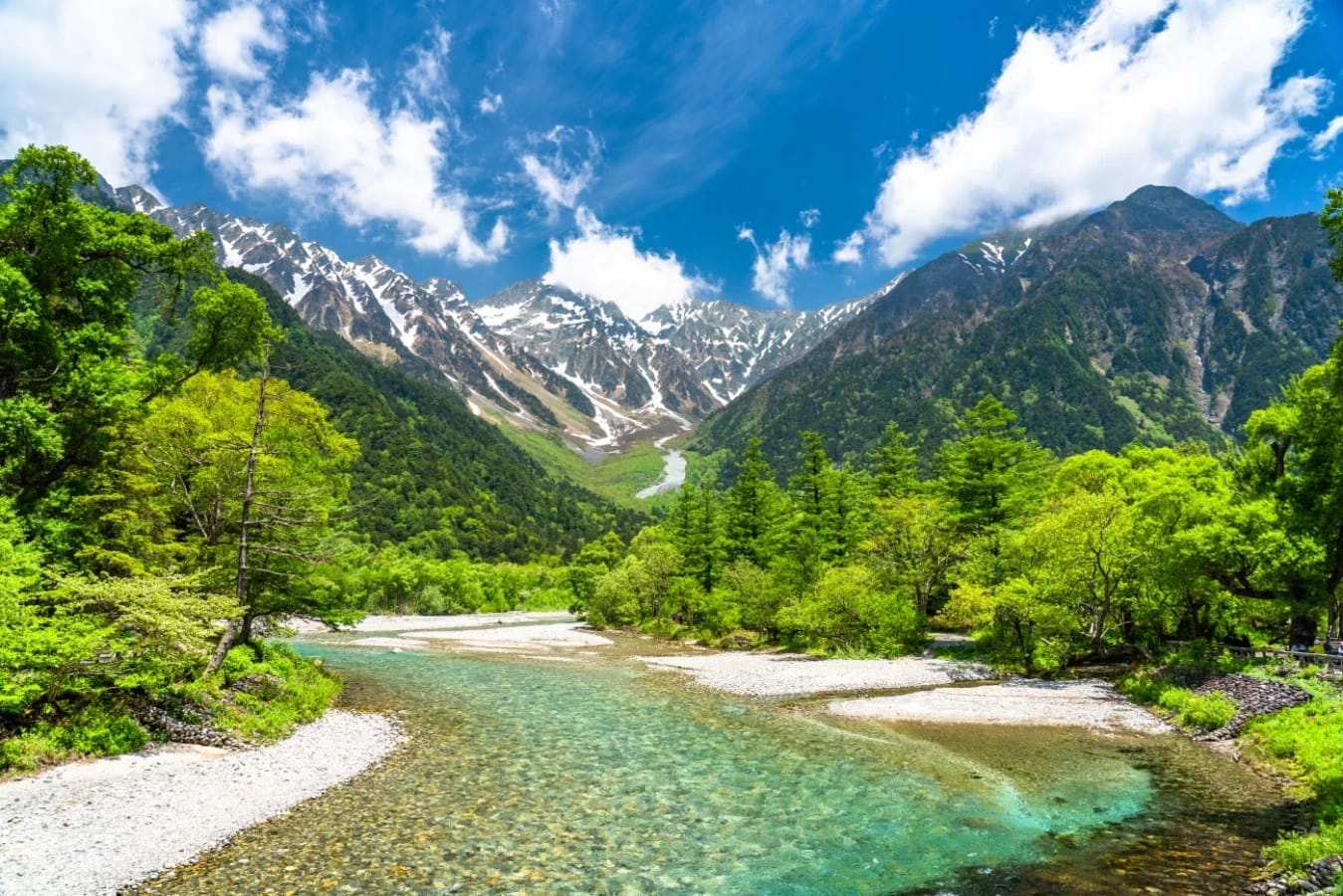
Kamikochi is a glacial valley at 1,500 m, closed to private cars, reached by bus from Sawando or Hirayu. An easy walk follows the Azusa river to Myojin Pond, 90 minutes there and back; experienced hikers climb to the Yokoo hut, at the foot of the Hotaka walls. The valley is open only from mid-April to mid-November. Mountain huts must be booked, especially in summer and during the October foliage.

Takayama, Shirakawa-go and the Hida

Takayama keeps an old town of dark wooden merchant houses, a morning market by the river and sake breweries open for tasting in winter. An hour away by bus, Shirakawa-go and its steep-thatched gassho-zukuri farmhouses are a UNESCO site; a night in one lets you stay after the coaches leave, around 4 p.m. Gokayama, further out and quieter, offers the same landscape without the crowd.

Kanazawa and the Sea of Japan

On the north-west coast, Kanazawa escaped the bombing and keeps an intact old centre. The Kenroku-en garden, one of Japan's three great gardens, is visited at opening to beat the groups. The Higashi Chaya geisha district, the Omicho market and the 21st Century Museum of Contemporary Art, closed on Mondays, fit into a day and a half. In winter, snow falls here by the metre, driven by Siberian winds.

Cities to visit in Chubu

Featured destinations appear first.
Coming soon.

Chubu in pictures

Chubu's must-sees

Named sites to spread between the mountains, the listed villages and the region's cities.

Matsumoto Castle

One of five original keeps designated a national treasure, entirely black, reflected in its moat.

Kamikochi

A glacial valley at 1,500 m closed to cars, with the Kappa bridge and the Hotaka walls as a backdrop.

Shirakawa-go

A UNESCO-listed village of steep-thatched farmhouses, spectacular buried under snow in winter.

Takayama old town

The Sanmachi district of wooden merchant houses, a morning market and the sake breweries of the Hida.

Kenroku-en garden

One of Japan's three great gardens in Kanazawa, with the Kotoji lantern and a pump-free fountain.

Tateyama-Kurobe route

An alpine crossing combining bus, funicular and ropeway, with a 15 m snow wall in April and May.

Nakasendo Magome-Tsumago

A paved section of the historic mountain road, walkable in three hours between two post towns.

Jigokudani macaques

Snow monkeys bathing in a hot spring at Yamanouchi, the clearest sight from December to March.

Similar regions

Other regions you might like as much as Chubu.

Similar destinations

Other countries you might like as much as Chubu.

Chubu FAQ

How do you get to Takayama?
By express train from Nagoya, about 2 h 20 on the Hida line, one of the country's finest rail journeys along the river. By coach from Matsumoto or Toyama, about 2 h 30, or from Shinjuku in Tokyo in 5 h 30.
Should you visit Chubu from Tokyo or from Kyoto?
The region fits naturally between the two, on a Tokyo-Kanazawa-Takayama-Nagoya-Kyoto route. It can also be done as a loop from Nagoya if you only want the Alps and the Hida villages.
Is Kamikochi accessible all year?
No: the valley opens to shuttle traffic around mid-April and closes in mid-November. In winter, only hikers on snowshoes reach it on foot, on a long approach, with no lodging open.
Can you visit Chubu without a car?
Yes for Nagoya, Matsumoto, Takayama, Shirakawa-go and Kanazawa, all linked by train or coach. A car only helps for the side valleys and the Kiso outside the Nakasendo. Kamikochi and Shirakawa are reached by bus.
Shirakawa-go as a day trip or an overnight?
A night changes everything: the coaches leave around 4 p.m. and the village regains its calm. You can then climb to the Shiroyama viewpoint at sunset and dine around a farmhouse hearth, which a flying visit does not allow.
Can you see Mount Fuji from Chubu?
From the east of the region only, around the Kofu valley and Lake Suwa on a clear day. The alpine heart, Kamikochi and Takayama, is too far west and ringed by its own 3,000 m peaks.
Is the Nakasendo walk between Magome and Tsumago hard?
No: 8 km on a well-marked path, with a climb to the Magome pass then a long descent, about three hours on foot. A service carries luggage between the two villages, so you can walk light.

Plan your trip to Chubu

Day-by-day itinerary, budget, bookings and packing in a single app.
Aperçu de l'application PlanTripNow