Visit Brittany: when to go, what to see and where to head

Brittany has France's longest coastline: the Pink Granite Coast, the Pointe du Raz, the Gulf of Morbihan, around fifteen inhabited islands and the customs officers' path linking it all. Inland, the Argoat keeps its forests of legend. Most people come between April and October, for the light and the trails.

Why visit Brittany?

Brittany offers a rare range of coastal landscapes for a single region: pink cliffs, dunes, rias, salt marshes and abers. This peninsula in western France combines a living Celtic heritage, language and music included, a renowned seafood cuisine and a mild climate that lets you walk year-round.

What is there to discover in Brittany?

The Emerald Coast, from Cancale to Cap Frehel

The north-east coast takes two to three days. Saint-Malo and its walled-town ramparts, about 2 kilometres long, are the anchor point; Chateaubriand's tomb, on the Grand Be islet, is only reachable at low tide, so a tide table is essential. Dinard lines up its Belle Epoque villas and the Clair de Lune promenade, Cancale its oyster beds facing the bay of Mont-Saint-Michel. Further west, Cap Frehel with its heath and lighthouse, and Fort la Latte on its rocky spur, close the picture. The tidal range here regularly tops 12 metres at springs.

The Gulf of Morbihan, Carnac and the Rhuys peninsula

In the south, the Gulf of Morbihan is a small inland sea dotted with about forty islands, including the Ile aux Moines and the Ile d'Arz, served by boat from Vannes or Port-Blanc in around fifteen minutes. Nearby, the Carnac alignments count over 3,000 standing stones across 4 kilometres, freely accessible in winter and guided from June to September to protect the site. The Quiberon peninsula, joined by a thin isthmus, gives access to its wild coast and to the island ferries.

The Pink Granite Coast and the Tregor

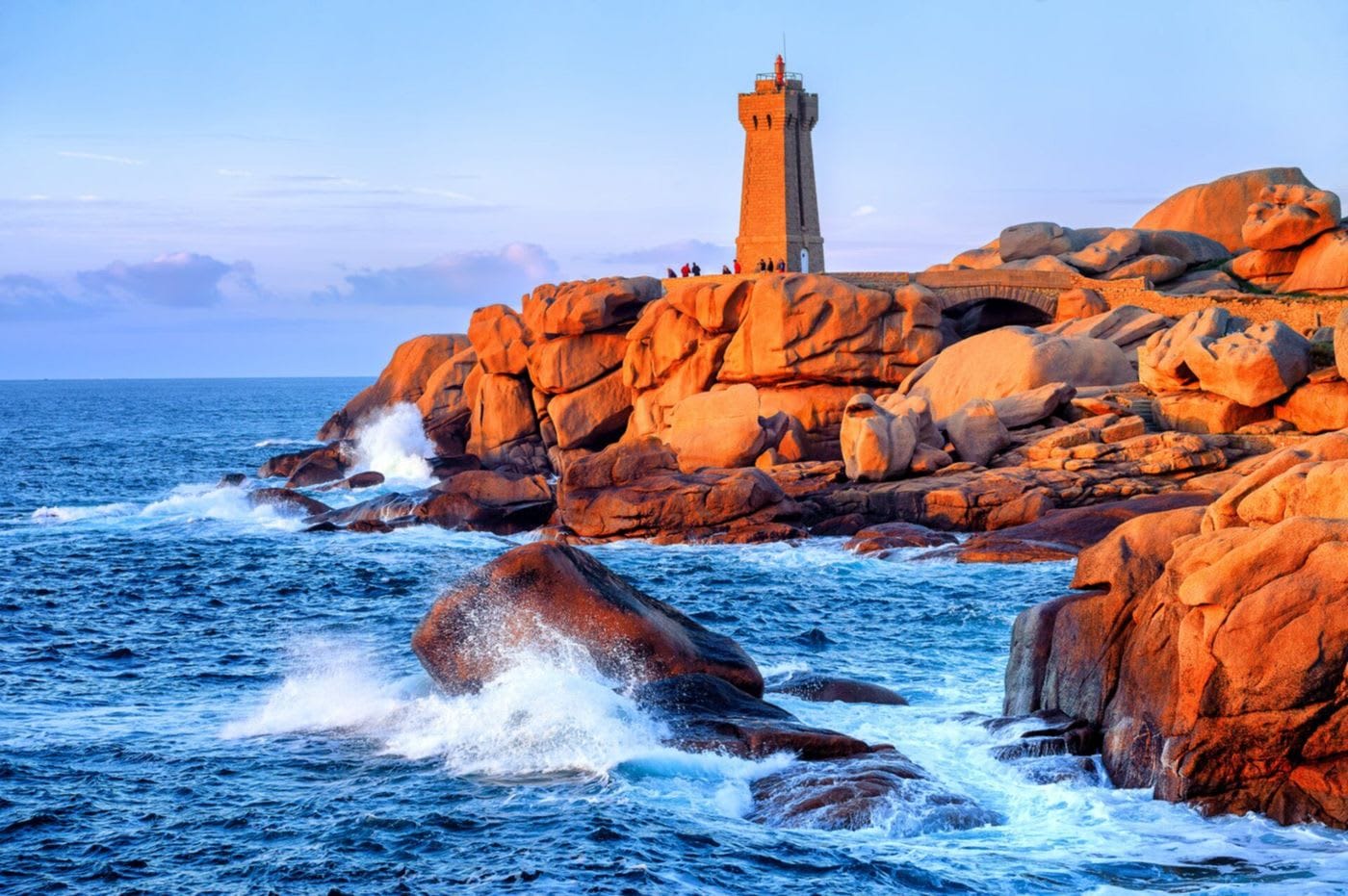
Between Perros-Guirec and Tregastel, over about 10 kilometres, pink granite forms a jumble of rounded boulders that the coast path hugs closely: allow an hour's walk between Trestraou beach and the Mean Ruz lighthouse at Ploumanac'h. Offshore, the Sept-Iles reserve, France's most important for seabirds, shelters gannets and puffins, best seen by boat from April to July. The car-free island of Brehat is a day trip from the Pointe de l'Arcouest.

Finistere, from the Pointe du Raz to Crozon

The Breton end of the world has to be earned: the Pointe du Raz, a classified site, is reached by shuttle or a 15-minute walk from the car park, above the Baie des Trepasses. The Crozon peninsula lines up the Pointe de Pen-Hir and its Tas de Pois, the Cap de la Chevre and beaches with restricted summer access. For towns, Quimper and its cathedral, Locronan and its granite houses, Douarnenez and its port-museum. The parish closes of the Elorn, with carved calvaries from the 16th and 17th centuries, form a loop from Landerneau.

The Breton islands

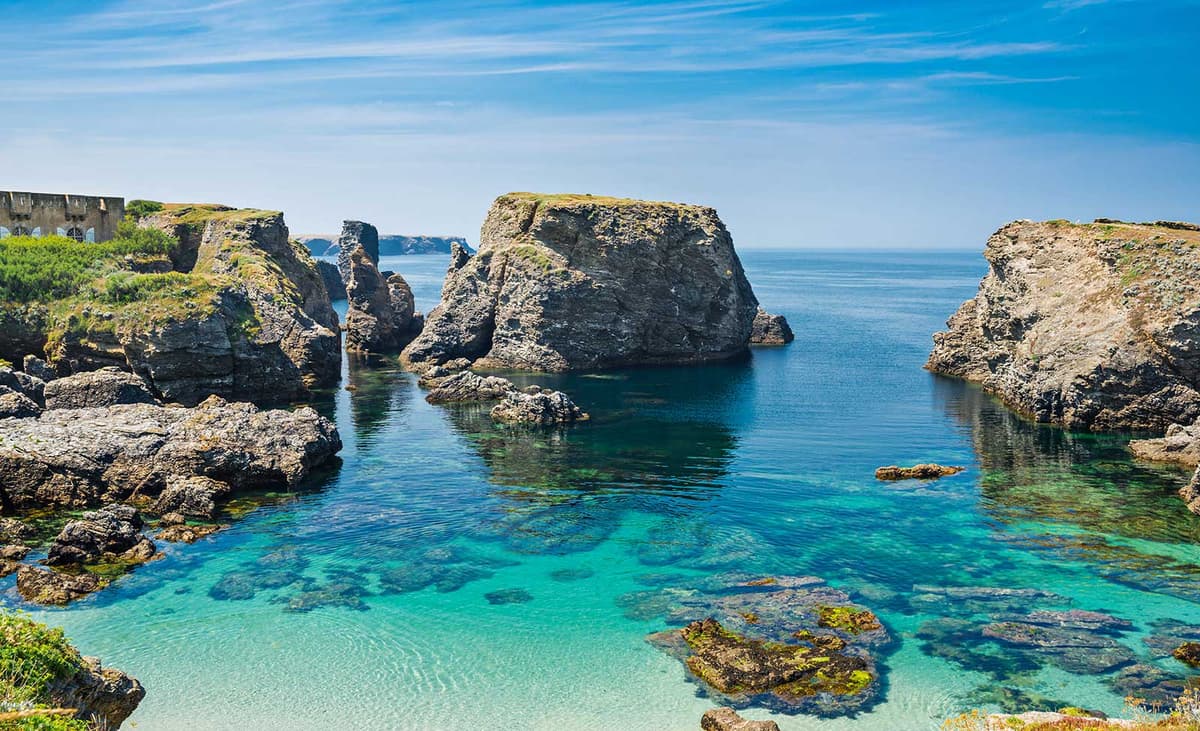
Brittany has around fifteen inhabited islands. Belle-Ile-en-Mer, the largest, is 45 minutes by ferry from Quiberon and is toured by bike. Ouessant, at the far west, is 2h15 by boat from Le Conquet or 15 minutes by plane from Brest, and lives to the rhythm of the five lighthouses marking the Ushant traffic lane. Groix, to the south, fits into a day by mountain bike. Sein, almost at water level, and car-free Brehat complete the list. Book the crossing as soon as sales open in summer.

The Argoat: Broceliande, the Monts d'Arree and the canal

The interior, the Argoat, or land of woods, stands against the Armor, the land of the sea. The forest of Paimpont, identified with Arthurian Broceliande, is explored around the Val sans Retour and the Barenton spring. The Monts d'Arree, the region's high point at 385 metres on the Roc'h Ruz, offer bare moorland and peat bogs, with the Yeun Elez marsh at their foot. The 360-kilometre Nantes-Brest canal suits cycling along its flat towpaths, notably around Bon-Repos abbey.

Crepes, cider, seafood and fest-noz

The savoury buckwheat galette differs from the sweet wheat-flour crepe; both come with a bowl of cider. The coast supplies oysters from Cancale and Riec, scallops from the Brest roadstead, blue lobster and spider crab. Kouign-amann, born in Douarnenez, and prune far breton finish the meal. As for living culture, the fest-noz, a traditional dance listed by UNESCO, is danced in a chain all year; the Lorient Interceltic Festival, in early August, is its showcase.
Cities to visit in Brittany

Featured destinations appear first.
Coming soon.

Brittany in pictures

Brittany highlights

Eight sites that sum up the range of the Breton coast and its hinterland.

Saint-Malo walled town

A corsair city rebuilt identically after 1944, ringed by ramparts walked high above the sea and the beaches.

Pointe du Raz

70-metre cliffs jutting into the Atlantic, a classified site and Grand Site de France, above the Baie des Trepasses.

Carnac alignments

Over 3,000 standing stones raised 6,000 years ago across 4 kilometres, the largest megalithic complex in the world.

Ploumanac'h

A jumble of pink granite and the Mean Ruz lighthouse, on a coast path regularly ranked among France's finest.

Cap Frehel and Fort la Latte

A windswept heath cape with a lighthouse and, an hour's walk away, a medieval fortress set on a spur.

Crozon peninsula

The heart of the Armorique regional park, with the Pointe de Pen-Hir, the Cap de la Chevre and some of the purest beaches in the region.

Concarneau Ville Close

A fortified islet in the middle of the fishing harbour, reached by a drawbridge, with its ramparts and fishing museum.

Oceanopolis

An ocean discovery park in Brest, in three pavilions, polar, tropical and temperate, one of Brittany's biggest family outings.

Similar regions

Other regions you might like as much as Brittany.

Similar destinations

Other countries you might like as much as Brittany.

Frequently asked questions about Brittany

North coast or south coast of Brittany: which to choose?
The north coast, more jagged and wild, for the pink granite, Saint-Malo and the big tides. The south coast, gentler and more sheltered, for the Gulf of Morbihan, Carnac and slightly warmer water in summer. For a first visit, the south is easier.
How long to tour Brittany?
A full loop of the coast needs at least two weeks to stay reasonable. In one week, better to pick one side: the north coast from Saint-Malo to Morlaix, or south Finistere from Quimper to the Crozon peninsula.
Can you swim in Brittany, and when?
Yes, mostly from late June to early October, when the sea reaches 16 to 18 degrees in the south and a little less in the north. The water is warmest in September. Many beaches are supervised in July and August only.
How do you get to Belle-Ile-en-Mer from Quiberon?
The Compagnie Oceane links Quiberon to Le Palais in about 45 minutes, several times a day year-round. Taking a car is expensive and books up early; on the island, a bike is plenty to ride round.
When can you see the Carnac alignments without the crowds?
From November to March the megalithic rows are freely accessible and often deserted on weekdays. From June to September the visit is guided only, by reservation, to protect the heath: take the first morning slot.
Is Mont-Saint-Michel in Brittany?
No, it is in Normandy, but on the border: the bay is shared with Brittany and Cancale is only about twenty kilometres away. Many stays on the Emerald Coast include a day trip to the Mont.
Which Breton island can you visit in a day?
Brehat from the Arcouest or the Ile aux Moines in the Gulf of Morbihan work very well in a day, with a short crossing and a tour on foot or by bike. Ouessant and Belle-Ile deserve at least one night.
How do you reach Chateaubriand's tomb on the Grand Be?
The Grand Be islet, off Saint-Malo, is reached on foot across the foreshore about two hours either side of low tide. Outside that window the way back is cut by the sea: times are posted at the start of the causeway.
Where can you see puffins and gannets in Brittany?
At the Sept-Iles reserve, off Perros-Guirec, which holds France's largest seabird colony, including the country's only gannet rock. Commented boat trips leave from Perros-Guirec and Tregastel, mainly from April to July, during the nesting season, and do not land on the protected islands.
Galette or crepe: what is the difference in Brittany?
The galette is made of buckwheat flour, contains no sugar and is filled savoury, egg, ham, cheese. The crepe is wheat-flour, sweet, served for dessert. In Finistere the galette is sometimes called a ble noir crepe.

Plan your trip to Brittany

Day-by-day itinerary, budget, bookings and packing in a single app.
Aperçu de l'application PlanTripNow