The abbey crowns a granite rock in the middle of a bay where the sea is said to rise at the speed of a galloping horse. Visit early, before the groups: the Grande Rue fills fast, while the abbey at the top has more room. The bay is crossed on foot with a guide, 2 to 3 hours from Genets, never alone because of quicksand and the tide. The biggest tides, around the equinox, cut the Mont off completely for a few hours and draw crowds onto the ramparts.
From the Pointe du Hoc to Ouistreham, five code-named beaches, Utah, Omaha, Gold, Juno, Sword, stretch over 80 kilometres. The American cemetery at Colleville-sur-Mer, above Omaha, holds nearly 9,400 graves; the Pointe du Hoc keeps its craters and bunkers; Arromanches preserves the caissons of the artificial harbour. Bayeux, the first French town liberated and spared by the bombing, makes an ideal base: its 11th-century Tapestry, 70 metres long, is seen at opening with the audio guide.
Caen, William the Conqueror's city, keeps its ducal castle and two abbeys he founded, the Abbaye aux Hommes and the Abbaye aux Dames. The Caen Memorial traces the 20th century and the Cold War; allow at least a half-day. The centre was largely rebuilt after 1944. To the north, the Cote de Nacre lines up the family resorts of Lion-sur-Mer, Luc and Courseulles, with long sand beaches at low tide and the Juno Beach Centre devoted to the Canadians.
On the south bank of the estuary, the Cote Fleurie launched seaside tourism in the 19th century. Honfleur and its Vieux Bassin, lined with tall narrow houses painted by Boudin, keep an all-timber Sainte-Catherine church built by ship's carpenters. Deauville lines up its boardwalk, its villas and its racecourse; Trouville stays more down-to-earth, Cabourg more Proustian. The Deauville American Film Festival, in early September, extends the season by a week.
Behind the coast, the Pays d'Auge unrolls a bocage of hedges, orchards and half-timbered manors. The cider road, about forty kilometres around Cambremer and Beuvron-en-Auge, one of France's loveliest villages, links farms selling cider, perry and pommeau, and calvados makers ageing spirit in the cask. The four AOP Normandy cheeses, camembert, livarot, pont-l'eveque and neufchatel, are tasted in their home villages, often with a dairy visit.
Rouen, the former capital of Normandy, packs a half-timbered medieval centre around Notre-Dame cathedral, painted thirty times by Monet at different hours. The Place du Vieux-Marche marks where Joan of Arc was burned in 1431, and the Aitre Saint-Maclou keeps a cloister with macabre carvings. Downstream, the Seine draws meanders lined with chalk cliffs, with the abbeys of Jumieges and Saint-Wandrille and the Chateau de La Roche-Guyon on the edge of the Ile-de-France.
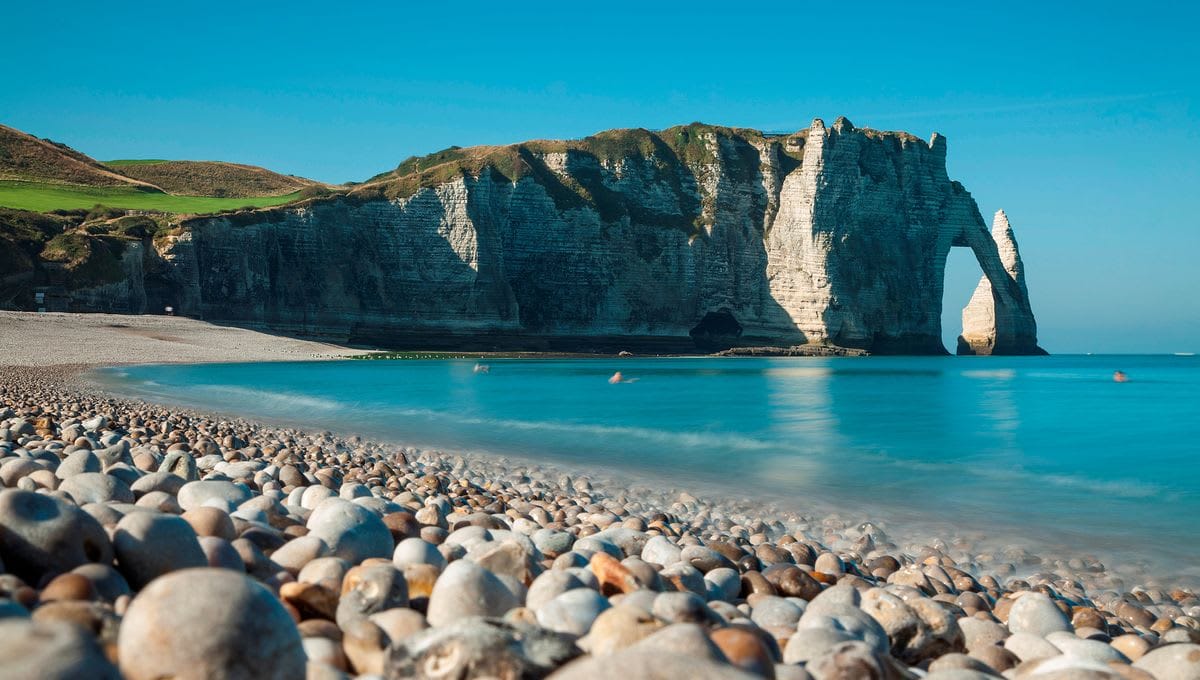
From the Seine to the Somme, the Alabaster Coast raises 130 kilometres of white chalk cliffs. Etretat is the highlight: the Porte d'Aval, the Needle and the Manneporte are seen from the coast path, walked at low tide and evening light; the contemporary Etretat gardens hang over the void. Fecamp holds the Benedictine palace, half factory, half museum, where the liqueur has been distilled since 1863. Dieppe, France's first seaside resort, keeps its castle, its fishing port and an open seafront.
The Cotentin peninsula, the region's wildest, reaches toward England. The Nez de Jobourg and Cap de la Hague offer cliffs battered by the currents of the Raz Blanchard, among the strongest in Europe. The west coast lines up long windy beaches, popular for sand yachting, and the bay of the Mont to the south. Barfleur and Saint-Vaast-la-Hougue, oyster ports, are among the prettiest anchorages. From Carteret, a boat reaches the Channel Islands of Jersey and Guernsey in an hour.