Guadeloupe

Nicknamed the butterfly island, Guadeloupe has two faces: Grande-Terre with its golden beaches, and Basse-Terre with its rainforest crowned by the Soufrière volcano. Around them, a string of islands, Les Saintes, Marie-Galante, La Désirade, invites you to extend the journey amid lagoons, rum and Creole culture.

Why visit Guadeloupe?

Guadeloupe stands out for its variety of landscapes within a small territory: white-sand beaches, sheltered lagoons, rainforest, waterfalls and the Soufrière volcano. As a French Caribbean territory, it combines tropical escape with easy travel, using the euro as currency and French as its language.

What to discover in Guadeloupe?

Guadeloupe is made up of two main islands linked by a bridge, forming a butterfly silhouette. To the east, Grande-Terre concentrates the most accessible beaches, from Sainte-Anne to Le Gosier, along with the Pointe des Châteaux and its cliffs battered by the Atlantic. To the west, Basse-Terre offers a very different setting: the rainforest of the National Park, waterfalls such as the Carbet Falls, hiking trails and the climb up the Soufrière volcano, the highest point of the Lesser Antilles.
Around the main archipelago lie several islands with strong character. Les Saintes charm visitors with a bay ranked among the most beautiful in the world, Marie-Galante preserves a living sugar and rum tradition, and La Désirade offers wild, unspoilt nature. The Grand Cul-de-Sac Marin, a vast lagoon fringed with mangroves and reefs, completes this picture of remarkable biodiversity, ideal for snorkelling, kayaking and watching marine wildlife.

Cities to visit in Guadeloupe

Featured destinations appear first.
Coming soon.

Guadeloupe in pictures

The must-sees

Beaches, volcano, islands and nature: here is what not to miss in Guadeloupe.

Grande-Terre beaches

From Sainte-Anne to Le Gosier, southern Grande-Terre lines up turquoise lagoons and white-sand beaches fringed with coconut palms, all easy to reach.

The Soufrière volcano

The highest point of the Lesser Antilles, this active volcano is climbed through rainforest to a summit often wrapped in mist.

Les Saintes

This small archipelago charms visitors with its renowned bay, its colourful streets and Fort Napoléon, which offers a sweeping panoramic view over the sea.

The island of Marie-Galante

The island of a hundred windmills keeps a sugar and rum tradition alive, between cane fields, small craft distilleries and unspoilt, quiet beaches.

The Carbet Falls

Deep within the National Park, these spectacular waterfalls are reached via trails crossing a lush, humid rainforest rich in tropical plants and wildlife.

Grand Cul-de-Sac Marin

This vast lagoon of mangroves and coral reefs can be explored by kayak or boat, ideal for snorkelling and watching colourful marine wildlife.

Practical information

Capital
Basse-Terre (prefecture)
Area
About 1,628 km²
Population
About 380,000 inhabitants
Languages
French, Guadeloupean Creole
Currency
Euro (€)
Time zone
UTC−4 (AST)
Climate
Tropical, warm year-round
Best season
December to April (dry season)

Similar regions

Other regions you might like as much as Guadeloupe.

Frequently asked questions

When should I visit Guadeloupe?
The dry season, from December to April, offers the most pleasant weather with less rain. The wet and cyclone season runs from June to November, with a higher risk of showers and storms.
Do I need a passport to visit Guadeloupe?
Guadeloupe is a French territory. French citizens can travel simply with a national ID card. Other travellers should check the entry requirements applying to French territory according to their own nationality before departure.
What currency is used in Guadeloupe?
The currency used is the euro, exactly as in mainland France. Bank cards are widely accepted everywhere, and ATMs are easy to find in the main towns across the archipelago.
How long should I stay in Guadeloupe?
One to two weeks is enough to combine the beaches of Grande-Terre, the lush nature of Basse-Terre, and one or two nearby islands such as Les Saintes or Marie-Galante, all at a relaxed pace.
How do I get around Guadeloupe?
Renting a car is the most convenient way to explore the two main islands freely. Ferries also connect the archipelago to nearby islands from Pointe-à-Pitre or Trois-Rivières throughout the year.
Is French spoken in Guadeloupe?
Yes, French is the official and everyday language used everywhere across the territory. Guadeloupean Creole is also very present in daily life, music and local culture among the island's residents.

Plan your trip to Guadeloupe

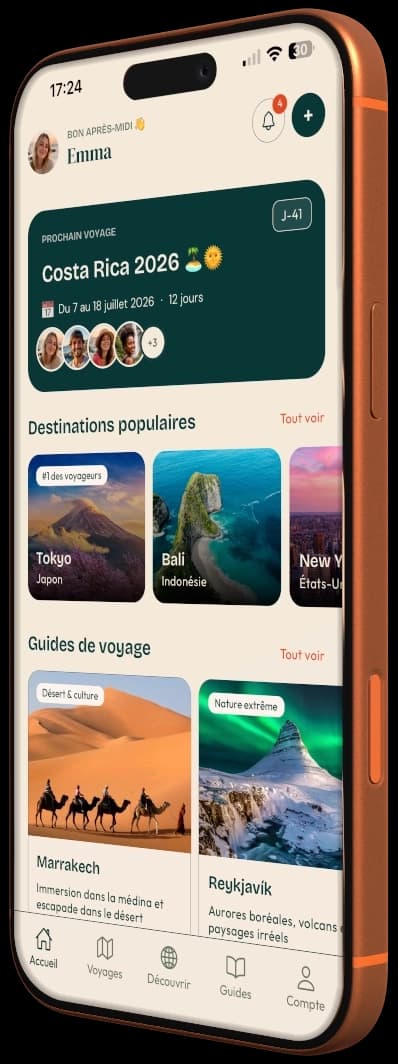
Day-by-day itinerary, budget, bookings and packing in a single app.
Aperçu de l'application PlanTripNow