Java travel guide: temples, volcanoes, when to go and which route

Java packs into 1,000 km one of the highest population densities on the planet, the two largest temples in Southeast Asia, Borobudur and Prambanan, and around thirty active volcanoes including Bromo and Ijen, climbed at night for sunrise and the blue flame.

Why visit Java?

Java is the political and economic centre of Indonesia and the cradle of its great Buddhist and Hindu empires before Islam. People come for a unique monumental heritage, a spectacular volcanic chain and a rail network that lets you cross the island without a car, rare in the archipelago.

What to discover in Java?

Yogyakarta and the temples

Yogyakarta, the island's cultural capital and the seat of a still-active sultanate, is the base for the two great temples. Borobudur, an 8th-century Buddhist monument of stupas, caps the number of visitors at the top and requires booking; Prambanan, a 9th-century Hindu complex of tall towers, is visited in the late afternoon with a Ramayana ballet in the evening. In town: the kraton, the Taman Sari water castle, the batik workshops and Malioboro street. Three days is enough.
The Dieng plateau and the centre

West of Yogyakarta, the volcanic Dieng plateau sits at 2,000 m: cold air, the boiling Sikidang crater, the coloured Telaga Warna lake and the small Arjuna Hindu temples, eighth century, among the oldest on Java. Sunrise at the Sikunir viewpoint is over a sea of clouds. Further south, the Magelang area, around Borobudur, rolls out rice fields and hills and lets you stay right by the temple to see it at dawn.

The eastern volcanoes: Bromo, Ijen, Semeru

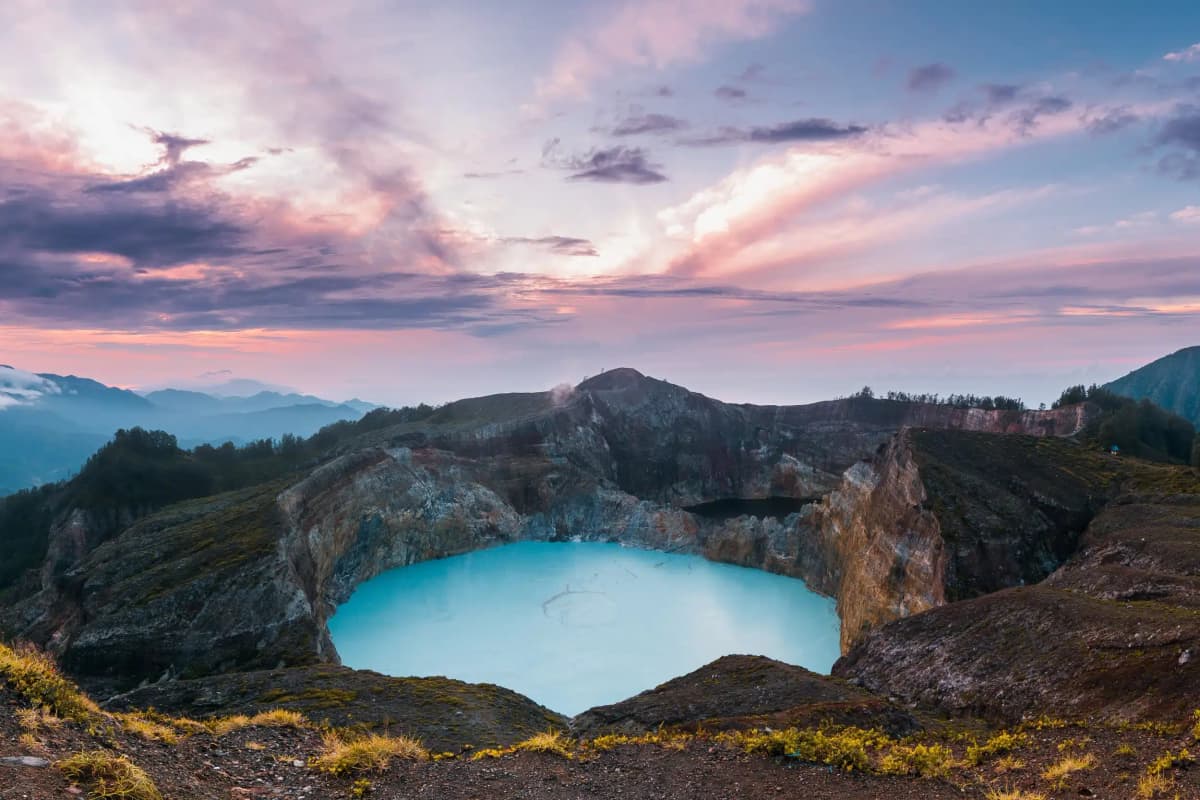
Eastern Java holds the country's most-visited volcanoes. Mount Bromo, in the Tengger caldera, is viewed from a lookout reached by jeep before dawn, then on foot across a sand sea to the smoking crater. Ijen, further east, is climbed around midnight to see the blue sulphur flames before daylight, then its turquoise acid lake in the light. Semeru, the island's highest peak, is for experienced hikers over several days. From Ijen, a one-hour ferry reaches Bali at Banyuwangi.

Jakarta, Bandung and the west

Jakarta, a capital of over ten million people, is passed through more than visited: the colonial old town of Kota Tua, the national monument and a few museums fit into a day between flights. Bandung, three hours by train in the highlands, offers cooler air, tea plantations, the Tangkuban Perahu crater and a noted food scene. Further west still, the Ujung Kulon park shelters the last Javan rhinos.

Cities to visit in Java

Featured destinations appear first.
Coming soon.

Java in pictures

Java's must-sees

Named sites to spread between the central temples and the eastern volcanoes.

Borobudur

The largest Buddhist temple in the world, from the 8th century, formed of terraces and stupas; access to the top is limited and by reservation.

Prambanan

A group of 9th-century Hindu temples with tapering towers, with a Ramayana ballet performed in the evening facing the monuments.

Yogyakarta kraton

The still-inhabited sultan's palace, with its pavilions, its gamelan and its dance and wayang performances.

Mount Bromo

A cone in a sand sea within the Tengger caldera, viewed at sunrise from a lookout reached by jeep.

Ijen blue flame

Blue flames of burning sulphur visible at night in the crater, unique in Asia; the climb starts around midnight with a gas mask.

Dieng temples

Small eighth-century Hindu shrines on a volcanic plateau at 2,000 m, among the oldest in Indonesia.

Jakarta old town

The Kota Tua district with its Dutch colonial buildings around Fatahillah square, toured on colourful bikes.

Similar regions

Other regions you might like as much as Java.

Similar destinations

Other countries you might like as much as Java.

Java FAQ

How many days for Java?
Three days for Yogyakarta and the temples, two more for the Dieng plateau, and three to four for the eastern volcanoes. A full crossing from Jakarta to Banyuwangi takes ten to twelve days by train.
How do you get from Yogyakarta to Mount Bromo?
There is no fast direct link. The simplest way is a night train to Malang or Probolinggo, then a jeep transfer to Cemoro Lawang. Allow a full travel day, as the distance is over 400 km.
Can you go down into the Ijen crater?
Technically yes, on a steep path used by the sulphur porters, but the gases are toxic and the descent is not always allowed. An effective gas mask, supplied by a serious guide, is essential; otherwise, you watch the flames from the rim.
Is Java better by train or by car?
By train for the long distances between cities: it is comfortable, punctual and cheap. A car with a driver only helps for access to the volcanoes and villages, poorly served, or for a very flexible pace.
Should you do Java before or after Bali?
Often after: you finish eastern Java with Ijen, then cross to Bali on the Banyuwangi ferry, an hour's crossing. The other way round works too, starting with Yogyakarta after a flight to Jakarta.
Is there a major volcanic risk in Java?
Java is among the most volcanic regions in the world. Merapi near Yogyakarta and Semeru near Malang erupt regularly, with exclusion zones and sometimes site closures. Follow the alert levels from the Indonesian volcanology centre.

Plan your trip to Java

Day-by-day itinerary, budget, bookings and packing in a single app.
Aperçu de l'application PlanTripNow