Skip to content

Visit Porto : the Ribeira, Gaia cellars and the Douro

Porto is walked downhill towards the river: from the tiled station and the Lello bookshop to the Ribeira quays, then across the Dom Luís bridge to taste port wine in the Gaia cellars. Two days are enough in the city, three with the ocean at Foz or a trip into the Douro Valley.

At a glance

Visa
None
7-day budget
€833
Per person, comfort profile, excluding international flights.

Why visit Porto?

Porto is Portugal's second city and one of Europe's cheapest getaways, under two hours' flight from Paris. Its UNESCO-listed historic centre is covered on foot; it is also the starting point for the cruises and panoramic trains of the Douro Valley, the world's oldest demarcated wine region.

When to visit Porto

Temperatures, rainfall and crowds month by month, to pick your window.
When to visit Porto
MonthTemperaturesRainCrowdsVerdict
January6 to 14 °C13 dQuietThe wettest month of the year, grey and windy, but the Gaia wine cellars can be toured with no wait.
February7 to 15 °C10 dQuietStill Atlantic winter, mild but damp; low season when city-centre hotels are at their cheapest.
March9 to 17 °C10 dModerateSpring shows between showers, the Crystal Palace gardens turn green again and terraces reopen.
April10 to 18 °C10 dModerateFickle weather swinging between squalls and bright spells; Easter week still tightens prices.
May12 to 20 °C9 dBusyThe best trade-off: 20°C, long evenings and rain in clear retreat, before the summer crowds.
June15 to 23 °C5 dPackedThe São João festival on 23-24 June turns the whole city into one giant party; everything sells out weeks ahead.
July16 to 24 °C3 dPackedDry and sunny, tempered by the Atlantic breeze: pleasant to visit but packed and expensive everywhere.
August16 to 25 °C3 dPackedThe hottest and priciest month, with long lines at the Luís I bridge and the Lello bookshop.
September15 to 24 °C6 dBusyThe grape harvest starts in the Douro Valley and the weather holds: the second-best window after May.
October13 to 21 °C11 dModerateAtlantic autumn brings the rain back, often in heavy bursts, though mild days remain plentiful.
November9 to 17 °C13 dQuietLow skies and rain-washed streets: the city empties and returns to a local pace.
December8 to 15 °C12 dModerateLights along Avenida dos Aliados and a Christmas market, in a damp cold that never needs more than a light coat.
Source: Normales IPMA 1991-2020 (station de l'aéroport de Porto), recoupées avec la série Fontainhas 1981-2010 ; température de mer laissée vide faute de source mensuelle fiable ; relevé septembre 2026

Porto's must-sees

Central monuments and a bridge, all within walking distance, plus the cellars on the far bank.

Lello bookshop

A 1906 neo-Gothic bookshop with a curving red staircase; a paid ticket deducted from a purchase, slots to book to avoid the crush.

São Bento station

A hall covered in 20,000 azulejos telling Portugal's history, freely accessible in a still-working station.

Clérigos tower

A 76-metre baroque bell tower by Nasoni, 240 steps up to a circular platform above the whole centre.

Dom Luís I bridge

An 1886 double-deck iron bridge; the upper level, for pedestrians, links the old town to the Gaia viewpoints.

Palácio da Bolsa

A 19th-century former stock exchange, famous for its gilded Arab Room inspired by the Alhambra; guided visit only.

Cathedral (Sé)

A 12th-century Romanesque fortress on the hill, with a Gothic cloister of azulejos and a plunging view over the rooftops.

Serralves foundation

A contemporary art museum and Art Deco villa in an 18-hectare park, west of the city; closed Monday off-season.

What to discover in Porto, neighbourhood by neighbourhood?

The Baixa and the Ribeira

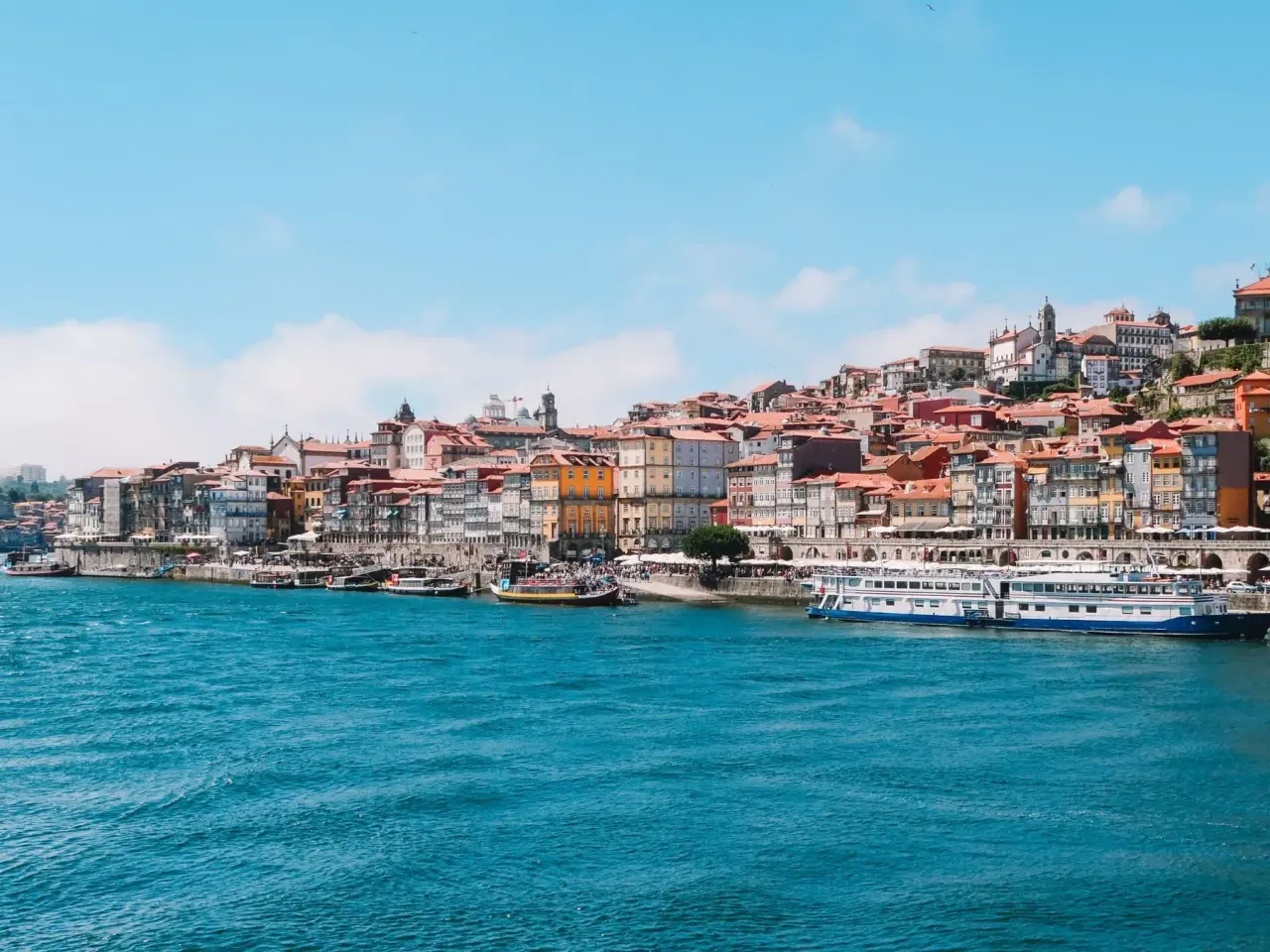
The centre drops steeply from Praça dos Aliados towards the river. You string together São Bento station and its 20,000 azulejos, the Clérigos tower (240 steps, a 360-degree view), the Lello bookshop and its red staircase, then the cathedral on its promontory. Down below, the Ribeira, a listed former fishing quarter, lines up colourful houses and terraces facing Gaia; it is very touristy in the evening, quieter at dawn.
Vila Nova de Gaia and the cellars

Technically a separate town, Gaia occupies the south bank, opposite the Ribeira. This is where port wine ages: around fifty cellars (Graham's, Taylor's, Sandeman, Cálem) offer a guided tour and tasting, to book online for the busiest ones, around 20 to 30 euros. The upper deck of the Dom Luís I bridge, for the metro and pedestrians, gives the best view of the old town; you come back down by cable car or the Guindais funicular.

Foz do Douro and the ocean

At the river mouth, 6 km from the centre, Foz is Porto's smart seaside quarter: a lighthouse, seafront gardens, terraces and beaches battered by the Atlantic, too cold for a long swim. The historic line 1 tram runs there from the Ribeira in 25 minutes along the Douro. Carrying on north, Matosinhos has the city's best grilled-fish restaurants, around Rua Heróis de França.

Cedofeita and creative Porto

West of the Clérigos, the Cedofeita district and Rua Miguel Bombarda concentrate art galleries, record shops, vintage stores and concept shops, with joint openings every two months. The Bolhão market, reopened in 2022 after restoration, is worth a visit for its stalls and its cast-iron architecture. Further south, the Serralves foundation gathers a contemporary art museum, an Art Deco villa and 18 hectares of park, usually closed on Monday outside summer.

Around Porto: the Douro and the Minho

The Douro Valley is reached by train from São Bento: the line hugs the river after Régua and leads to Pinhão in two hours, amid the terraced vineyards. To the north, Guimarães, the cradle of Portugal, and Braga, a city of baroque churches, are day trips an hour away by train. Aveiro and its canals are 1h15 to the south.

How much it costs

Per person per day, excluding international travel.
Budget
51 €/ day
974 € for 2 people, 7 days, return flights included
Accommodation
20 €
Food
20 €
Local transport
4 €
Sights and activities
7 €
Comfort
119 €/ day
1 926 € for 2 people, 7 days, return flights included
Accommodation
58 €
Food
38 €
Local transport
7 €
Sights and activities
16 €
Premium
257 €/ day
3 858 € for 2 people, 7 days, return flights included
Accommodation
125 €
Food
70 €
Local transport
20 €
Sights and activities
42 €
Prices checked: Prix relevés en septembre 2026, hors São João et pont du 15 août : fourchettes recoupées entre porto-north-portugal.com, neverendingfootsteps et gotripzi, tarifs hôteliers Booking. La taxe touristique municipale (environ 2 EUR/pers/nuit) et le couvert au restaurant sont inclus dans les postes food. Occupation : dortoir pour backpacker, double partagée à deux pour comfort et premium. Vol A/R Paris-Porto inclus dans le total semaine, estimé 260 EUR pour deux hors vacances scolaires (Ryanair, Transavia, easyJet).

Getting there

Airports serving Porto, from main hubs to secondary ones.
  • FAOFaro - Gago Coutinho International AirportFaroMain
  • FNCCristiano Ronaldo International AirportFunchalMain
  • LISLisbon Humberto Delgado AirportLisbonMain
  • OPOFrancisco de Sá Carneiro AirportPortoMain
  • PDLJoão Paulo II AirportPonta DelgadaMain
  • BGCBragança AirportBragançaSecondary

Entry, health and safety

For FR travellers

Entry requirements

No visa for a tourist stay

Le Portugal est membre de l'Union européenne et de l'espace Schengen : les ressortissants français, mineurs inclus, entrent librement avec une carte nationale d'identité ou un passeport en cours de validité, sans visa ni limite de durée pour un séjour touristique. Chaque enfant doit avoir son propre document ; le livret de famille et l'acte de naissance ne sont pas acceptés. Au-delà de trois mois, s'enregistrer auprès de la mairie.

Health

Advised: Aucun vaccin obligatoire ni spécifique. Vérifier que les vaccinations courantes (dont rougeole, diphtérie, tétanos, poliomyélite) sont à jour.

Emportez la carte européenne d'assurance maladie (CEAM), qui donne accès aux soins publics dans les mêmes conditions que les résidents. Le nord du Portugal connaît d'importants feux de forêt l'été : suivez les consignes de la Protection civile en cas de randonnée dans l'arrière-pays.

Safety

Normal precautions

Emergency

112

Checked in septembre 2026 against the official source. Entry rules change: check the official source before you travel, it alone is authoritative.

Porto travel basics

Tourist tax

About 2 euros per person per night, capped at seven nights, paid at the accommodation, often in cash.

Couvert

Bread, olives and butter placed on the table by default are charged (1.50 to 3 euros); you can decline them without awkwardness.

Transport

A rechargeable Andante card for metro, buses and urban trains; metro line E links the airport to the centre in 25 minutes.

Historic trams

Three tourist lines (1, 18, 22) with a separate, higher fare than the normal network; line 1 runs along the Douro to Foz.

Gaia cellars

Tour and tasting to book online for the well-known houses, especially at weekends; allow 45 minutes to 1 hour per cellar.

Tipping

Not compulsory; round up the bill or leave 5 to 10% for good service.

Power sockets

Type F, 220 V: no adapter needed for a French device.

Atlantic weather

Frequent rain from October to March, often in heavy bursts; bring a waterproof jacket even in summer, mornings are cool.

Porto in pictures

Photo credits : Diego Delso, CC BY-SA 3.0, Wikimedia Commons ; Matt Kieffer from London, United Kingdom, CC BY-SA 2.0, Wikimedia Commons ; John Samuel, CC BY-SA 4.0, Wikimedia Commons ; Jakub Hałun, CC BY 4.0, Wikimedia Commons

Similar destinations

Other cities you might like as much as Porto.

Porto: frequently asked questions

Is the Lello bookshop worth the entry fee?
Entry costs a few euros, deducted from the purchase of a book. The neo-Gothic interior and the red staircase are worth seeing, but the place is small and packed: book an early-morning slot, or you will shuffle forward in the queue.
How many days do you need to visit Porto?
Two full days are enough for the centre, the Ribeira and the Gaia cellars. A third day allows Foz and the ocean, or a train trip into the Douro Valley. Four days open up Guimarães or Braga without rushing.
Should you visit the cellars in Porto or in Gaia?
In Gaia, on the south bank: that is where port wine ages, in lodges visited with a tasting. On the Porto side you mostly find wine bars and shops. Cross the Dom Luís bridge on the upper deck for the view.
Can you take a Douro cruise from Porto?
Yes. The short six-bridges cruise (50 minutes) leaves from the Ribeira year-round. Day cruises up to Régua, returning by train, run from March to October and need booking, especially at the September harvest.
Porto or Lisbon for a first trip to Portugal?
Porto is more compact, cheaper and seen in two or three days; Lisbon is bigger, hillier and needs more time. Many combine both, linked in under three hours by train, with Coimbra or Aveiro as a stop.
Is the Andante card useful in Porto?
Yes if you stay away from the centre or take the metro from the airport. In the old town almost everything is done on foot, and the steep hills are climbed faster than the funicular runs. Load the card per trip rather than as a pass if your journeys are few.

Plan your trip to Porto

Build your day-by-day itinerary and manage budget, bookings and packing in PlanTripNow.
Aperçu de l'application PlanTripNow