Norway travel guide: when to go, budget and itineraries

From the western fjords to the Lofoten Islands, Norway lines up some of Europe's most dramatic scenery. Come in summer for hiking and the midnight sun, in winter for the northern lights. What remains is choosing the season, the budget and the right route.
  • 1 city

Why visit Norway?

For nature of rare intensity: fjords with thousand-metre walls, glaciers, a coastline cut over 2,500 kilometres. It is one of the flagship countries of Northern Europe for hiking, scenic drives and watching the northern lights, from September to March. In summer the sun does not set north of the Arctic Circle.

What to discover in Norway?

Oslo and the South-East

The capital takes two to three days. The essentials sit on the Bygdøy peninsula, with the Viking ships, the Kon-Tiki raft and the Fram, plus the Vigeland sculpture park and the Opera quarter, whose sloping roof you can walk up. Many museums close on Mondays. Around Oslo, the Nordmarka forest and the Oslofjord make easy day trips by suburban train, for under ten euros return.
The western fjords

The heart of the trip. The Geirangerfjord and the Nærøyfjord, both UNESCO-listed, are seen by cruise or from the Dalsnibba and Stegastein road viewpoints. Allow at least four days to link the Sognefjord, the Hardangerfjord and Geiranger, since roads skirt every arm of sea and use ferries. The mountain-road season runs late May to October; outside that window several passes close.

Bergen, gateway to the fjords

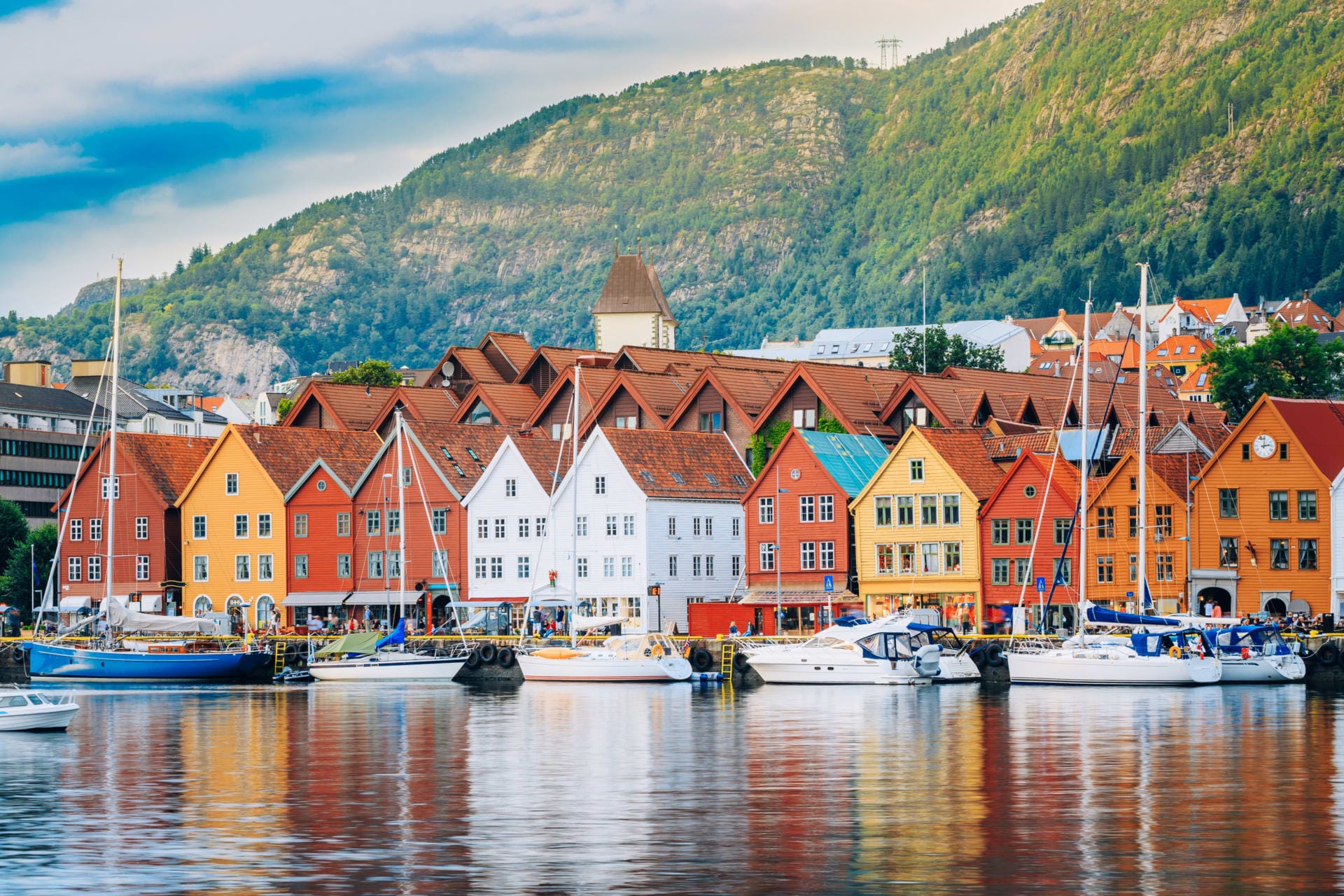
The country's second city and the most common starting point for the fjords. The UNESCO-listed Bryggen wharf, the Fløibanen funicular that climbs 320 metres in eight minutes, and the fish market fill a day. Bergen gets more than 200 rainy days a year: bring waterproofs and keep a spare day for when the weather closes in. This is where the Norway in a Nutshell route to Flåm begins, and where the Hurtigruten coastal ferry starts its six-day run up to Kirkenes.

The far north: Lofoten and Tromsø

The Lofoten Islands, about a 1h40 flight from Oslo, string together fishing villages with red cabins, white beaches and sheer peaks. You need a car: the E10 links every island. Tromsø, further north, is the base for aurora outings and winter whale safaris. The North Cape, the northernmost point of the continent reachable by car, is a long detour from Tromsø.

Northern lights and midnight sun

Two phenomena, two opposite seasons. The aurora shows from late September to late March, under clear skies, north of the Arctic Circle but sometimes as far south as Bergen; allow three or four nights to raise your odds, since cloud cover decides everything. Finnish Lapland and northern Sweden offer comparable conditions. The midnight sun lasts from late May to mid-July in Tromsø and Lofoten, when the sun never dips below the horizon and hiking days lose their timetable altogether.

Hiking and the great trails

Three signature walks, all in the South-West: Preikestolen (4 hours round trip, busy paid car park), Trolltunga (10 to 12 hours, mid-June to mid-September) and Kjeragbolten, a boulder wedged over the void above the Lysefjord. The Besseggen ridge, in Jotunheimen park, takes 6 to 8 hours with a boat crossing on Lake Gjende. Outside summer, these routes demand winter gear, crampons and real snow experience; accidents happen every year to walkers who set off too early in the season.

Trains and scenic drives

Norway suits slow travel. The Flåm Railway drops 865 metres over 20 kilometres, the Bergen line crosses the Hardangervidda plateau at over 1,200 metres, the Rauma line runs below the Trollveggen. On the road, eighteen national scenic routes are waymarked, including the Atlantic Road with its bridges laid across the sea and the switchbacks of the Aurlandsvegen. Ferries are frequent but fill up in July and August. For an island-hopping road trip, Norway rivals Iceland.

Cities to visit in Norway

Featured destinations appear first.

Norway in pictures

Norway's must-sees

From the western fjords to the far north, the sites that shape a first trip.

Geirangerfjord

The country's most photographed fjord, the Seven Sisters waterfall and the hairpin Dalsnibba road at 1,500 metres above sea level.

Bryggen, Bergen

The Hanseatic wharf with its colourful wooden facades, UNESCO-listed, the historic core of Norway's second city.

Lofoten Islands

An Arctic archipelago of fishing villages, white beaches and mountains dropping into the sea, driven along the E10.

Preikestolen

A vertical rock platform 600 metres above the Lysefjord, reached by a 4-hour hike from Stavanger.

Flåm Railway

Twenty kilometres of some of the world's steepest track, with a photo stop at the Kjosfossen waterfall.

Trolltunga

A granite tongue suspended above Ringedalsvatnet lake, at the end of a 10 to 12-hour walk in summer.

Nidaros Cathedral

The largest medieval building in Scandinavia, in Trondheim, long a pilgrimage goal on the St Olav Way.

Vigeland Park, Oslo

More than 200 bronze and granite sculptures by Gustav Vigeland, in a public park that is always open and free.

Atlantic Road

Eight kilometres of roadway and bridges laid over sea-battered islets, between Kristiansund and Molde.

North Cape

A 307-metre cliff billed as the northernmost point of Europe reachable by car, on a plateau often swept by wind.

Similar destinations

Other countries you might like as much as Norway.

Similar regions

Other regions you might like as much as Norway.

Frequently asked questions about Norway

Can you see the northern lights in Oslo?
Rarely. Oslo is too far south and too bright. For a reliable sighting you need to go above the Arctic Circle, towards Tromsø, Lofoten or Finnmark, between late September and late March, under clear skies.
How many days to see the Norwegian fjords?
Four days minimum to link Bergen, the Sognefjord and the Geirangerfjord, a week for a comfortable pace with the Hardangerfjord and Stavanger. Roads skirt every arm of sea and force ferry crossings, which stretches every journey.
Do you need a car for the Lofoten Islands?
In practice, yes. Public transport exists but is infrequent. A car, rented at Svolvær or Leknes airport, lets you follow the E10 from island to island and reach the remote beaches and trails.
Should you book the Flåm Railway in advance?
In summer, yes: the Flåmsbana is often full, especially when a cruise ship is docked at Flåm. Off-season, buying on the spot still works. The Norway in a Nutshell combined ticket covers the train, boat and bus.
Is Norway in a Nutshell worth it?
Yes if you have only one day between Oslo and Bergen: the route combines the Bergen line, the Flåm Railway and a Nærøyfjord cruise. But you stop nowhere. With two days, better to sleep in Flåm or Balestrand.
Can you swim in the Norwegian fjords?
Yes, but the water rarely exceeds 16 to 18 °C in summer, and much less in the north. Norwegians happily swim in July and August; the rest of the year you need a wetsuit.
Is the Trollstigen pass open?
The Trollstigen scenic road has been closed since 2024 because of rockfall risk, with no firm reopening date announced. To reach Geiranger from Åndalsnes in the meantime, you take the Linge-Eidsdal ferry and the road over the Ørnesvingen bends.
Oslo or Bergen to start a trip to Norway?
Bergen if the trip focuses on the western fjords: the city is their natural gateway. Oslo if you want to cross the country by train or head north. An open-jaw flight, into one and out of the other, avoids backtracking.

Plan your trip to Norway

Day-by-day itinerary, budget, bookings and packing in a single app.
Aperçu de l'application PlanTripNow
