The historic core is covered in a day. The cathedral, where you climb the 207 steps of the Micalet bell tower, keeps in a chapel an agate chalice venerated as the Holy Grail. Opposite it, the Lonja de la Seda, a UNESCO-listed former silk exchange, lines up its twisted columns. The Mercado Central, a 1928 Modernista hall with 1,200 stalls, closes in the afternoon and on Sunday: come before 2pm to grab lunch.
Northwest of the cathedral, the Carmen is the liveliest old quarter: medieval lanes, remnants of Arab and Christian walls, street art on the crumbling facades, cocktail bars and horchaterías. It is crossed on foot in an hour, but is best enjoyed in the evening, when the terraces on the little squares fill up. The Serranos and Quart towers, two Gothic gates of the vanished walls, mark its edges and can be climbed for the view.
After the 1957 flood, the river was diverted and its bed turned into a 9-kilometre linear park that rings the old town. You cover it on foot, running or by bike (Valenbisi stations everywhere): it is the best way to link the Serranos towers to the City of Arts in 30 minutes. Halfway along, the giant Gulliver, a 70-metre slide-sculpture, serves as a full-scale playground.
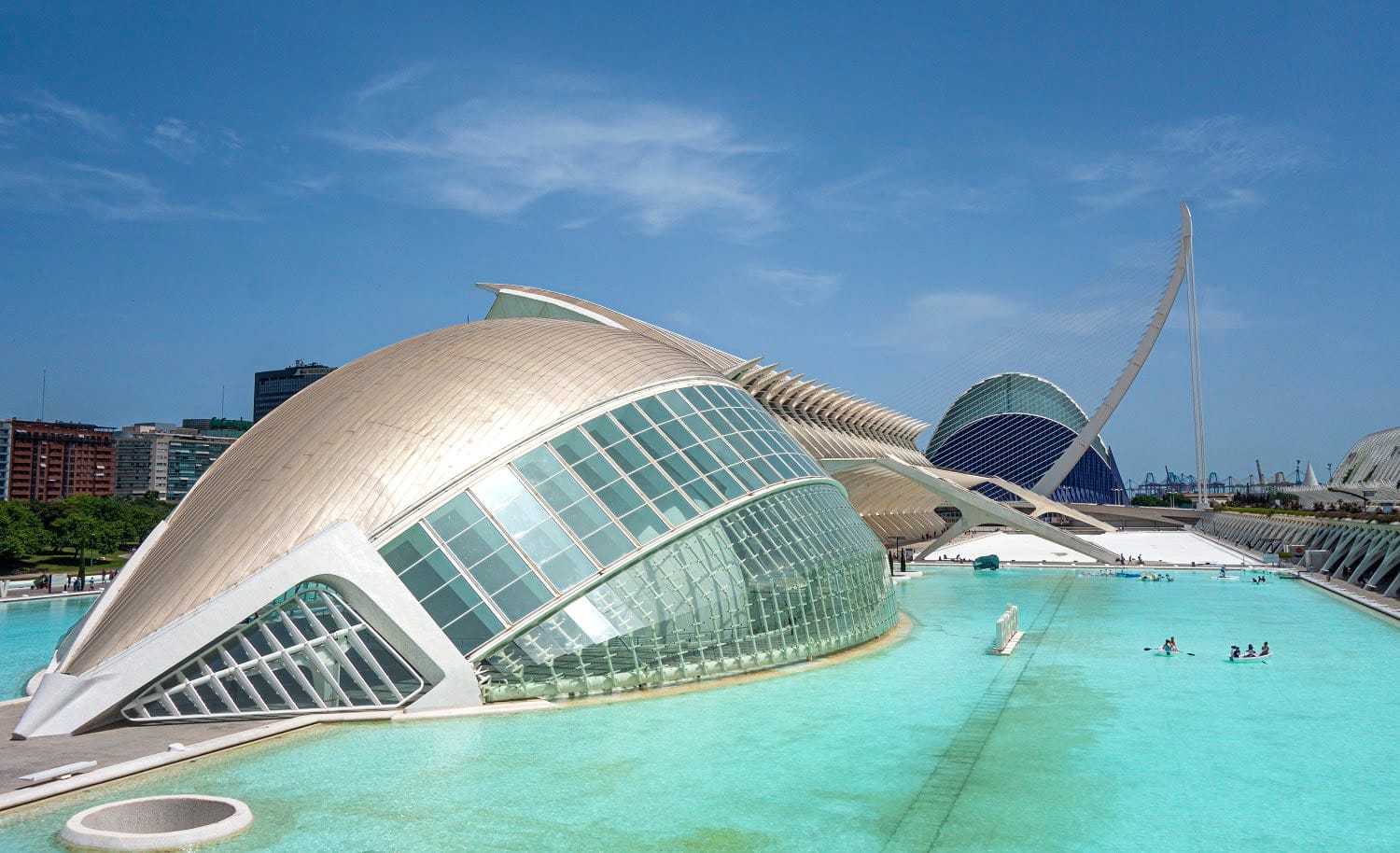
At the southern end of the Turia, Santiago Calatrava's white ensemble brings together five buildings: the spherical Hemisfèric cinema, the interactive Science Museum, the Umbracle plant walk, the Palau de les Arts opera house and the Oceanogràfic, Europe's largest aquarium, with its tunnels and beluga pool. Allow half a day for the Oceanogràfic alone, a full day for the whole complex; combined tickets are cheaper online.
To the east, the former fishing village of El Cabanyal lines up its low houses with azulejo facades, long under threat then saved, now being restored. It opens onto the Malvarrosa beach and its three-kilometre promenade, lined with restaurants serving paella at midday. Tram 4 or 6 links the centre to the beach in 20 minutes; swimming is pleasant from June to October.
Ten kilometres south, the Albufera is Spain's largest lagoon, ringed by the rice fields that supply Valencian paella. The village of El Palmar, on an island, lives off rice and boats: you have a wood-fired paella there, then take a traditional boat across the lake at sunset. The Racó de l'Olla trail has a bird hide over the reed beds. The 25 bus from the Porta de la Mar takes 40 minutes; bring insect repellent.