Travel to Sweden: when to go, budget and itineraries

Endless archipelagos, forest covering two thirds of the country, design-led cities and summer nights that never fall. Sweden runs from the cultivated south to the Arctic Circle, by train, ferry or car, with a relationship to nature that changes the way you travel.

Why visit Sweden?

Sweden is one of the largest countries in Europe yet one of the least densely populated, which means vast wilderness and a right of public access written into law (allemansratten). People come for Stockholm and its archipelago of 30,000 islands, for Lapland and its northern lights, and for logistics that make travel easy: punctual trains, English spoken everywhere, near-universal cashless payment.

What to see in Sweden

Stockholm and Lake Malaren

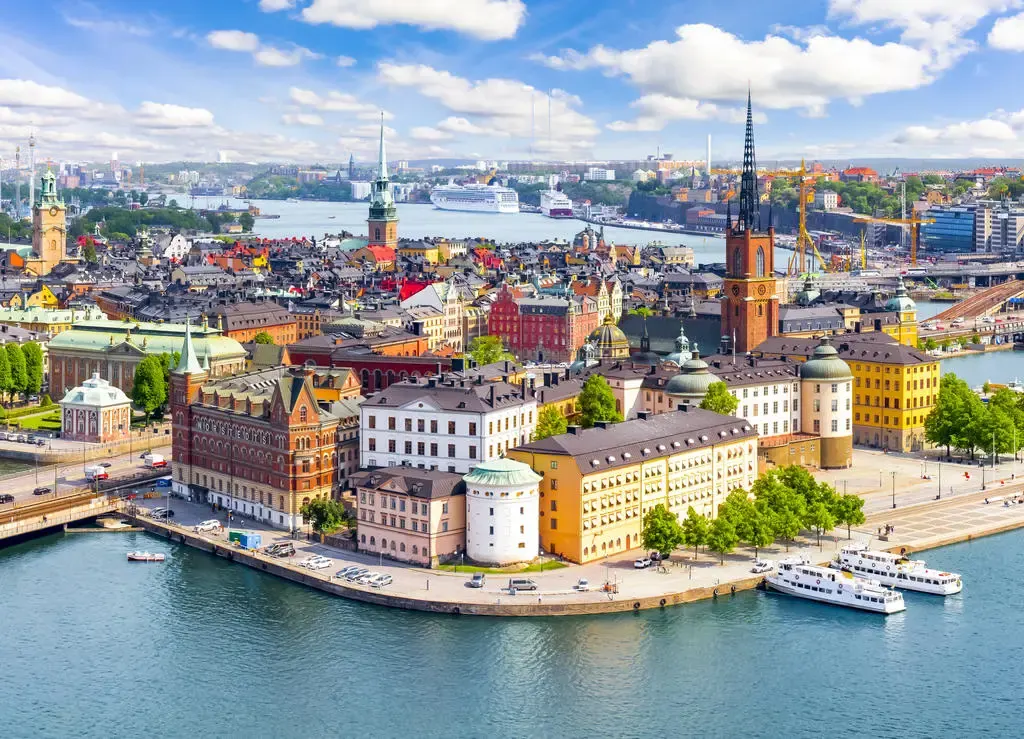
The capital spreads across fourteen islands linked by some fifty bridges. Allow three full days: Gamla Stan, the Vasa Museum and its 1628 warship, Skansen and a ferry trip into the near archipelago (Vaxholm is 1h15 by boat). Around the city, Lake Malaren serves Uppsala, a university town with a Gothic cathedral, 40 minutes by train, and Sigtuna, the country's oldest town. A 72-hour transit pass costs around 40 EUR and covers metro, buses and city boats.

Gothenburg and the west coast

The country's second city revolves around its canals, the wooden Haga district and a respected food scene. From here the southern archipelago is free with the transit card, and the Bohuslan coast runs north between pink granite and fishing villages. Gothenburg is three hours by train from Stockholm and just over two from Malmo, making it a practical gateway via Landvetter airport. Denmark is reachable by ferry from the region.

Scania and the farming south

The far south, Scania, feels closer to Denmark than to the rest of Sweden: grain plains, Renaissance castles, rapeseed fields in spring. Malmo, linked to Copenhagen in 35 minutes by train across the Oresund bridge, works as a base. On the Osterlen coast, the standing stones of Ales Stenar overlook the sea and villages such as Kaseberga live on smoked herring. A car helps here: distances between sites run 30 to 60 minutes.

Gotland and Oland, the Baltic islands

Gotland, about 3 hours by ferry from Oskarshamn or Nynashamn, holds Visby, a walled Hanseatic town listed by UNESCO, and limestone beaches. The island is best explored by bike. Oland, joined to the mainland by a 6 km bridge from Kalmar, is easier for a short visit: windmills, the Stora Alvaret limestone heath and the royal family's summer residence. Both islands fill up in July, when Swedes take their holidays; aim for June or August.

Dalarna and traditional Sweden

Around Lake Siljan, Dalarna concentrates the country's folk imagery: red cottages, Dala horses carved in Nusnas, especially lively Midsummer celebrations. It is also a starting point for hiking and canoeing. Rattvik and Mora, reached in 3h40 by train from Stockholm, make good bases. The Zorn Museum in Mora, devoted to the painter Anders Zorn, closes on Mondays outside the summer season.

Lapland and the far north

Beyond the Arctic Circle, Swedish Lapland lives by the midnight sun from late May to mid-July and the polar night in December and January. Abisko, known for its clear skies, is one of the best places in Europe for the northern lights, from September to March. Kiruna, a mining town being physically relocated, and the Sami village of Jukkasjarvi with its Icehotel complete the stop. You get there by plane (1h20 from Stockholm) or night train (about 16h). The range continues on the Norwegian side.

Cities to visit in Sweden

Featured destinations appear first.
Coming soon.

Sweden in pictures

Sweden's must-see sights

From urban landmarks to Arctic landscapes, these are the places most trips to Sweden are built around.

Vasa Museum

In Stockholm, the world's only near-intact 17th-century warship, raised in 1961 after 333 years on the seabed.

Gamla Stan

Stockholm's medieval core on its islet: cobbled lanes, Stortorget square, the royal palace and the country's narrowest street.

Abisko National Park

In Lapland, a glacial valley with a dry microclimate, a world reference for viewing the northern lights between September and March.

Icehotel, Jukkasjarvi

An ice hotel rebuilt every winter since 1989 beside the Torne River, with a refrigerated section open year-round.

Visby, Gotland

A UNESCO-listed Hanseatic town ringed by 3.5 km of 13th-century walls and church ruins overrun with roses.

Stockholm City Hall

Home of the Blue Hall where the Nobel banquet is held each 10 December, seen only on a guided tour, with a 106 m tower.

Oresund Bridge

A 16 km part-bridge, part-tunnel crossing between Malmo and Copenhagen, covered in 35 minutes by train to link Sweden with the continent.

Similar destinations

Other countries you might like as much as Sweden.

Similar regions

Other regions you might like as much as Sweden.

Frequently asked questions about travelling in Sweden

How many days do you need for Stockholm and Lapland?
Plan at least 8 to 10 days: three or four days for Stockholm and its archipelago, a domestic flight, then three or four days around Abisko and Kiruna. In under a week you have to choose one or the other.
Can you see the northern lights from Stockholm?
It is rare and unreliable: Stockholm is too far south and too bright. For real chances you need to go up to Lapland, to Abisko, Kiruna or Jukkasjarvi, between late September and early April.
Is the night train to Kiruna worth it?
Yes if the journey is part of the trip: about 16 hours from Stockholm, sleeper cabins, arriving at dawn in the far north. Otherwise the plane (1h20) saves a full day.
Do you need to rent a car to visit Sweden?
Not for Stockholm, Gothenburg, Malmo or the Lapland area around Kiruna, all well served by train and plane. A car becomes useful for Osterlen, Oland, Dalarna and the High Coast, where public transport is sparse.
When is Midsummer and do you need to book?
The festival falls on the Friday between 19 and 25 June. Cities empty out, the archipelago and countryside fill up, and many urban shops close that day. Book accommodation and ferries several months ahead.
Gotland or Oland, which should you choose?
Oland, joined by a bridge from Kalmar, suits a one or two-day detour by car. Gotland needs a 3-hour ferry but offers Visby, a UNESCO walled town, and deserves two to three days by bike.
Can you visit the Icehotel in Jukkasjarvi in summer?
Yes: the classic structure carved each winter melts in spring, but a section called Icehotel 365, refrigerated using solar power through the polar summer, stays open all year for a guided visit or a night in an ice room.
Is Sweden really a cashless country?
Almost entirely: many shops, museums and buses no longer accept banknotes at all, and some venues are card-only by policy. A fee-free international card is enough; carry a little cash only for the occasional rural market or roadside stall.

Plan your trip to Sweden

Day-by-day itinerary, budget, bookings and packing in a single app.
Aperçu de l'application PlanTripNow