Azores travel: when to go, what to do and which island to pick

Set a thousand kilometres out from mainland Portugal, the nine islands of the Azores line up flooded craters, glowing pastures, fumaroles and cliffs battered by the Atlantic. You come to hike, watch sperm whales year-round and slip into a geothermal bath when the rain moves in.

Why visit the Azores?

The Azores are an autonomous region of Portugal set far out in the Atlantic, about two hours' flight from Lisbon and with no meaningful time difference for a European traveller. The archipelago has committed to managed outdoor tourism: waymarked trails, quotas on whale watching, geothermal energy. It stays cool in summer and is at its best from May to September.

What to discover in the Azores?

Sao Miguel, the gateway

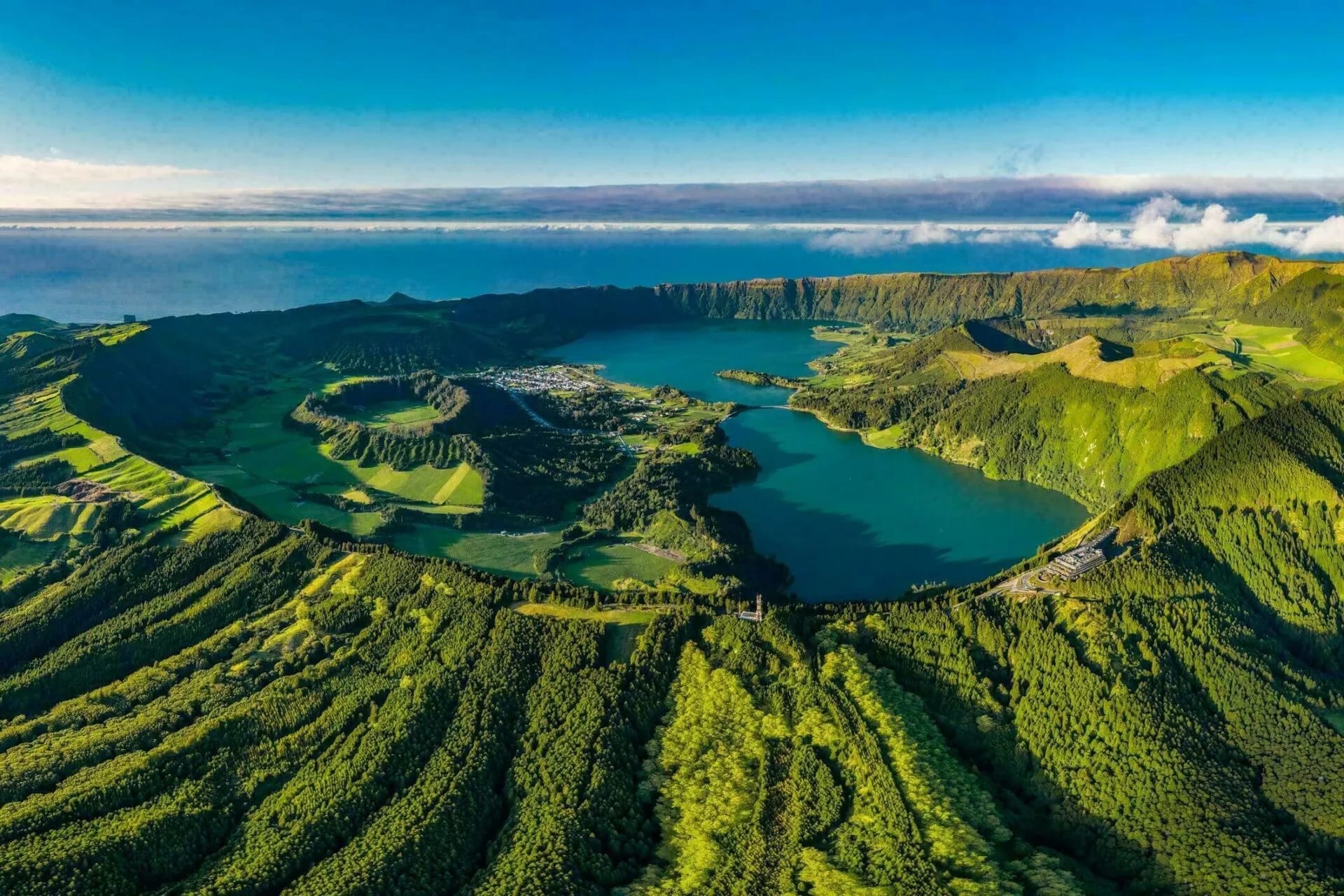
The largest island takes up most first trips. In three days you see the Sete Cidades crater and its two lakes, the Lagoa do Fogo viewpoint (a 30-minute walk down) and the Furnas geothermal valley, where cozido stew cooks underground. Allow 45 minutes by road from Ponta Delgada to Furnas. A week lets you add the north-east, the Gorreana tea plantation and the Caloura pools. There are no long sandy beaches here as in the Algarve: you swim mostly in lava rock pools.
The Triangle: Faial, Pico and Sao Jorge

Three islands packed into the central group, linked by ferries of 30 to 60 minutes in summer. Faial is explored around its caldera and the Capelinhos volcano, which rose from the sea in 1957. Pico holds the highest summit in Portugal, 2351 metres, a 6 to 8-hour round-trip climb, and UNESCO-listed vineyards grown in lava enclosures, a listing they share with the terraces of the Douro. Sao Jorge lines up fajas, coastal shelves formed by landslides. Allow at least four days for the three.

Terceira and the central group

Terceira leans on Angra do Heroismo, the archipelago's first UNESCO-listed town, and on the Algar do Carvao, a volcanic chimney you descend into in the afternoon. It is also the island of the touradas a corda, street bull runs held from May to October. Azores Airlines internal flights put it 45 minutes from Sao Miguel, making it the most common second stop on a five-day trip and easier to reach than the western islands.

Flores and Corvo, the far west

Flores and Corvo form the westernmost point of geographical Europe. Flores lives for its waterfalls, crater lagoons and the hamlet of Faja Grande, and has to be earned: flights from Sao Miguel take nearly 2 hours with a stop, and fog regularly cancels rotations. Corvo, 400 residents, is visited on a half-day boat trip from Flores. Put these two islands at the start and end of your trip to absorb a possible flight delay.

Hiking, whales and warm water

The archipelago has dozens of official trails, often loops of 2 to 4 hours along irrigation channels or crater rims. Whale watching runs year-round from Ponta Delgada, Lajes do Pico and Horta: blue whales and fin whales pass on migration between April and June, sperm whales are resident. Afterwards, the iron-rich pools of Terra Nostra park in Furnas and the warm Caldeira Velha waterfall cost a few euros. A daily budget runs from about 55 euros in a dorm to 250 euros in an upmarket hotel.

Cities to visit in Azores

Featured destinations appear first.
Coming soon.

Azores in pictures

The Azores' must-sees

Seven sites that sum up the archipelago's volcanic variety from one island to the next.

Sete Cidades

Two lakes, one green and one blue, at the bottom of a five-kilometre crater overlooked from the Vista do Rei and Boca do Inferno viewpoints.

Lagoa do Fogo

A wild crater lake in the centre of Sao Miguel, with no access road, reached by a steep path of about thirty minutes.

Furnas

A village set on a field of fumaroles, with bubbling pools by the lake, a botanical garden and the iron-rich thermal bath of Terra Nostra park.

Montanha do Pico

The highest point in Portugal at 2351 metres, a climb managed from the Casa da Montanha, often above a sea of clouds.

Capelinhos volcano

A grey ash landscape at the tip of Faial, born of an undersea eruption in 1957, with a half-buried lighthouse and a buried visitor centre.

Angra do Heroismo

A UNESCO-listed port town on Terceira, a grid of colourful houses between two bays, once a stop for fleets bound for the Americas.

Natural pools

Seawater pools built into the lava at Biscoitos, Mosteiros or Ferraria, the last warmed by a hot spring at low tide.

Similar regions

Other regions you might like as much as Azores.

Similar destinations

Other countries you might like as much as Azores.

Azores: frequently asked questions

How many days do you need for Sao Miguel?
Three full days are enough for Sete Cidades, Lagoa do Fogo and Furnas with a rental car. Five days let you add the north-east, the Ribeira Grande coast and a boat trip without rushing.
Can you visit the Azores without renting a car?
On Sao Miguel, yes, by combining organised excursions and a few buses. On the other islands it is very hard: public transport is sparse and sights are scattered. A car is strongly advised outside Ponta Delgada.
Which Azores island should you choose for a first trip?
Sao Miguel for a first visit: it has the most direct flights, the most places to stay and the most varied scenery over short distances. Add Pico or Faial if you have a full week.
When do the hydrangeas bloom in the Azores?
Blue hydrangea hedges line the roads from mid-June to late August, peaking in July. This is also the busiest and priciest period: book a car and lodging several months ahead.
How do you get from Sao Miguel to Pico?
There is no direct ferry. You take an Azores Airlines flight to Horta on Faial, about 45 minutes, then the ferry to Madalena, a 30-minute crossing. A few flights also serve Pico airport directly.
Do you need a guide to climb Pico?
Climbing Montanha do Pico requires compulsory registration at the Casa da Montanha, and an accredited guide is needed for night starts or outside the summer season. Allow 6 to 8 hours round trip and 1100 metres of ascent.
Can you swim in the Azores?
Yes, mostly in natural pools built into the lava, such as at Biscoitos or Mosteiros, and on a few black-sand beaches on Sao Miguel. The sea reaches 22 °C in August but stays around 17 °C in winter.

Plan your trip to Azores

Day-by-day itinerary, budget, bookings and packing in a single app.
Aperçu de l'application PlanTripNow